top of page
Beautiful French Town

The towns and villages of France

  • 32
    Page 17
As you wander through the pedestrian maze of old Millau, the atmosphere becomes intimate, hushed, and warm, punctuated by the gleam of its ochre limestone.

The Millau Belfry (The Square Tower): Dominating the old town, this unique architectural ensemble combines a 12th-century square tower (formerly the castle of the King of Aragon) with a 17th-century octagonal tower. After climbing its steps, the summit offers a remarkable panoramic view of the tiled roofs and the surrounding limestone plateaus.

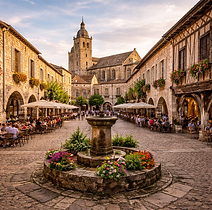
Marshal Foch Square and its arcades: This is the beating heart of the historic center. Lined with 15th- and 16th-century houses supported by magnificent arcaded galleries, this shaded square is home to charming café terraces surrounding a cool stone fountain.

The Ayrolle Wash House: A masterpiece of 18th-century civil architecture, this listed monument surprises with its vast structure of covered arcades surrounding an immense basin, testifying to the historical importance of water for the tanners of the city.

Millau

The Millau Viaduct: a human challenge and the vertigo of steel

Nestled in the heart of the "Bois des Pauvres" (Poor Man's Wood), on the outskirts of the city, lies one of Europe's most monumental and unusual contemporary artworks: the Cyclops.

A Monumental and Collaborative Work: Conceived in secret starting in 1969 by the Swiss sculptor Jean Tinguely and his partner Niki de Saint Phalle, this architectural sculpture stands over 22 meters tall and weighs approximately 350 tons of steel and concrete. It incorporates contributions from some fifteen artist friends (such as Daniel Spoerri and César).

A Dazzling Structure: The monster has a single golden eye, a one-ton articulated ear, and an immense face covered in thousands of mirrors that reflect the surrounding forest, perfectly integrating the wild art with nature. Its tongue is a giant metal slide.

An Interior Mechanical Labyrinth: During guided tours (suitable for ages 8 and up), visitors enter the mind to discover a surreal universe. Scrap metal gears come to life with a metallic clatter, giant marbles travel on rails, and numerous clandestine works of art (including a tribute to Yves Klein at the top) punctuate the different levels.

Milly-la-Forêt

The Historic Centre and the Medieval Market Hall

Moissac was built with and by water. The town boasts magnificent historical waterways, ideal for leisurely strolls and ecotourism.

The Garonne Canal: An extension of the Canal du Midi, forming the "Canal des Deux Mers" (connecting the Mediterranean to the Atlantic), this peaceful waterway flows through Moissac. Its banks, once used for towpaths, have now been transformed into a greenway, much to the delight of cyclists and walkers.

The Cacor Aqueduct: Located just outside the town, this exceptional 356-meter-long structure, built of pink brick and Quercy stone, allows the navigable canal to cross... the Tarn River! Watching boats navigate a bridge over another river is a fascinating feat of engineering.

The Marina: Located in the heart of the city centre, the river port welcomes boaters from all over the world in a warm and rustic atmosphere, lined with restaurants and flowery harbor master's offices.

Moissac

Saint Peter's Abbey, World Sanctuary of Roman Art

The highest point of Monflanquin Hill offers one of the most beautiful viewpoints in the region, a reminder of the town's strategic location.

The Pech Belvedere: Located on the site of the former seigniorial castle, this landscaped esplanade offers a breathtaking view of the rolling landscape of the Upper Agenais region, often compared to a "Little Tuscany" because of its cypress trees, orchards, and sunflower fields.

The Orientation Table: Situated at the summit, it allows visitors to identify the surrounding castles (such as Biron Castle) and to understand the geological evolution of this fertile valley traversed by the Lède River.

The War Memorial and the Resistance Monument: This highly symbolic memorial also commemorates the heroic commitment of the Lot-et-Garonne resistance fighters during the Second World War in these hilly and densely forested lands.

Monflanquin

The Place des Arcades, the Geometric Heart of the Bastide

Montargis knows how to delight its visitors' taste buds with its top-notch artisanal expertise and legendary sweet specialties.

The Prasline de Montargis (Maison Mazet): Invented in 1636 during the reign of Louis XIII by the cook of Marshal de Plessis-Praslin, this confection is the oldest in France. It consists of a roasted and caramelized almond made according to a secret, unchanging recipe. The historic Mazet shop, opposite the church, is worth a visit for its period decor.

The Crottes du Chien de Montargis (Montargis Dog Droppings): A sweet nod to the famous legend! Rest assured, this is a delicious chocolate specialty made of hazelnut praline coated in nougatine and dark chocolate.

The Praslin Market: An unmissable event to immerse yourself in the local way of life, meet producers from the Gâtinais region and taste the region's cheeses, honeys and ciders.

Montargis

A city on the water — The canals and the bridge circuit

Moulins has surprised everyone by welcoming a unique, modern cultural institution that has become an international showcase for the performing arts.

The CNCS (Quartier Villars): Located on the left bank of the Allier River in a splendid 18th-century cavalry barracks, this museum is the world's leading conservation center dedicated to stage costumes (theater, opera, ballet).

Prestigious collections: The center houses more than 10,000 legendary costumes on loan from the Comédie-Française, the Paris Opera, or donated by renowned artists such as Rudolf Nureyev. An exceptional permanent space is dedicated to the life and collections of this ballet star.

Immersive temporary exhibitions: The CNCS does not have a permanent costume collection due to the fragility of the textiles. However, it offers two temporary exhibitions a year with breathtaking scenography that captivates visitors.

Mills

The Bourbon quarter and the ducal heritage

Dominating the city skyline, the former Saint-Maurice Cathedral impresses with its bold dimensions and the elegance of its Southern Gothic architecture.

An Exceptional Unique Vessel: The most striking feature of this nave is its monumental width. At 22 meters across, the single nave of Saint-Maurice is the widest in Europe for a Gothic stone building, even surpassing that of the famous Girona Cathedral in Spain.

The Soaring Spire-Bell Tower: Standing 60 meters tall, the octagonal bell tower was built in the 16th century by Bishop Philippe de Lévis. It rises proudly into the Ariège sky and serves as a visual landmark for miles around.

The Mystical Labyrinth: On the floor, the cathedral conceals a labyrinth of bricks and stones laid in the 16th century, inspired by the one in the Provost's Court of Toulouse. In the Middle Ages, pilgrims walked along it on their knees as a form of penance.

The Adjacent Bishop's Palace: Built during the same period, this Renaissance-style palace features finely carved mullioned windows, extending the magnificence of the religious complex.

Mirepoix

The Place des Couverts, the Beating Heart of the City

Monaco pulsates to the rhythm of major international events that regularly transform its urban landscape, particularly along its marinas.

Port Hercule: This natural bay shelters one of the deepest and most famous harbors in the world. It is home to the largest mega-yachts on the planet. It is also along these quays that the Monaco Fair, the Yacht Show, and the paddocks for motor racing are set up each year.

The Monaco Formula 1 Circuit: Unlike other circuits, this one uses the city streets. Motorsport enthusiasts can walk or drive on the legendary sections of the track: the Grand Hotel hairpin, the pit straight on the harbor, or the breathtaking curve under the tunnel.

The Fontvieille district and its port: Entirely reclaimed from the sea in the 1970s, this modern district is home to a peaceful residential marina, dominated by the Louis-II stadium (home of AS Monaco) and the magnificent Collection of Cars of H.S.H. the Prince of Monaco, comprising more than a hundred historic vehicles.

Monaco

The Rock (Monaco-Ville), the Historical Cradle

Mont Saint-Michel is also a journey for the taste buds and a treasure trove of fantastical tales.

The Legend of the Foundation: Legend has it that in the year 708, the archangel Michael appeared in a dream to Aubert, the Bishop of Avranches, ordering him to build a sanctuary on this rock, then called Mont Tombe. When the bishop hesitated, the archangel is said to have left the imprint of his finger on his skull.

Mother Poulard's Omelette: Cooked over a wood fire in a large copper pan to the rhythm of a musical whisk, this giant soufflé omelette has been a global culinary tradition since the 19th century.

Salt Marsh Lamb: The sheep that graze on the salt marshes of the bay (regularly covered by the sea) produce meat with a unique and refined flavor, protected by an AOC (Appellation d'Origine Contrôlée).

Mont Saint-Michel

The Hanging Abbey, the "Wonder"

After being a rebellious and independent Protestant stronghold in the 17th century, Montauban was brought under the control of the royal power of Louis XIV, which transformed its urban landscape.

The Cathedral of Our Lady of the Assumption: Commissioned by Louis XIV to affirm the triumph of Catholicism, it stands in stark contrast to the rest of the city. Built entirely of white cut stone (and not brick) at the highest point in the city, its monumental classical style is striking. It houses Ingres's famous masterpiece: The Vow of Louis XIII.

The Old College: This superb Baroque building with its monumental inner courtyard was founded by the Jesuits to lead the Counter-Reformation. Today, it is a major cultural center of the city.

The Centre for the Interpretation of Architecture and Heritage (CIAP): Located in the cultural hub, this modern centre provides all the historical keys to the city through captivating models and interactive displays.

Montauban

The historic heart and the brick architecture

  • 32
    Page 17
bottom of page