
Mirepoix
Nestled on the banks of the Hers-Vif river, at the border of the Ariège and Aude departments, Mirepoix is a true medieval gem of Cathar Country. Rebuilt according to the regular plans of bastides following a devastating flood in 1289, this City of Art and History has preserved a captivating architectural authenticity. Between its colorful half-timbered facades, its covered galleries, and the spiritual imprint of the bishops who built it, Mirepoix promises an unforgettable immersion into the heart of medieval southern France.
The Place des Couverts, the Beating Heart of the City
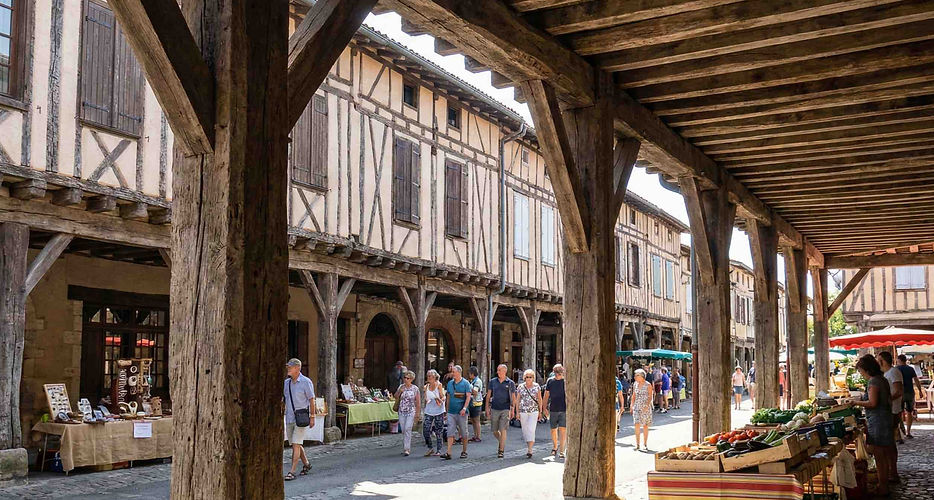
The central square of Mirepoix is one of the most spectacular and best-preserved in France, forming a vast square surrounded by medieval wooden arcades.
The Covered Galleries (Les Couverts): The lower floors of the houses rest on immense horizontal wooden beams, creating shaded galleries where pedestrians can shelter from the sun or rain. Each section of the square bears a historical name (Saint-Antoine Arcades, the Grands Couverts, Midy Arcades, etc.).
The Half-Timbered Houses: The facades, painted in pastel or vibrant colors, display magnificent geometric timber framing. These houses, mostly dating from the 14th and 15th centuries, bear witness to the wealth of the merchants who once had shops there.
The Baltard-Style Market Hall: In the center of the square stands a wrought-iron market hall erected in the 19th century. It replaced the old wooden structure and hosts one of the region's largest farmers' markets every Monday morning.
The Atmosphere of the Terraces: Today, these centuries-old arcades house charming cafes, bookstores, and artisan boutiques. Sitting down for a drink here allows you to soak up the city's atmosphere in a theatrical setting.


The Secrets of the House of Consuls

Adjoining the Place des Couverts, the Maison des Consuls is Mirepoix's civic masterpiece, world-renowned for its unusual wooden statuary.
The Seat of Local Power: This 15th-century building served as the meeting place for the Consuls, the magistrates responsible for administering the town and dispensing justice.
The 103 Wooden Sculptures (The Corbels): Looking up under the gallery's beams, one discovers a fantastic and frightening bestiary. One hundred and three pieces of oak wood have been carved into the ends of the beams. They represent human figures (a woman with a headdress, soldiers), exotic animals (monkeys, lions), and grimacing monsters.
Satirical Representations: These magnificently preserved corbels offer a striking glimpse into the medieval imagination, blending humor, popular beliefs, and critiques of the customs of the time.
The Hall of Honor: Inside, the building retains painted ceilings and monumental fireplaces that testify to the architectural splendor accorded to the representatives of the bastide.

Saint-Maurice Cathedral and the widest nave in Europe
Dominating the city skyline, the former Saint-Maurice Cathedral impresses with its bold dimensions and the elegance of its Southern Gothic architecture.
An Exceptional Unique Vessel: The most striking feature of this nave is its monumental width. At 22 meters across, the single nave of Saint-Maurice is the widest in Europe for a Gothic stone building, even surpassing that of the famous Girona Cathedral in Spain.
The Soaring Spire-Bell Tower: Standing 60 meters tall, the octagonal bell tower was built in the 16th century by Bishop Philippe de Lévis. It rises proudly into the Ariège sky and serves as a visual landmark for miles around.
The Mystical Labyrinth: On the floor, the cathedral conceals a labyrinth of bricks and stones laid in the 16th century, inspired by the one in the Provost's Court of Toulouse. In the Middle Ages, pilgrims walked along it on their knees as a form of penance.
The Adjacent Bishop's Palace: Built during the same period, this Renaissance-style palace features finely carved mullioned windows, extending the magnificence of the religious complex.


Medieval Fortifications and Remains
Mirepoix was a walled town, designed to withstand the onslaughts of the tumultuous Middle Ages and the Hundred Years' War. Several remains recall this military purpose.
The Porte d'Aval (14th century): This is the only fortified gate that survived the destruction of the ramparts. A listed historical monument, it still shows the location of its portcullis and its powerful wooden gates. It is surmounted by the engraved coat of arms of the town.
The Remains of the Ramparts: Along the outer courtyards (the current boulevards that encircle the historic center), the foundations of the old walls and moats that protected the town from bands of marauders can still be seen in places.
Terride Castle: Located at the edge of town, on a hill overlooking the Hers River, this fortified castle (privately owned) was the stronghold of the Lévis family after the Albigensian Crusade. Its massive towers are a reminder of the strategic importance of the site.

The Surrounding Area: Cathar History and Preserved Nature
Milly-la-Forêt has its forest, Mirepoix has the Pyrenees as a backdrop and its verdant hills steeped in history.
Camon, the Village of a Hundred Rosebushes: Located just ten kilometers away, this neighbor of Mirepoix is listed among the "Most Beautiful Villages of France." This fortified village developed around a former 10th-century Benedictine abbey. In spring, hundreds of climbing roses bloom along its stone lanes.
Lagarde Castle: Nicknamed "the Versailles of the Pyrenees," this impressive ruined monument lends a romantic silhouette to the landscape. Originally a watchtower in the 11th century, it was transformed into a sumptuous palace in the 17th century.
Lake Montbel: About fifteen kilometers away, this vast turquoise artificial lake of 550 hectares is a paradise for outdoor activities: swimming, canoeing, sailing, or hiking and horseback riding along its shaded shores.
Conclusion
In conclusion, Mirepoix is much more than just a tourist stop; it's a masterpiece of medieval urban planning that has survived the centuries without losing its soul. From the architectural boldness of its cathedral to the picturesque charm of its Place des Couverts, every alleyway of this bastide town tells a story of resilience, commerce, and art. Ideally located at the gateway to the major Cathar sites, Mirepoix is an essential destination where the gentle pace of Occitan life meets the grandeur of French heritage.
Cathar Pyrenees Tourist Office
Information Regarding Visuals: This website uses computer-generated images and illustrations created by artificial intelligence for atmospheric and stylistic purposes. These representations are not actual photographs and are strictly non-binding.