top of page

Moissac

Moissac was built with and by water. The town boasts magnificent historical waterways, ideal for leisurely strolls and ecotourism.

The Garonne Canal: An extension of the Canal du Midi, forming the "Canal des Deux Mers" (connecting the Mediterranean to the Atlantic), this peaceful waterway flows through Moissac. Its banks, once used for towpaths, have now been transformed into a greenway, much to the delight of cyclists and walkers.

The Cacor Aqueduct: Located just outside the town, this exceptional 356-meter-long structure, built of pink brick and Quercy stone, allows the navigable canal to cross... the Tarn River! Watching boats navigate a bridge over another river is a fascinating feat of engineering.

The Marina: Located in the heart of the city centre, the river port welcomes boaters from all over the world in a warm and rustic atmosphere, lined with restaurants and flowery harbor master's offices.

Nestled between the Tarn River and the Garonne Canal, in the heart of the Tarn-et-Garonne department in Occitanie, Moissac is a major and enchanting stop in Southwest France. World-renowned for its exceptional Romanesque heritage, a UNESCO World Heritage Site as part of the Routes of Santiago de Compostela, the town is also a land of bountiful orchards and tranquil waters. Between spiritual fervor, architectural masterpieces, and a sun-drenched lifestyle, Moissac offers an absolutely unmissable cultural and bucolic escape.

Saint Peter's Abbey, World Sanctuary of Roman Art

Founded in the 7th century, the Benedictine abbey of Moissac was one of the most powerful religious centers in medieval Europe. Today, it houses sculpted treasures of unparalleled finesse.

The Tympanum of the Portal (12th century): A true masterpiece of Romanesque sculpture, the large tympanum of the south entrance illustrates the vision of the Apocalypse according to Saint John. It depicts a monumental Christ in Majesty surrounded by the symbols of the four Evangelists and the 24 Elders of the Apocalypse, all gazing towards him. The expressiveness of the faces and the movement of the drapery are striking.

The Trumeau and Porch Sculptures: The central pillar (the trumeau) supports the tympanum with incredible technical virtuosity, displaying entwined lions and the elongated figures of the prophets Jeremiah and Isaiah who seem to emerge from the stone.

The Abbey Church: While the porch is Romanesque, the nave of the church was rebuilt in the Gothic period using Toulouse bricks, offering a striking contrast of materials. It houses magnificent sacred art, including a moving 15th-century Entombment and a polychrome wooden Pietà.
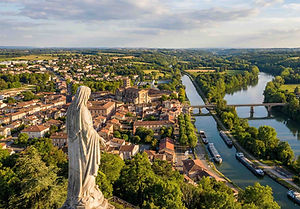
Moissac was built with and by water. The town boasts magnificent historical waterways, ideal for leisurely strolls and ecotourism.

The Garonne Canal: An extension of the Canal du Midi, forming the "Canal des Deux Mers" (connecting the Mediterranean to the Atlantic), this peaceful waterway flows through Moissac. Its banks, once used for towpaths, have now been transformed into a greenway, much to the delight of cyclists and walkers.

The Cacor Aqueduct: Located just outside the town, this exceptional 356-meter-long structure, built of pink brick and Quercy stone, allows the navigable canal to cross... the Tarn River! Watching boats navigate a bridge over another river is a fascinating feat of engineering.

The Marina: Located in the heart of the city centre, the river port welcomes boaters from all over the world in a warm and rustic atmosphere, lined with restaurants and flowery harbor master's offices.
Moissac was built with and by water. The town boasts magnificent historical waterways, ideal for leisurely strolls and ecotourism.

The Garonne Canal: An extension of the Canal du Midi, forming the "Canal des Deux Mers" (connecting the Mediterranean to the Atlantic), this peaceful waterway flows through Moissac. Its banks, once used for towpaths, have now been transformed into a greenway, much to the delight of cyclists and walkers.

The Cacor Aqueduct: Located just outside the town, this exceptional 356-meter-long structure, built of pink brick and Quercy stone, allows the navigable canal to cross... the Tarn River! Watching boats navigate a bridge over another river is a fascinating feat of engineering.

The Marina: Located in the heart of the city centre, the river port welcomes boaters from all over the world in a warm and rustic atmosphere, lined with restaurants and flowery harbor master's offices.
Moissac was built with and by water. The town boasts magnificent historical waterways, ideal for leisurely strolls and ecotourism.

The Garonne Canal: An extension of the Canal du Midi, forming the "Canal des Deux Mers" (connecting the Mediterranean to the Atlantic), this peaceful waterway flows through Moissac. Its banks, once used for towpaths, have now been transformed into a greenway, much to the delight of cyclists and walkers.

The Cacor Aqueduct: Located just outside the town, this exceptional 356-meter-long structure, built of pink brick and Quercy stone, allows the navigable canal to cross... the Tarn River! Watching boats navigate a bridge over another river is a fascinating feat of engineering.

The Marina: Located in the heart of the city centre, the river port welcomes boaters from all over the world in a warm and rustic atmosphere, lined with restaurants and flowery harbor master's offices.

Chasselas de Moissac, White Gold and Exceptional Terroir

Moissac was built with and by water. The town boasts magnificent historical waterways, ideal for leisurely strolls and ecotourism.

The Garonne Canal: An extension of the Canal du Midi, forming the "Canal des Deux Mers" (connecting the Mediterranean to the Atlantic), this peaceful waterway flows through Moissac. Its banks, once used for towpaths, have now been transformed into a greenway, much to the delight of cyclists and walkers.

The Cacor Aqueduct: Located just outside the town, this exceptional 356-meter-long structure, built of pink brick and Quercy stone, allows the navigable canal to cross... the Tarn River! Watching boats navigate a bridge over another river is a fascinating feat of engineering.

The Marina: Located in the heart of the city centre, the river port welcomes boaters from all over the world in a warm and rustic atmosphere, lined with restaurants and flowery harbor master's offices.

Moissac is inextricably linked to its agricultural terroir and boasts a tradition of exceptional fruit-growing, embodied by a jewel of viticulture.

The First Appellation Fruit: Chasselas de Moissac is a white table grape of extraordinary finesse. In 1971, it was the very first fresh fruit in France to obtain the prestigious Appellation d'Origine Contrôlée (AOC, now AOP).

An Ancestral Know-How: This grape, with its golden and translucent berries, bursting with sunshine, is cultivated by hand on the clay-limestone slopes surrounding the town. The art of harvesting the bunches (known as "pillage") requires patience and dexterity passed down through generations.

The Chasselas Festival: Every autumn, at harvest time, the town comes alive to celebrate its golden fruit through tastings, gourmet markets and folk parades honoring local brotherhoods.

Moissac was built with and by water. The town boasts magnificent historical waterways, ideal for leisurely strolls and ecotourism.

The Garonne Canal: An extension of the Canal du Midi, forming the "Canal des Deux Mers" (connecting the Mediterranean to the Atlantic), this peaceful waterway flows through Moissac. Its banks, once used for towpaths, have now been transformed into a greenway, much to the delight of cyclists and walkers.

The Cacor Aqueduct: Located just outside the town, this exceptional 356-meter-long structure, built of pink brick and Quercy stone, allows the navigable canal to cross... the Tarn River! Watching boats navigate a bridge over another river is a fascinating feat of engineering.

The Marina: Located in the heart of the city centre, the river port welcomes boaters from all over the world in a warm and rustic atmosphere, lined with restaurants and flowery harbor master's offices.

Along the Water: Canal des Deux Mers and Canal Bridge

Moissac was built with and by water. The town boasts magnificent historical waterways, ideal for leisurely strolls and ecotourism.

The Garonne Canal: An extension of the Canal du Midi, forming the "Canal des Deux Mers" (connecting the Mediterranean to the Atlantic), this peaceful waterway flows through Moissac. Its banks, once used for towpaths, have now been transformed into a greenway, much to the delight of cyclists and walkers.

The Cacor Aqueduct: Located just outside the town, this exceptional 356-meter-long structure, built of pink brick and Quercy stone, allows the navigable canal to cross... the Tarn River! Watching boats navigate a bridge over another river is a fascinating feat of engineering.

The Marina: Located in the heart of the city centre, the river port welcomes boaters from all over the world in a warm and rustic atmosphere, lined with restaurants and flowery harbor master's offices.

Moissac was built with and by water. The town boasts magnificent historical waterways, ideal for leisurely strolls and ecotourism.

The Garonne Canal: An extension of the Canal du Midi, forming the "Canal des Deux Mers" (connecting the Mediterranean to the Atlantic), this peaceful waterway flows through Moissac. Its banks, once used for towpaths, have now been transformed into a greenway, much to the delight of cyclists and walkers.

The Cacor Aqueduct: Located just outside the town, this exceptional 356-meter-long structure, built of pink brick and Quercy stone, allows the navigable canal to cross... the Tarn River! Watching boats navigate a bridge over another river is a fascinating feat of engineering.

The Marina: Located in the heart of the city centre, the river port welcomes boaters from all over the world in a warm and rustic atmosphere, lined with restaurants and flowery harbor master's offices.

The Cloister of Moissac, a Unique Stone Paradise in the World

Adjoining the church, the abbey cloister is considered by art historians to be the oldest and best-preserved of the great Romanesque cloisters in Christendom.

A Perfect Harmony: Completed precisely in the year 1100, the cloister is organized around a large central garden shaded by a majestic cedar tree. Its four galleries are punctuated by a perfect alternation of single and double marble columns.

The 76 Sculpted Capitals: This is the site's greatest treasure. Each capital is a miniature work of art depicting scenes from the Bible (Old and New Testaments), the lives of saints, or displaying floral motifs and fantastical animals. The precision of the details makes it an open history book, sculpted in stone.

The Corner Pillars: At the four corners and in the middle of the galleries, large marble plaques sculpted in bas-relief represent the Apostles in human size as well as the first abbot of Moissac, Durand de Bredons.

Moissac was built with and by water. The town boasts magnificent historical waterways, ideal for leisurely strolls and ecotourism.

The Garonne Canal: An extension of the Canal du Midi, forming the "Canal des Deux Mers" (connecting the Mediterranean to the Atlantic), this peaceful waterway flows through Moissac. Its banks, once used for towpaths, have now been transformed into a greenway, much to the delight of cyclists and walkers.

The Cacor Aqueduct: Located just outside the town, this exceptional 356-meter-long structure, built of pink brick and Quercy stone, allows the navigable canal to cross... the Tarn River! Watching boats navigate a bridge over another river is a fascinating feat of engineering.

The Marina: Located in the heart of the city centre, the river port welcomes boaters from all over the world in a warm and rustic atmosphere, lined with restaurants and flowery harbor master's offices.

A Mythical Stage on the Way of St. James and an Art of Living

A cosmopolitan and welcoming town, Moissac lives to the rhythm of encounters, Art Deco architecture, and hikers from all over the world.

The Way of St. James (Via Podiensis): Moissac is one of the key stops on the GR65, the route that starts in Le Puy-en-Velay. Every year, thousands of pilgrims stop here. The town has a long history of welcoming pilgrims, particularly at the former Carmelite monastery guesthouse, which overlooks the town and offers a superb panoramic view.

Art Deco Heritage: Following the devastating floods of 1930 that destroyed part of the lower town, Moissac was partially rebuilt in the style of the 1930s. While strolling, you'll discover beautiful geometric Art Deco facades and the charming Uvarium kiosk.

The Gastronomy of Tarn-et-Garonne: Beyond grapes, the tables of Moissac give pride of place to fattened duck (magrets, foie gras), melons from the neighboring Quercy, Reine-Claude plums and local wines such as the AOC Lavilledieu.

Conclusion

In conclusion, Moissac is a haven where time seems to stand still, lulled by the calm waters of its canals and the age-old serenity of its cloister. More than just an abbey visit, the town offers a complete sensory experience: one marvels at the genius of medieval sculptors, savors the sweet flavor of perfectly ripe Chasselas grapes, and shares in the authentic conviviality of the great hiking trails. A luminous and rejuvenating destination in the heart of Southwest France.

Moissac-Terres des Confluences Tourist Office

Information Regarding Visuals: This website uses computer-generated images and illustrations created by artificial intelligence for atmospheric and stylistic purposes. These representations are not actual photographs and are strictly non-binding.

bottom of page