top of page
Beautiful French Town

The towns and villages of France

  • 32
    Page 16
While strolling through the historic center of Luxeuil, look up: the town boasts a remarkable collection of Renaissance mansions, built by wealthy families of notables and clergymen.

The Aldermen's Tower (or Square House): This iconic 15th-century monument is flanked by a tall, openwork Gothic tower. It now houses the municipal museum of art and archaeology, and its summit offers breathtaking panoramic views over the town's rooftops and the foothills of the Vosges Mountains.

The Cardinal Jouffroy House: Admire its spectacular 15th-century façade adorned with an overhanging sculpted balcony, mullioned windows, and fantastical gargoyles. It is one of the finest examples of transitional architecture between Flamboyant Gothic and Renaissance styles in Franche-Comté.

The Hôtel de Pusel and the Maison François Ier: These remarkable residences mark the historic pedestrian route, revealing secret inner courtyards, arcaded galleries and exquisitely sculpted details.

Luxeuil-les-Bains

Saint-Colomban Abbey and the archaeological site of Old Saint-Martin

Rising dramatically at the far end of the château grounds, the ruins of the Maintenon aqueduct form one of the most romantic settings in France, a testament to the Sun King's megalomania.

Louis XIV's project: Conceived by Vauban and the engineer La Hire in the 1680s, this colossal project aimed to divert the waters of the Eure River over 80 kilometers to supply the fountains and water features of the Palace of Versailles, which was then suffering from a critical water shortage.

Melancholic remains: Interrupted by the wars of Louis XIV and the epidemics that decimated the thousands of soldier-workers, the aqueduct remained unfinished. Today, its first row of monumental stone arches, overgrown with vegetation, raises its poetic silhouettes above the damp meadows.

The story of a preserved monument: Classified as a Historical Monument thanks to the joint action of the Noailles family and the State, this stone giant can be discovered up close during walks in the park, impressing visitors with the size of its masonry piers.

Maintenon

The Château de Maintenon, the setting for a royal destiny

You can't truly understand the soul of Meaux without sitting down and paying homage to the exceptional product that has earned it international gastronomic renown.

The story of a royal cheese: Crowned "King of Cheeses" by Talleyrand at the Congress of Vienna in 1815, Brie de Meaux (which holds a Protected Designation of Origin) is a soft, bloomy-rind cheese made from raw milk. Its creamy texture and subtle aromas of hazelnut and mushroom can be savored at the cheese shops in the city center.

The Maison du Brie de Meaux: Located in the heart of the Episcopal City, this vibrant exhibition space allows visitors to discover all the stages of production of this "white gold," from milk collection to the delicate aging process on rye straw mats.

The famous Pommery Meaux Mustard: Another local pride, this old-fashioned grain mustard, packaged in its famous stoneware pots sealed with wax, has been prepared according to a secret recipe since the 18th century, bringing a touch of character to the excellent tables of Meaux.

Meaux

Saint Stephen's Cathedral, a Gothic stone lacework

Rising like a vertical limestone wall directly above the town, Mount Mimat is Mende's sacred mountain and unmissable natural viewpoint.

The Hermitage of Saint Privat: Clinging to the cliffside amidst a pine forest, this major spiritual site in the region houses the cave where Privat, the 3rd-century martyr and evangelizer of Gévaudan, lived. It is a peaceful pilgrimage site conducive to meditation.

The Cross of Mount Mimat and the viewing walkways: Erected at the summit of the plateau, this monumental iron cross overlooks the void. From the orientation table, the panorama is breathtaking: the town of Mende unfolds at your feet like a model, surrounded by the endless horizons of the Margeride and Aubrac regions.

The former airfield and pop culture: The flat, wild summit plateau is home to the Mende-Brenoux airfield. Film buffs will instantly recognize the filming location of the cult final scene of the film La Grande Vadrouille, where Louis de Funès and Bourvil take flight.

Mende

The Cathedral of Our Lady and Saint Privat, a giant of faith and legends

This is the most famous and mystical site in the park, located at the foot of Mont Bégo.

The Rock Engravings: This exceptional archaeological site contains more than 40,000 engravings dating from the Bronze Age (around 2000 BC). Engraved on colored schist slabs, they depict daggers, horned figures, and tribal chiefs (such as the famous "Sorcerer").

Strict Regulations: As the site is fragile and highly protected, exploring the engravings off the marked trails is only permitted with a licensed guide to fully understand their cosmology and sacred secrets.

The Museum of Wonders in Tende: Located in the Roya Valley, this modern museum perfectly complements the visit by showcasing original artifacts and the history of the pastoral peoples who considered the mountain sacred.

Mercantour National Park

The High Altitude Lakes and the Giant of Allos

You can't understand Lyon without sitting down to a meal. The city has elevated cuisine to the status of a national art, carried by the legacy of the famous "Mères Lyonnaises" (Lyon's female chefs) and the enduring genius of Paul Bocuse.

Authentic Lyonnais Bouchons: Certified to guarantee their authenticity, these small, traditional restaurants with their convivial atmosphere offer generous portions: Lyonnaise salad, pike quenelle with crayfish coulis, tripe, brioche sausage, all finished off with a pink praline tart.

Les Halles de Lyon - Paul Bocuse: This covered temple of gastronomy brings together the region's finest artisans of taste (fishmongers, charcutiers, cheesemakers like the renowned Maison Richard). It's the essential meeting place for gourmets to enjoy a glass of Beaujolais or Côtes-du-Rhône.

The Parc de la Tête d'Or: A true green lung of 117 hectares in the heart of the city, this English-style park borders the Rhône. It houses a huge lake, a magnificent international rose garden and a free-access zoo, offering an ideal bucolic escape.

Lyon

Fourvière, the hill that prays and the Roman cradle

Stretching along the coastline from Plage des Catalans, the Corniche Président-John-Fitzgerald-Kennedy offers a spectacular panoramic promenade, bordered by the world's longest stone pier (nearly 3 kilometers).

Vallon des Auffes: A picture-perfect harbor in the heart of the city, this small fishing haven is nestled in a rocky cove, spanned by a three-arched stone viaduct. Traditional fishing boats, known as "pointus," are moored at the foot of traditional fishermen's huts, where you can savor the best bouillabaisse in town.

Anse de Malmousque: Venture off the main roads and lose yourself in the Malmousque peninsula. This area, reminiscent of a fishing village, boasts small, secluded coves of white rocks where locals come to swim and nap to the gentle lapping of the waves.

The Château d'If and the Frioul Islands: Facing the Corniche, this archipelago of white limestone can be visited by boat from the Old Port. The Château d'If is the legendary 16th-century fortress that served as a prison and inspired Alexandre Dumas for his famous novel The Count of Monte Cristo.

Marseille

The Old Port and the Panier district, the historical and popular soul

Megève invented a unique architectural style, now adopted throughout the Alps, combining respect for traditional farmhouses with the comforts of contemporary homes.

The legacy of Henry Jacques Le Même: In the 1930s, this visionary architect designed the "skier's chalet" for Baroness de Rothschild. He reinterpreted the traditional Savoyard farmhouse, adding large bay windows to let in light, warm living rooms around monumental fireplaces, and refined modern comforts.

The restored mountain farms: The Megève style is characterized by the use of noble, raw materials: larch or fir weathered by time (old wood), local stone, and slate for the roofs. Many old mountain farms have been converted into private chalets or luxury boutique hotels.

The art of bespoke design and decoration: The decoration shops and art galleries in the city center bear witness to this taste for excellence, where contemporary design blends harmoniously with warm wool fabrics and mountain crafts.

Megève

The Historic Village, an authentic cobblestone fairytale

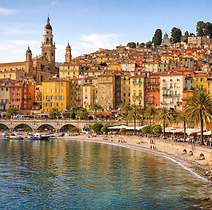
Frequented in the 19th century by the English and Russian aristocracy, Menton retains sumptuous vestiges of this golden age, enriched in the 20th century by the presence of visionary artists.

Belle Époque Architecture and Palaces: As you stroll along Boulevard de Garavan or Avenue Boyer, admire the imposing silhouettes of the Riviera Palace and the Winter Palace. These former grand luxury hotels, surrounded by palm groves, impress with their sculpted facades, monumental glass roofs, and stucco decorations that evoke the splendor of the winter visitors of yesteryear.

The Jean Cocteau Museum – Le Bastion: Housed in a 17th-century stone fort on the harbor breakwater, this museum was entirely designed by Jean Cocteau himself. The artist created pebble mosaics, drawings, tapestries, and ceramics of striking poetic modernity.

The Wedding Hall of the Town Hall: Cocteau also completely decorated this state room in the 1950s, covering the walls with monumental frescoes depicting mythological and Mediterranean loves, making each union a unique artistic moment.

Menton

The Old Town: A Cascade of Colors

Created at the end of the 19th century during the annexation of the city by the German Empire (1871-1918), the Imperial Quarter of Metz is a monumental urban ensemble unique in the world, designed to showcase the power of Emperor Wilhelm II.

Architectural eclecticism: This district, laid out around wide, tree-lined avenues, surprises with the diversity of its styles, theatrically blending Neo-Romanesque, Neo-Gothic, German Renaissance, and superb touches of Art Nouveau.

Metz-Ville Station, a historical monument: Over 300 meters long, this monumental station, built of gray sandstone (which deliberately contrasts with the yellow stone of the old town), resembles a fortified palace or a civic cathedral. Its 40-meter bell tower houses the former Emperor's Pavilion, adorned with stained glass windows and bas-reliefs.

The Governor's Palace and state villas: While strolling along Rue de l'Hospice or around Place Raymond-Mondon, admire the sumptuous bourgeois residences with turrets, loggias and secret hanging gardens that recall the splendor of high society life of yesteryear.

Metz

Saint Stephen's Cathedral, the "lantern of God"

  • 32
    Page 16
bottom of page