top of page

Metz

Created at the end of the 19th century during the annexation of the city by the German Empire (1871-1918), the Imperial Quarter of Metz is a monumental urban ensemble unique in the world, designed to showcase the power of Emperor Wilhelm II.

Architectural eclecticism: This district, laid out around wide, tree-lined avenues, surprises with the diversity of its styles, theatrically blending Neo-Romanesque, Neo-Gothic, German Renaissance, and superb touches of Art Nouveau.

Metz-Ville Station, a historical monument: Over 300 meters long, this monumental station, built of gray sandstone (which deliberately contrasts with the yellow stone of the old town), resembles a fortified palace or a civic cathedral. Its 40-meter bell tower houses the former Emperor's Pavilion, adorned with stained glass windows and bas-reliefs.

The Governor's Palace and state villas: While strolling along Rue de l'Hospice or around Place Raymond-Mondon, admire the sumptuous bourgeois residences with turrets, loggias and secret hanging gardens that recall the splendor of high society life of yesteryear.

Bathed by the waters of the Moselle and Seille rivers, Metz is an imperial and royal city with a magnetic charm, located in the heart of the Grand Est region. Rich in 3,000 years of history, the former capital of the Kingdom of Lorraine is an open-air architectural masterpiece that surprises and delights at every turn. Nicknamed the "City of Lights" for its nighttime displays and "the City of Jaumont Stone" because of the local limestone with its brilliant golden hue that adorns its monuments, Metz achieves the remarkable feat of blending medieval splendor, German imperial rigor, and the boldness of contemporary art. Between its verdant islands, its monumental sacred heritage, and its gentle way of life, it stands out as a royal stopover of rare elegance.

Saint Stephen's Cathedral, the "lantern of God"

Proudly dominating the heart of the city, Saint-Étienne Cathedral (built between the 13th and 16th centuries) is one of the most magnificent masterpieces of Gothic art in Europe, striking the imagination with its soaring 42-meter vaulted ceiling.

The triumph of light: Nicknamed the "Lantern of God," the cathedral boasts the largest stained-glass surface area in the world for a religious building, covering nearly 6,500 square meters. The Jaumont stone walls seem to vanish, giving way to an immense glass canopy.

A dialogue of eras through glass: As visitors wander through the naves, they witness a unique artistic encounter. Masterpieces by medieval and Renaissance glassmakers stand alongside the graphic and poetic creations of major 20th-century artists, such as the famous blue and scarlet stained-glass windows by Marc Chagall.

The Mutte Tower and its exquisite carving: The outer portal and the tall guard tower (the Mutte), which rises to 88 meters, display a profusion of sculptures, pinnacles, and gargoyles carved from ochre limestone with goldsmith-like precision.

Created at the end of the 19th century during the annexation of the city by the German Empire (1871-1918), the Imperial Quarter of Metz is a monumental urban ensemble unique in the world, designed to showcase the power of Emperor Wilhelm II.

Architectural eclecticism: This district, laid out around wide, tree-lined avenues, surprises with the diversity of its styles, theatrically blending Neo-Romanesque, Neo-Gothic, German Renaissance, and superb touches of Art Nouveau.

Metz-Ville Station, a historical monument: Over 300 meters long, this monumental station, built of gray sandstone (which deliberately contrasts with the yellow stone of the old town), resembles a fortified palace or a civic cathedral. Its 40-meter bell tower houses the former Emperor's Pavilion, adorned with stained glass windows and bas-reliefs.

The Governor's Palace and state villas: While strolling along Rue de l'Hospice or around Place Raymond-Mondon, admire the sumptuous bourgeois residences with turrets, loggias and secret hanging gardens that recall the splendor of high society life of yesteryear.
Created at the end of the 19th century during the annexation of the city by the German Empire (1871-1918), the Imperial Quarter of Metz is a monumental urban ensemble unique in the world, designed to showcase the power of Emperor Wilhelm II.

Architectural eclecticism: This district, laid out around wide, tree-lined avenues, surprises with the diversity of its styles, theatrically blending Neo-Romanesque, Neo-Gothic, German Renaissance, and superb touches of Art Nouveau.

Metz-Ville Station, a historical monument: Over 300 meters long, this monumental station, built of gray sandstone (which deliberately contrasts with the yellow stone of the old town), resembles a fortified palace or a civic cathedral. Its 40-meter bell tower houses the former Emperor's Pavilion, adorned with stained glass windows and bas-reliefs.

The Governor's Palace and state villas: While strolling along Rue de l'Hospice or around Place Raymond-Mondon, admire the sumptuous bourgeois residences with turrets, loggias and secret hanging gardens that recall the splendor of high society life of yesteryear.
Created at the end of the 19th century during the annexation of the city by the German Empire (1871-1918), the Imperial Quarter of Metz is a monumental urban ensemble unique in the world, designed to showcase the power of Emperor Wilhelm II.

Architectural eclecticism: This district, laid out around wide, tree-lined avenues, surprises with the diversity of its styles, theatrically blending Neo-Romanesque, Neo-Gothic, German Renaissance, and superb touches of Art Nouveau.

Metz-Ville Station, a historical monument: Over 300 meters long, this monumental station, built of gray sandstone (which deliberately contrasts with the yellow stone of the old town), resembles a fortified palace or a civic cathedral. Its 40-meter bell tower houses the former Emperor's Pavilion, adorned with stained glass windows and bas-reliefs.

The Governor's Palace and state villas: While strolling along Rue de l'Hospice or around Place Raymond-Mondon, admire the sumptuous bourgeois residences with turrets, loggias and secret hanging gardens that recall the splendor of high society life of yesteryear.

The Centre-Pompidou-Metz, the beacon of contemporary art

Created at the end of the 19th century during the annexation of the city by the German Empire (1871-1918), the Imperial Quarter of Metz is a monumental urban ensemble unique in the world, designed to showcase the power of Emperor Wilhelm II.

Architectural eclecticism: This district, laid out around wide, tree-lined avenues, surprises with the diversity of its styles, theatrically blending Neo-Romanesque, Neo-Gothic, German Renaissance, and superb touches of Art Nouveau.

Metz-Ville Station, a historical monument: Over 300 meters long, this monumental station, built of gray sandstone (which deliberately contrasts with the yellow stone of the old town), resembles a fortified palace or a civic cathedral. Its 40-meter bell tower houses the former Emperor's Pavilion, adorned with stained glass windows and bas-reliefs.

The Governor's Palace and state villas: While strolling along Rue de l'Hospice or around Place Raymond-Mondon, admire the sumptuous bourgeois residences with turrets, loggias and secret hanging gardens that recall the splendor of high society life of yesteryear.

Inaugurated in 2010, the Centre Pompidou-Metz is a symbol of the city's cultural transformation, attracting architecture and contemporary art enthusiasts from around the world.

An architectural feat by Shigeru Ban: The building instantly captivates with its bold structure. Its monumental roof, inspired by a traditional Chinese hat, is an immense lacework of woven wood covered with a waterproof white membrane that illuminates at night.

The three suspended galleries: Inside, three long concrete and glass tubes intersect overhead. Their immense windows dramatically frame the urban landscape, offering framed views like paintings of the cathedral, the train station, and the surrounding parks.

Internationally significant exhibitions: Drawing on the rich collections of the Centre Pompidou in Paris, the Metz museum offers a wide variety of temporary exhibitions (paintings, sculptures, installations, design), making Metz a major artistic hub in Europe.

Created at the end of the 19th century during the annexation of the city by the German Empire (1871-1918), the Imperial Quarter of Metz is a monumental urban ensemble unique in the world, designed to showcase the power of Emperor Wilhelm II.

Architectural eclecticism: This district, laid out around wide, tree-lined avenues, surprises with the diversity of its styles, theatrically blending Neo-Romanesque, Neo-Gothic, German Renaissance, and superb touches of Art Nouveau.

Metz-Ville Station, a historical monument: Over 300 meters long, this monumental station, built of gray sandstone (which deliberately contrasts with the yellow stone of the old town), resembles a fortified palace or a civic cathedral. Its 40-meter bell tower houses the former Emperor's Pavilion, adorned with stained glass windows and bas-reliefs.

The Governor's Palace and state villas: While strolling along Rue de l'Hospice or around Place Raymond-Mondon, admire the sumptuous bourgeois residences with turrets, loggias and secret hanging gardens that recall the splendor of high society life of yesteryear.

The Imperial Quarter, Prussian splendor and excess

Created at the end of the 19th century during the annexation of the city by the German Empire (1871-1918), the Imperial Quarter of Metz is a monumental urban ensemble unique in the world, designed to showcase the power of Emperor Wilhelm II.

Architectural eclecticism: This district, laid out around wide, tree-lined avenues, surprises with the diversity of its styles, theatrically blending Neo-Romanesque, Neo-Gothic, German Renaissance, and superb touches of Art Nouveau.

Metz-Ville Station, a historical monument: Over 300 meters long, this monumental station, built of gray sandstone (which deliberately contrasts with the yellow stone of the old town), resembles a fortified palace or a civic cathedral. Its 40-meter bell tower houses the former Emperor's Pavilion, adorned with stained glass windows and bas-reliefs.

The Governor's Palace and state villas: While strolling along Rue de l'Hospice or around Place Raymond-Mondon, admire the sumptuous bourgeois residences with turrets, loggias and secret hanging gardens that recall the splendor of high society life of yesteryear.

Created at the end of the 19th century during the annexation of the city by the German Empire (1871-1918), the Imperial Quarter of Metz is a monumental urban ensemble unique in the world, designed to showcase the power of Emperor Wilhelm II.

Architectural eclecticism: This district, laid out around wide, tree-lined avenues, surprises with the diversity of its styles, theatrically blending Neo-Romanesque, Neo-Gothic, German Renaissance, and superb touches of Art Nouveau.

Metz-Ville Station, a historical monument: Over 300 meters long, this monumental station, built of gray sandstone (which deliberately contrasts with the yellow stone of the old town), resembles a fortified palace or a civic cathedral. Its 40-meter bell tower houses the former Emperor's Pavilion, adorned with stained glass windows and bas-reliefs.

The Governor's Palace and state villas: While strolling along Rue de l'Hospice or around Place Raymond-Mondon, admire the sumptuous bourgeois residences with turrets, loggias and secret hanging gardens that recall the splendor of high society life of yesteryear.

The hill of Sainte-Croix and the baroque squares of Old Metz

As you wander through the pedestrian maze of the old town, the atmosphere becomes intimate and welcoming, punctuated by Romanesque, Gothic, and Italian architectural influences.

Sainte-Croix Hill, the city's birthplace: This is the original historical heart. The steep, cobbled streets lead to the Church of Sainte-Ségolène or the Cloister of the Récollets, a 14th-century medieval haven that now houses the European Institute of Ecology.

Place Saint-Louis and its medieval arcades: Evoking the squares of Tuscany or the Languedoc plain, this long, 14th-century medieval square is characterized by its tall houses with golden-yellow gable walls, supported by magnificent stone arcades (cornières) that once sheltered money changers.

The Porte des Allemands: A fortified sentinel spanning the Seille, this monumental urban fortress with two medieval towers and two Renaissance towers is the last intact vestige of the city's ramparts, bearing witness to the city's defensive past.
Created at the end of the 19th century during the annexation of the city by the German Empire (1871-1918), the Imperial Quarter of Metz is a monumental urban ensemble unique in the world, designed to showcase the power of Emperor Wilhelm II.

Architectural eclecticism: This district, laid out around wide, tree-lined avenues, surprises with the diversity of its styles, theatrically blending Neo-Romanesque, Neo-Gothic, German Renaissance, and superb touches of Art Nouveau.

Metz-Ville Station, a historical monument: Over 300 meters long, this monumental station, built of gray sandstone (which deliberately contrasts with the yellow stone of the old town), resembles a fortified palace or a civic cathedral. Its 40-meter bell tower houses the former Emperor's Pavilion, adorned with stained glass windows and bas-reliefs.

The Governor's Palace and state villas: While strolling along Rue de l'Hospice or around Place Raymond-Mondon, admire the sumptuous bourgeois residences with turrets, loggias and secret hanging gardens that recall the splendor of high society life of yesteryear.

The Moselle Islands and the gentle, gourmet lifestyle

Metz is one of the greenest cities in France. Crisscrossed by numerous branches of the Moselle and Seille rivers, it offers idyllic riverside landscapes combined with a bountiful agricultural landscape.

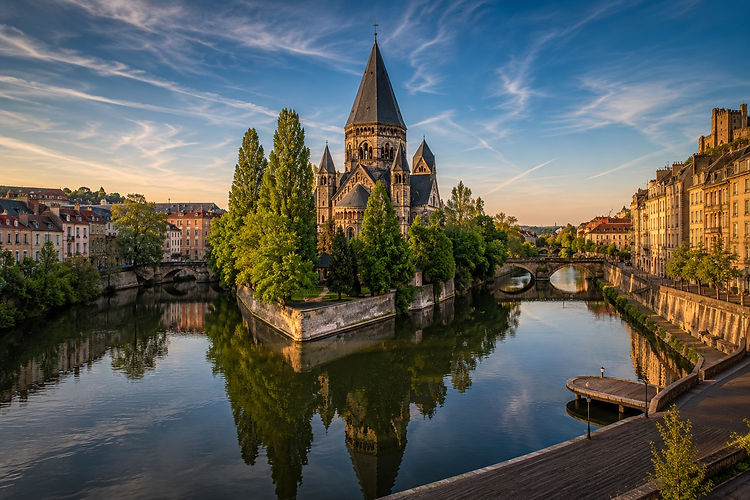
The Roches district and the Temple Neuf: Perched on the tip of the Île du Petit-Saulcy, in the middle of the Moselle River, the Temple Neuf (a neo-Romanesque building in gray sandstone) forms, along with the Jardin d'Amour (Garden of Love) and the stone bridges, one of the most romantic and photographed settings in Europe.

The Covered Market (Place de la Chambre): Housed in the former 18th-century episcopal palace, it is the city's gourmet heart. The stalls overflow with authentic Lorraine specialties: the true Quiche Lorraine, Metz pâté, Lorraine fusilli (dry sausage), and the ever-popular sweets made with Mirabelle plums, available in tarts, jams, and fragrant brandies.

Moselle AOC wines: The sunny hillsides surrounding the Moselle Valley are home to a distinctive vineyard. Take advantage of your stay to taste fruity white wines made from the Auxerrois or Pinot Gris grapes, perfect for pairing with local cuisine.

The lake and marina: Located just a few minutes' walk from the historic center, this vast natural and recreational area welcomes sailboats and walkers, and offers the opportunity to rent small electric boats or canoes for a leisurely paddle along the Roman ramparts.

Conclusion

Metz is a truly regal destination that masterfully blends the raw power of its defensive past with the luminous poetry of its ochre architecture. From the glass and azure vaults of its medieval cathedral to the bold lines of woven wood at the Centre Pompidou, and the southern charm of the arcades in Place Saint-Louis, this city on the Moselle River captivates with its striking contrasts and gentle, landscaped atmosphere. By successfully uniting the monumental rigor of its German past with the vibrant warmth of the Lorraine region, it stands out as a timeless, surprising, and intensely restorative stopover in the heart of Europe. A magical city from which one departs with eyes dazzled by the golden light that makes its Jaumont stone shimmer.

Metz Tourist Office - Inspire Metz Agency

Information Regarding Visuals: This website uses computer-generated images and illustrations created by artificial intelligence for atmospheric and stylistic purposes. These representations are not actual photographs and are strictly non-binding.

bottom of page