
Vesoul

Famous far and wide thanks to Jacques Brel's immortal song, Vesoul, the capital of the Haute-Saône department in the Bourgogne-Franche-Comté region, is a heritage city that truly deserves to be discovered. Nestled at the foot of its protective hill, La Motte, this "City of Character" reveals a discreet and authentic charm, far from the main tourist crowds. Between its two-tone stone houses, its secret courtyards, its vast recreational lake, and its typically Franche-Comté way of life, Vesoul offers a refreshing and surprising stopover.
The Hill of La Motte, the green and sacred lung
Dominating the city from its 378-meter summit, the Hill of La Motte is the unmistakable symbol of Vesoul, visible for miles around.
The ascent via the Stations of the Cross: A shaded footpath, marked with stone stations, leads from the historic center to the summit. It's a bucolic walk much appreciated by locals for escaping into nature.
The Chapel of La Motte: Built in 1857 on the site of a former medieval castle, this white chapel is dedicated to the Virgin Mary. It was constructed by the inhabitants in gratitude for sparing the city from a cholera epidemic. A monumental statue of the Virgin Mary proudly watches over the city.
The 360-degree panorama: From the summit esplanade, the view over the rooftops of Vesoul, the Durgeon Valley, and, on a clear day, the Vosges and Jura mountain ranges, is simply spectacular.


Old Vesoul, a medieval and classical architectural journey
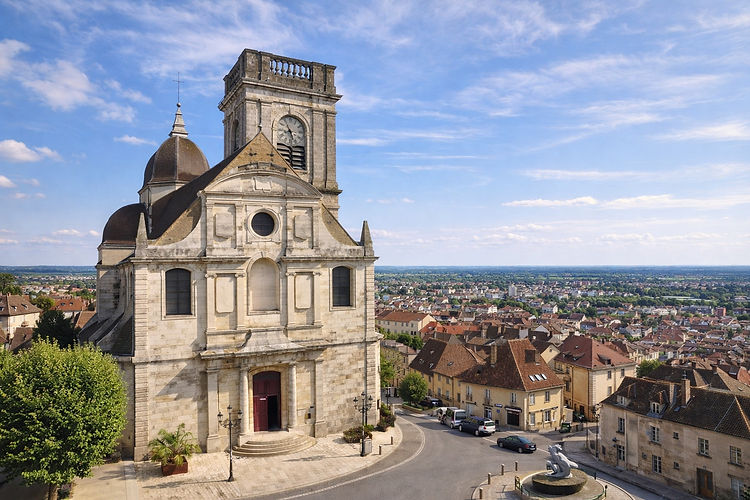
The historic heart of Vesoul, laid out around cobbled streets and ancient squares, boasts a rich architectural heritage built with local limestone in shades of blue and yellow.
Saint George's Church: Built in the 18th century, this monumental church is striking for the height of its nave and the richness of its furnishings. It houses magnificent woodwork, listed organs, and superb paintings, all testaments to the religious splendor of the era.
Private Mansions and Courtyards: As you stroll through the streets of Palais, Église, or Docteur-Doillon, look up to admire the 16th- and 17th-century facades. Behind the heavy carriage gates lie magnificent courtyards, spiral staircases, and Renaissance turrets.
The Town Hall and the former Courthouse: These classical-style buildings impose their architectural rigor on the city center. They recall the city's historical administrative and judicial role at the heart of the Bailiwick of Amont.

Lake Vesoul-Vaivre, an oasis of leisure and nature
Just minutes from the city center, the artificial lake of Vaivre offers an exceptional 95-hectare space dedicated to relaxation, sports, and biodiversity.
The sailing center and water sports: A true haven for watersports enthusiasts, the lake is perfect for windsurfing, catamaran sailing, canoeing, kayaking, and stand-up paddleboarding. A sandy beach welcomes swimmers during the warm summer months.
The walking and cycling path: A flat, fully developed 5-kilometer path circles the entire lake. It's the ideal playground for joggers, cyclists, and families looking for a pleasant walk in the fresh air.
The bird sanctuary: Part of the lake is classified as a protected natural area. Equipped with observation points, it shelters dozens of species of migratory and resident birds (herons, great crested grebes, mallards), delighting nature photographers.


Culture, Museum and the legacy of Jacques Brel
A vibrant city, Vesoul showcases the arts through its museums and festivals, while paying eternal tribute to its most celebrated artistic ambassador.
The Georges-Garret Museum: Housed in the former Ursuline convent, this municipal museum boasts two rich collections. One is dedicated to regional archaeology, and the other to 19th-century art, magnificently highlighting the works of Vesoul-born painter and sculptor Jean-Léon Gérôme.
The International Asian Film Festival (FICA): Every year, Vesoul becomes the European capital of Asian cinema. This internationally renowned festival, one of the oldest of its kind, attracts filmmakers from around the world and a passionate audience.
A nod to Jacques Brel: It's impossible to visit the city without thinking of the lyrics, "You wanted to see Vesoul, and we saw Vesoul." The city honors the artist with a bronze bust in his likeness installed in the city theatre, and many cultural spaces proudly bear his name.

Local produce, markets and gastronomy of Haute-Saône
Franche-Comté is a land of food lovers, and Vesoul is no exception, offering a generous culinary scene rich in authentic products.
The large weekly market: On Thursday and Saturday mornings, the Place de la République and the market halls come alive. It's the perfect opportunity to meet local producers and savor the aromas of the region.
Cheese and cured meat specialties: Vesoul's tables feature Comté, Morbier, and Cancoillotte (the famous melted cheese of Franche-Comté). These cheeses pair wonderfully with Morteau or Montbéliard sausage and Luxeuil ham.
Local biscuits and sweets: Local pastry chefs perpetuate traditional recipes such as Vesoul croquets (small dry almond biscuits) or treats made with Fougerolles griottines (cherries in brandy), located not far from there.
Conclusion
Vesoul is not a city to be rushed through; it's a city to be savored. Between the spiritual heights of the Motte and the soothing coolness of its lake, it offers a perfect balance between culture and nature. Far from simply being "desired" as the song goes, Vesoul is a destination chosen for its understated elegance, its golden light, and its proud and welcoming provincial soul. A charming stopover that proves beauty often lies in the simplicity and authenticity of a preserved region.
Vesoul Agglomeration Tourist Office
Information Regarding Visuals: This website uses computer-generated images and illustrations created by artificial intelligence for atmospheric and stylistic purposes. These representations are not actual photographs and are strictly non-binding.