top of page

Vaison-la-Romaine

Just cross the bridge and you'll step back in time. Perched on its rocky spur, the medieval town keeps its secrets hidden behind ramparts of golden stone.

A labyrinth of cobbled streets and fountains: Strolling through the Upper Town is a sensory experience. Footsteps echo on the cobblestone lanes, ivy adorns the facades of the townhouses, and the murmur of fountains, like the one in Place de l'Orme, offers welcome coolness in the height of summer.

The Belfry and the fortified gate: Marking the entrance to the old town, this clock tower topped with an elegant wrought-iron bell tower recalls the town's defensive past. It's the starting point for a poetic ascent.

The Château des Comtes de Toulouse: Proudly overlooking the valley from its 22-meter cliff, this 12th-century fortress, built to assert the count's power over the bishop, offers a spectacular panorama. From its forecourt, the view encompasses the plain, the city rooftops, and the bluish silhouette of the Giant of Provence.

Nestled at the foot of majestic Mont Ventoux and serenaded by cicadas, Vaison-la-Romaine is an open-air masterpiece. Few places can boast such a seamless and spectacular journey through time. Here, the Ouvèze River doesn't just divide the town geographically; it traces a poetic boundary between the opulence of Roman Antiquity and the secret charm of the Middle Ages.

The Largest Archaeological Field in France

Vaison-la-Romaine is home to the largest open-air Gallo-Roman site in France. The ancient city of Vasio Julia Vocontiorum reveals its secrets across nearly 15 hectares, divided into two main districts.

The Puymin Site: This is where the heart of public and residential life beat. Visitors can stroll along period cobblestone streets, admire the Laurel House, and imagine past grandeur by observing the Portico of Pompey, a sumptuous sanctuary dedicated to leisure and culture.

The Villasse Site: A true commercial and spa district of the time, this site impresses with its "Dolphin House," an immense bourgeois residence of 2,700 m². Its layout and plumbing systems testify to the absolute comfort enjoyed by the Gallo-Roman elite.

The Théo Desplans Archaeological Museum: Nestled in the heart of the excavations, this museum houses the treasures discovered on site. One is left speechless by the magnificent imperial marble statues (notably those of the emperors Claudius and Hadrian), the perfectly preserved mosaics, and the everyday objects that make this civilization seem so close to us.

Just cross the bridge and you'll step back in time. Perched on its rocky spur, the medieval town keeps its secrets hidden behind ramparts of golden stone.

A labyrinth of cobbled streets and fountains: Strolling through the Upper Town is a sensory experience. Footsteps echo on the cobblestone lanes, ivy adorns the facades of the townhouses, and the murmur of fountains, like the one in Place de l'Orme, offers welcome coolness in the height of summer.

The Belfry and the fortified gate: Marking the entrance to the old town, this clock tower topped with an elegant wrought-iron bell tower recalls the town's defensive past. It's the starting point for a poetic ascent.

The Château des Comtes de Toulouse: Proudly overlooking the valley from its 22-meter cliff, this 12th-century fortress, built to assert the count's power over the bishop, offers a spectacular panorama. From its forecourt, the view encompasses the plain, the city rooftops, and the bluish silhouette of the Giant of Provence.
Just cross the bridge and you'll step back in time. Perched on its rocky spur, the medieval town keeps its secrets hidden behind ramparts of golden stone.

A labyrinth of cobbled streets and fountains: Strolling through the Upper Town is a sensory experience. Footsteps echo on the cobblestone lanes, ivy adorns the facades of the townhouses, and the murmur of fountains, like the one in Place de l'Orme, offers welcome coolness in the height of summer.

The Belfry and the fortified gate: Marking the entrance to the old town, this clock tower topped with an elegant wrought-iron bell tower recalls the town's defensive past. It's the starting point for a poetic ascent.

The Château des Comtes de Toulouse: Proudly overlooking the valley from its 22-meter cliff, this 12th-century fortress, built to assert the count's power over the bishop, offers a spectacular panorama. From its forecourt, the view encompasses the plain, the city rooftops, and the bluish silhouette of the Giant of Provence.
Just cross the bridge and you'll step back in time. Perched on its rocky spur, the medieval town keeps its secrets hidden behind ramparts of golden stone.

A labyrinth of cobbled streets and fountains: Strolling through the Upper Town is a sensory experience. Footsteps echo on the cobblestone lanes, ivy adorns the facades of the townhouses, and the murmur of fountains, like the one in Place de l'Orme, offers welcome coolness in the height of summer.

The Belfry and the fortified gate: Marking the entrance to the old town, this clock tower topped with an elegant wrought-iron bell tower recalls the town's defensive past. It's the starting point for a poetic ascent.

The Château des Comtes de Toulouse: Proudly overlooking the valley from its 22-meter cliff, this 12th-century fortress, built to assert the count's power over the bishop, offers a spectacular panorama. From its forecourt, the view encompasses the plain, the city rooftops, and the bluish silhouette of the Giant of Provence.

The Roman Bridge, the thousand-year-old link

Just cross the bridge and you'll step back in time. Perched on its rocky spur, the medieval town keeps its secrets hidden behind ramparts of golden stone.

A labyrinth of cobbled streets and fountains: Strolling through the Upper Town is a sensory experience. Footsteps echo on the cobblestone lanes, ivy adorns the facades of the townhouses, and the murmur of fountains, like the one in Place de l'Orme, offers welcome coolness in the height of summer.

The Belfry and the fortified gate: Marking the entrance to the old town, this clock tower topped with an elegant wrought-iron bell tower recalls the town's defensive past. It's the starting point for a poetic ascent.

The Château des Comtes de Toulouse: Proudly overlooking the valley from its 22-meter cliff, this 12th-century fortress, built to assert the count's power over the bishop, offers a spectacular panorama. From its forecourt, the view encompasses the plain, the city rooftops, and the bluish silhouette of the Giant of Provence.

If there is one monument that single-handedly symbolizes the resilience and identity of Vaison, it is its bridge spanning the Ouvèze River.

A feat of ancient engineering: Built in the 1st century AD, this 17-meter-long, single-arch structure is anchored directly into the rock of the hillside. It is the widest bridge in Roman Gaul still in use.

A survivor of history: This bridge is not just a monument, it is a miracle. It has withstood the ravages of time, German dynamiting during the Second World War, and above all, the devastating flood of September 22, 1992, where modern infrastructure collapsed.

A photographer's perspective: It is the perfect spot to capture the essence of the town. At sunset, the low-angled light sets the stone ablaze and highlights the striking contrast between the lower town and the medieval silhouette rising towards the sky.
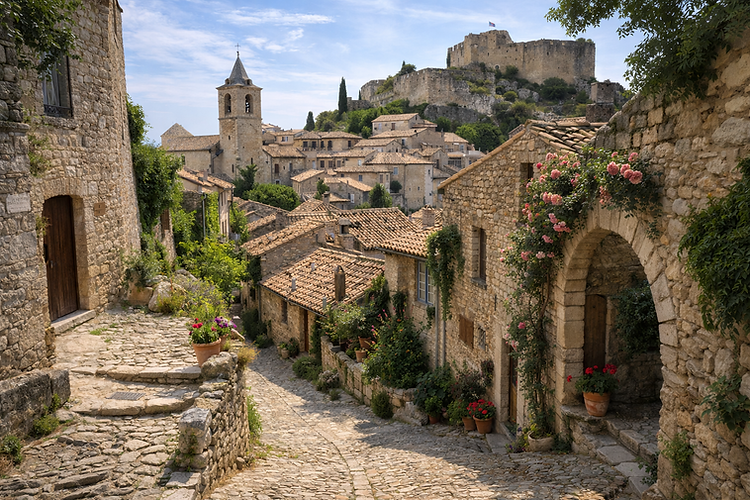
Just cross the bridge and you'll step back in time. Perched on its rocky spur, the medieval town keeps its secrets hidden behind ramparts of golden stone.

A labyrinth of cobbled streets and fountains: Strolling through the Upper Town is a sensory experience. Footsteps echo on the cobblestone lanes, ivy adorns the facades of the townhouses, and the murmur of fountains, like the one in Place de l'Orme, offers welcome coolness in the height of summer.

The Belfry and the fortified gate: Marking the entrance to the old town, this clock tower topped with an elegant wrought-iron bell tower recalls the town's defensive past. It's the starting point for a poetic ascent.

The Château des Comtes de Toulouse: Proudly overlooking the valley from its 22-meter cliff, this 12th-century fortress, built to assert the count's power over the bishop, offers a spectacular panorama. From its forecourt, the view encompasses the plain, the city rooftops, and the bluish silhouette of the Giant of Provence.

The Upper Town, a suspended medieval journey

Just cross the bridge and you'll step back in time. Perched on its rocky spur, the medieval town keeps its secrets hidden behind ramparts of golden stone.

A labyrinth of cobbled streets and fountains: Strolling through the Upper Town is a sensory experience. Footsteps echo on the cobblestone lanes, ivy adorns the facades of the townhouses, and the murmur of fountains, like the one in Place de l'Orme, offers welcome coolness in the height of summer.

The Belfry and the fortified gate: Marking the entrance to the old town, this clock tower topped with an elegant wrought-iron bell tower recalls the town's defensive past. It's the starting point for a poetic ascent.

The Château des Comtes de Toulouse: Proudly overlooking the valley from its 22-meter cliff, this 12th-century fortress, built to assert the count's power over the bishop, offers a spectacular panorama. From its forecourt, the view encompasses the plain, the city rooftops, and the bluish silhouette of the Giant of Provence.

Just cross the bridge and you'll step back in time. Perched on its rocky spur, the medieval town keeps its secrets hidden behind ramparts of golden stone.

A labyrinth of cobbled streets and fountains: Strolling through the Upper Town is a sensory experience. Footsteps echo on the cobblestone lanes, ivy adorns the facades of the townhouses, and the murmur of fountains, like the one in Place de l'Orme, offers welcome coolness in the height of summer.

The Belfry and the fortified gate: Marking the entrance to the old town, this clock tower topped with an elegant wrought-iron bell tower recalls the town's defensive past. It's the starting point for a poetic ascent.

The Château des Comtes de Toulouse: Proudly overlooking the valley from its 22-meter cliff, this 12th-century fortress, built to assert the count's power over the bishop, offers a spectacular panorama. From its forecourt, the view encompasses the plain, the city rooftops, and the bluish silhouette of the Giant of Provence.

Provençal Romanesque art, between shadow and light

Vaison-la-Romaine boasts a Christian heritage of rare architectural purity, a testament to its religious importance from the earliest centuries of our era.

Notre-Dame-de-Nazareth Cathedral: Built in the 11th century on ancient ruins, it impresses with its majestic austerity. Its walls bear the imprint of history, incorporating Roman stone blocks reused by medieval builders.

A cloister of absolute serenity: Adjoining the cathedral, this cloister is one of the most beautiful in Provence. Its four galleries frame a peaceful garden. Observing the small columns and sculpted motifs, one feels an atmosphere conducive to contemplation, far removed from the tourist bustle.

Saint-Quenin Chapel: Dedicated to the city's patron saint, this 12th-century gem intrigues architects worldwide because of its unique triangular apse. Its column decorations and Corinthian capitals directly recall the influence of nearby Roman monuments.

Just cross the bridge and you'll step back in time. Perched on its rocky spur, the medieval town keeps its secrets hidden behind ramparts of golden stone.

A labyrinth of cobbled streets and fountains: Strolling through the Upper Town is a sensory experience. Footsteps echo on the cobblestone lanes, ivy adorns the facades of the townhouses, and the murmur of fountains, like the one in Place de l'Orme, offers welcome coolness in the height of summer.

The Belfry and the fortified gate: Marking the entrance to the old town, this clock tower topped with an elegant wrought-iron bell tower recalls the town's defensive past. It's the starting point for a poetic ascent.

The Château des Comtes de Toulouse: Proudly overlooking the valley from its 22-meter cliff, this 12th-century fortress, built to assert the count's power over the bishop, offers a spectacular panorama. From its forecourt, the view encompasses the plain, the city rooftops, and the bluish silhouette of the Giant of Provence.

Mont Ventoux: The Giant of Provence

Nicknamed the "Giant of Provence," Mont Ventoux rises to 1,912 meters and offers a breathtaking natural spectacle, visible for miles around.

A Lunar Summit: Its summit, devoid of vegetation and covered in limestone scree, gives it an eternally snow-capped appearance, creating a striking contrast with the cedar and oak forests that blanket its slopes.

A Legendary Challenge: An absolute myth for cyclists worldwide, climbing its vertiginous slopes is a test of endurance rewarded by an exceptional panorama stretching from the Alps to the Mediterranean.

A Biosphere Reserve: Designated by UNESCO, the massif is home to rare biodiversity where Mediterranean flora grows alongside alpine species, offering a privileged playground for hikers.

Conclusion

Vaison-la-Romaine is much more than just a tourist destination: it's a timeless haven in the heart of Provence. Successfully blending the legacy of the Roman Empire, the mysteries of the Middle Ages, and the gentle pace of contemporary life, it offers a truly timeless escape. Whether you're a history buff, a lover of ancient stones, or simply seeking an authentic way of life, Vaison leaves a lasting impression on all who visit.

Vaison Ventoux Provence Tourist Office

Information Regarding Visuals: This website uses computer-generated images and illustrations created by artificial intelligence for atmospheric and stylistic purposes. These representations are not actual photographs and are strictly non-binding.

bottom of page