
Troyes

Bathed by the waters of the Seine and unusually shaped like a champagne cork, Troyes is a city of absolute elegance and rare, mineral poetry. Located in the Aube department of the Grand Est region, the former historical capital of the Counts of Champagne is a jewel miraculously preserved from the ravages of time. Swept away by a terrible fire in 1524, the city was entirely rebuilt during the Renaissance to become the largest and most cohesive collection of half-timbered houses in France. Between the sandstone lacework of its ten listed churches, the vibrant colors of its unique medieval stained-glass windows, the bustle of its factory outlets, and the delights of its sparkling local produce, the city of Troyes promises a tourist getaway of absolute refinement and romance.
The "Champagne Cork" and the Jewel Box of Half-Timbered Houses
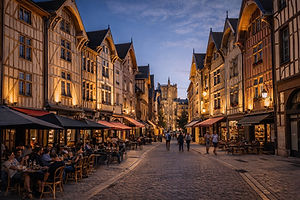
The very shape of Troyes' historic center, defined by its ancient medieval moats, evokes a champagne cork. Within this area lies a picture-postcard setting unique in Europe.
The Saint-Jean Quarter and the Rue des Chats (Cats' Alley): Strolling through these cobbled lanes, visitors embark on a true journey through time. The Rue des Chats is so narrow that the facades of the houses meet at the top, allowing cats to pass from one rooftop to the other. The pavement still retains its medieval central gutter.
The Baker's House and the Goldsmith's Turret: At the corner of Rue Champeaux, the Baker's House (16th century) boasts magnificent dark half-timbering and a sculpted awning. Just opposite, the Goldsmith's Turret seems suspended in mid-air, a testament to the genius of Renaissance carpenters.
The Court of the Golden Mortar: Accessible through a discreet porch, this restored inner courtyard offers a spectacular view of colorful half-timbering in ochre, red and blue tones, enhanced by suspended wooden galleries where time seems to have stopped.


The Cathedral of Saint Peter and Saint Paul and the City of Stained Glass

Troyes is nicknamed the "holy city of stained glass." Its churches house a collection of stained glass windows dating from the 12th to the 17th centuries, of unparalleled richness and size in France.
The Cathedral of Saint Peter and Saint Paul: This colossus of Gothic architecture impresses with its western façade sculpted like lace in white limestone. Its single nave, bathed in abundant light, is surrounded by 1,500 square meters of original stained glass windows that unfold sacred history in a kaleidoscope of shimmering colors.
The Church of Saint Madeleine and its Stone Rood Screen: This church houses one of the finest masterpieces of French sculpture: a white stone rood screen in the Flamboyant Gothic style (1508). Chiseled with surgical precision, it resembles lace suspended between the nave and the choir. Its large stained-glass window depicting the Creation is an absolute jewel.
The Basilica of Saint-Urbain: A true masterpiece of Rayonnant Gothic founded by Pope Urban IV (a native of Troyes), this basilica surprises with the slenderness of its stone structures, giving way to immense stained-glass windows that give it the appearance of a giant luminous glass cage.
Great Museums: From Workers' Tools to Modern Art
A city of culture and craftsmanship, Troyes showcases its industrial and artistic history through museum spaces of international renown.
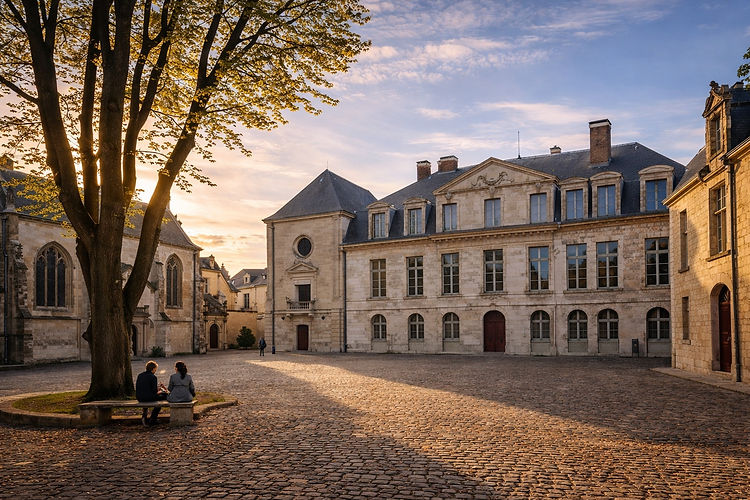
The MOPO (Maison de l'Outil et de la Pensée Ouvrière - House of Tools and Workers' Thought): Located in the magnificent Hôtel de Mauroy (16th century), this collection is unique in the world. It displays over 12,000 hand-crafting tools from the 18th and 19th centuries, presented in elegant, graphic displays, paying a vibrant tribute to the skill of the hand and the journeymen of the guilds.
The Museum of Modern Art (MAM): Situated in the former Bishop's Palace, this museum houses the prestigious Pierre and Denise Lévy donation. Visitors can admire masterpieces of modern art by André Derain, Georges Braque, Maurice de Vlaminck, and an exceptional collection of glassware by Maurice Marinot.
The Apothecary of the Hôtel-Dieu-le-Comte: Recently restored, this medieval hospital houses one of the finest historic pharmacies in France. Its dark wood-paneled walls contain hundreds of painted wooden boxes from the Louis XIV era and earthenware jars used to store the secrets of medicinal plants.


The Heart of Champagne, the Quays of the Seine and the Apiary
Troyes flourishes at water level, crisscrossed by the canals of the Seine, which open onto hidden green spaces and contemporary romantic settings.
The Heart of Troyes and the Quays: Completely redesigned, the quays of the Haute-Seine canal offer pedestrian walkways punctuated by murmuring fountains. Here stands The Heart of Troyes, a monumental sculpture in silver stainless steel, illuminated by light displays after nightfall, a symbol of Troyes' romanticism.
The Garden of the Innocents and the Squares: Hidden behind the Church of Sainte-Madeleine, this garden of medicinal plants and old roses offers a haven of peace shaded by ancient plane trees, embodying the tranquility of old medieval cloisters.
The Forêt d'Orient Regional Natural Park: Just twenty kilometers from the city gates, this vast natural haven boasts three large reservoir lakes. It's a paradise for water sports, cycling under the oak canopy, and observing wild migratory birds.

Troyes Andouillette, Prunelle and Factory Outlet Fever
The art of living in Troyes is savored with a distinctly indulgent spirit, fueled by centuries-old charcuterie traditions and its status as the European capital of window shopping.
The Authentic Troyes Andouillette (AAAAA): An undisputed star of regional cuisine, the Troyes andouillette is prepared exclusively by hand according to a historical recipe using pork chitterlings and stomachs seasoned with herbs. It is best enjoyed grilled, topped with a Meaux mustard sauce made with Chaource wine.
Chaource Cheese and Prunelle de Troyes: The local cheese platter showcases Chaource (AOP), a soft cow's milk cheese with a bloomy rind and an exquisitely creamy texture. To aid digestion, gourmets savor Prunelle de Troyes, a sloe berry liqueur made since 1840 in the historic distillery opposite the cathedral.
Champagne and Shopping Fever: Troyes is surrounded by the vineyards of the Côte des Bars. Local cellars offer delightful Champagne tastings. At the same time, the city is the historical home of French hosiery (Lacoste, Petit Bateau) and boasts some of Europe's largest outlet centers (McArthurGlen, Marques Avenue), attracting fashion enthusiasts from around the world.
Conclusion
Troyes is a magnificent tourist destination, a charming stopover steeped in history and gastronomy that captivates every traveler with the power of its visual identity. By successfully achieving the remarkable feat of blending the poetic and colorful geometry of its Renaissance half-timbered facades with the luminous brilliance of its stained-glass cathedrals, the precision and nobility of its craft collections, the tranquility of its canals along the Seine, and the conviviality of its award-winning cuisine, the city of the Counts of Champagne establishes itself as a truly complete destination. Whether one comes to seek the reflection of centuries past in the Rue des Chats (Cats' Alley), to be moved by the stone lacework of Sainte-Madeleine Church, or to share a glass of Champagne after a day of shopping, Troyes leaves an indelible impression of a luminous, welcoming city, forever etched in the heart of French heritage.
Troyes Tourist Office (Troyes La Champagne Tourisme)
Information Regarding Visuals: This website uses computer-generated images and illustrations created by artificial intelligence for atmospheric and stylistic purposes. These representations are not actual photographs and are strictly non-binding.