top of page

Strasbourg

A testament to Alsace's turbulent history, the Neustadt (New Town) is a monumental district developed by the German Empire at the end of the 19th century, offering a unique urban planning model.

Republic Square and the Rhine Palace: The heart of the Neustadt, this circular square is bordered by the Rhine Palace (the former imperial palace dedicated to Wilhelm II). With its massive Neo-Renaissance dome and shaded park, it embodies the splendor of Prussian architecture.

The National and University Library (BNU): This rigorously classical monument houses one of the richest manuscript collections in Europe. Its glass dome floods the interior with light conducive to scholarship.

Liberty Avenue and Art Nouveau Buildings: Linking the Imperial Palace to the University, this wide, tree-lined avenue displays opulent facades blending neo-baroque, neo-gothic styles and superb touches of Jugendstil (Germanic Art Nouveau) with original floral and geometric motifs.

A vibrant crossroads of Europe, nestled on the banks of the Ill and Rhine rivers in the Bas-Rhin department, Strasbourg is a metropolis of majestic beauty and a profoundly bicultural soul. Capital of the Grand Est region and home to major European institutions, this Alsatian city is a poetic link between German rigor and French refinement. A UNESCO World Heritage Site, the city captivates with the virtuosity of its architecture, from the delicate pink sandstone tracery of its thousand-year-old cathedral to the carved wooden facades of its historic districts. Blending Rhenish tradition, cosmopolitan boldness, romantic canals, and a gourmet lifestyle, Strasbourg promises a tourist experience of absolute richness and clarity.

Notre-Dame Cathedral, the Prodigy of Rhenish Gothic

Dominating the Alsatian plain with its single, soaring spire, Strasbourg Cathedral is an absolute masterpiece of medieval art, described by Victor Hugo as "a marvel of the gigantic and the delicate."

The Pink Sandstone Façade and its Single Spire: Built entirely of pink Vosges sandstone, its façade is a veritable stone lacework where thousands of statues come to life in the light. Its single spire, reaching a height of 142 meters, was the tallest man-made structure in the world until the 19th century, embodying the soaring and audacious style of Rayonnant Gothic architecture.

The Astronomical Clock and the Pillar of Angels: A jewel of the Renaissance, this monumental clock comes to life every day at 12:30 pm, depicting the procession of the Apostles before Christ, driven by a mechanism of surgical complexity. It faces the spectacular Pillar of Angels, which graphically illustrates the Last Judgment.

The Great Rose Window and Geiler's Pulpit: Upon entering the nave, visitors are dazzled by the 15-meter-diameter rose window, a medieval kaleidoscope of glass. Their gaze is also drawn to the sculpted pulpit by Jean Geiler of Kaysersberg, adorned with a small sculpture of a faithful dog.

A testament to Alsace's turbulent history, the Neustadt (New Town) is a monumental district developed by the German Empire at the end of the 19th century, offering a unique urban planning model.

Republic Square and the Rhine Palace: The heart of the Neustadt, this circular square is bordered by the Rhine Palace (the former imperial palace dedicated to Wilhelm II). With its massive Neo-Renaissance dome and shaded park, it embodies the splendor of Prussian architecture.

The National and University Library (BNU): This rigorously classical monument houses one of the richest manuscript collections in Europe. Its glass dome floods the interior with light conducive to scholarship.

Liberty Avenue and Art Nouveau Buildings: Linking the Imperial Palace to the University, this wide, tree-lined avenue displays opulent facades blending neo-baroque, neo-gothic styles and superb touches of Jugendstil (Germanic Art Nouveau) with original floral and geometric motifs.
A testament to Alsace's turbulent history, the Neustadt (New Town) is a monumental district developed by the German Empire at the end of the 19th century, offering a unique urban planning model.

Republic Square and the Rhine Palace: The heart of the Neustadt, this circular square is bordered by the Rhine Palace (the former imperial palace dedicated to Wilhelm II). With its massive Neo-Renaissance dome and shaded park, it embodies the splendor of Prussian architecture.

The National and University Library (BNU): This rigorously classical monument houses one of the richest manuscript collections in Europe. Its glass dome floods the interior with light conducive to scholarship.

Liberty Avenue and Art Nouveau Buildings: Linking the Imperial Palace to the University, this wide, tree-lined avenue displays opulent facades blending neo-baroque, neo-gothic styles and superb touches of Jugendstil (Germanic Art Nouveau) with original floral and geometric motifs.
A testament to Alsace's turbulent history, the Neustadt (New Town) is a monumental district developed by the German Empire at the end of the 19th century, offering a unique urban planning model.

Republic Square and the Rhine Palace: The heart of the Neustadt, this circular square is bordered by the Rhine Palace (the former imperial palace dedicated to Wilhelm II). With its massive Neo-Renaissance dome and shaded park, it embodies the splendor of Prussian architecture.

The National and University Library (BNU): This rigorously classical monument houses one of the richest manuscript collections in Europe. Its glass dome floods the interior with light conducive to scholarship.

Liberty Avenue and Art Nouveau Buildings: Linking the Imperial Palace to the University, this wide, tree-lined avenue displays opulent facades blending neo-baroque, neo-gothic styles and superb touches of Jugendstil (Germanic Art Nouveau) with original floral and geometric motifs.

La Petite France, the Romantic Jewel of the Canals

A testament to Alsace's turbulent history, the Neustadt (New Town) is a monumental district developed by the German Empire at the end of the 19th century, offering a unique urban planning model.

Republic Square and the Rhine Palace: The heart of the Neustadt, this circular square is bordered by the Rhine Palace (the former imperial palace dedicated to Wilhelm II). With its massive Neo-Renaissance dome and shaded park, it embodies the splendor of Prussian architecture.

The National and University Library (BNU): This rigorously classical monument houses one of the richest manuscript collections in Europe. Its glass dome floods the interior with light conducive to scholarship.

Liberty Avenue and Art Nouveau Buildings: Linking the Imperial Palace to the University, this wide, tree-lined avenue displays opulent facades blending neo-baroque, neo-gothic styles and superb touches of Jugendstil (Germanic Art Nouveau) with original floral and geometric motifs.

Once home to tanners, millers, and fishermen in the Middle Ages, Petite France is the most picturesque and enchanting area of Strasbourg's Grande Île.

The Half-Timbered Houses and the Tanners' House: Bordering the canals of the Ill River at water level, the imposing 16th- and 17th-century houses boast magnificent dark half-timbering and open, sloping roofs, once used for drying hides. The Tanners' House (1572) is its crowning glory.

The Covered Bridges and the Executioner's Tower: Spanning the river's branches, these three fortified bridges have retained their four tall 14th-century brick watchtowers, remnants of the old medieval fortifications of this merchant city.

The Vauban Dam and its Panoramic Terrace: Built upstream from the Covered Bridges to defend against 17th-century invasions, this pink sandstone lock-bridge allowed the southern part of the city to be flooded in case of attack. Its upper panoramic terrace now offers an unmissable breathtaking view overlooking the canals and the cathedral spires.
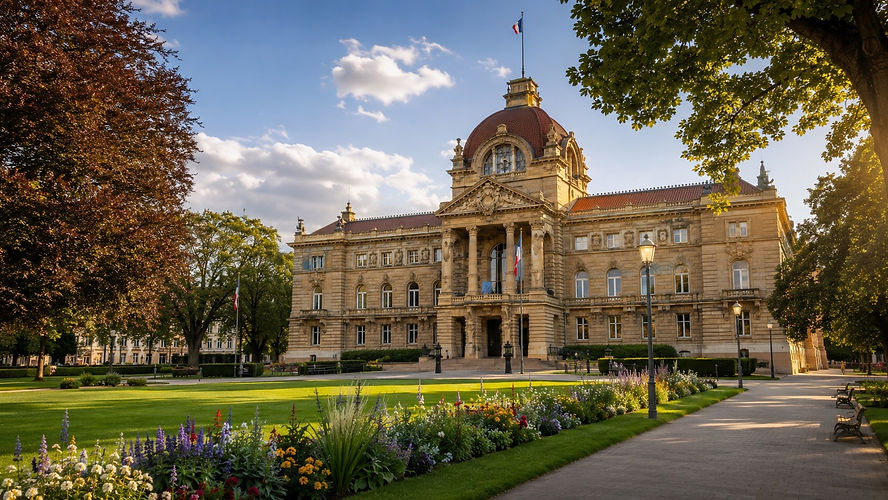
A testament to Alsace's turbulent history, the Neustadt (New Town) is a monumental district developed by the German Empire at the end of the 19th century, offering a unique urban planning model.

Republic Square and the Rhine Palace: The heart of the Neustadt, this circular square is bordered by the Rhine Palace (the former imperial palace dedicated to Wilhelm II). With its massive Neo-Renaissance dome and shaded park, it embodies the splendor of Prussian architecture.

The National and University Library (BNU): This rigorously classical monument houses one of the richest manuscript collections in Europe. Its glass dome floods the interior with light conducive to scholarship.

Liberty Avenue and Art Nouveau Buildings: Linking the Imperial Palace to the University, this wide, tree-lined avenue displays opulent facades blending neo-baroque, neo-gothic styles and superb touches of Jugendstil (Germanic Art Nouveau) with original floral and geometric motifs.

The Neustadt, the Elegance of German Imperial Architecture

A testament to Alsace's turbulent history, the Neustadt (New Town) is a monumental district developed by the German Empire at the end of the 19th century, offering a unique urban planning model.

Republic Square and the Rhine Palace: The heart of the Neustadt, this circular square is bordered by the Rhine Palace (the former imperial palace dedicated to Wilhelm II). With its massive Neo-Renaissance dome and shaded park, it embodies the splendor of Prussian architecture.

The National and University Library (BNU): This rigorously classical monument houses one of the richest manuscript collections in Europe. Its glass dome floods the interior with light conducive to scholarship.

Liberty Avenue and Art Nouveau Buildings: Linking the Imperial Palace to the University, this wide, tree-lined avenue displays opulent facades blending neo-baroque, neo-gothic styles and superb touches of Jugendstil (Germanic Art Nouveau) with original floral and geometric motifs.

A testament to Alsace's turbulent history, the Neustadt (New Town) is a monumental district developed by the German Empire at the end of the 19th century, offering a unique urban planning model.

Republic Square and the Rhine Palace: The heart of the Neustadt, this circular square is bordered by the Rhine Palace (the former imperial palace dedicated to Wilhelm II). With its massive Neo-Renaissance dome and shaded park, it embodies the splendor of Prussian architecture.

The National and University Library (BNU): This rigorously classical monument houses one of the richest manuscript collections in Europe. Its glass dome floods the interior with light conducive to scholarship.

Liberty Avenue and Art Nouveau Buildings: Linking the Imperial Palace to the University, this wide, tree-lined avenue displays opulent facades blending neo-baroque, neo-gothic styles and superb touches of Jugendstil (Germanic Art Nouveau) with original floral and geometric motifs.

The European Quarter, the Crossroads of Nations and the Orangerie Park

Strasbourg, along with Brussels and Luxembourg, is one of the few cities in the world to host international institutions without being a national capital, thus affirming its status as a capital of peace.

The European Parliament (Louise Weiss Building): This monumental contemporary building, blending glass, steel, and exposed concrete, is striking for its circular structure, partially open to the Ill River. It hosts the monthly plenary sessions of the Members of the European Parliament, symbolizing democratic transparency.

The Council of Europe and the Palace of Human Rights: Designed by architect Richard Rogers, the Palace of Human Rights evokes the stylized silhouette of the scales of justice, affirming Strasbourg's role as a guardian of fundamental freedoms in Europe.

The Orangerie Park and the Storks: Located opposite the institutions, this magnificent 26-hectare English-style park was designed in the 18th century. It is a haven of peace with a large lake, a pavilion of Empress Josephine and the main center for the reintroduction of the white stork, the bird symbol of Alsace which can be seen nesting in complete freedom.

A testament to Alsace's turbulent history, the Neustadt (New Town) is a monumental district developed by the German Empire at the end of the 19th century, offering a unique urban planning model.

Republic Square and the Rhine Palace: The heart of the Neustadt, this circular square is bordered by the Rhine Palace (the former imperial palace dedicated to Wilhelm II). With its massive Neo-Renaissance dome and shaded park, it embodies the splendor of Prussian architecture.

The National and University Library (BNU): This rigorously classical monument houses one of the richest manuscript collections in Europe. Its glass dome floods the interior with light conducive to scholarship.

Liberty Avenue and Art Nouveau Buildings: Linking the Imperial Palace to the University, this wide, tree-lined avenue displays opulent facades blending neo-baroque, neo-gothic styles and superb touches of Jugendstil (Germanic Art Nouveau) with original floral and geometric motifs.

Winstubs, Local Flavors and the Magic of Christmas

The Strasbourg way of life is expressed with legendary generosity through its distinctive cuisine and centuries-old festive traditions.

The Winstub, Temple of Conviviality: In these traditional taverns with their patinated woodwork and red-checkered tablecloths (the Kelsch), gourmets gather to savor sauerkraut with five kinds of meat, Baekeoffe (a three-meat stew simmered in Riesling), artisanal Spätzle, or a thin and crispy Flammekueche.

The Christkindelsmärik, World Capital of Christmas: Established in 1570, Strasbourg's Christmas market is the oldest in France. From the end of November, the city dons its festive attire: thousands of lights illuminate the narrow streets, the Great Christmas Tree in Place Kléber reaches for the sky, and wooden chalets fill the air with the aromas of cinnamon, gingerbread, and mulled wine.

Gingerbread, Kougelhopf, and Alsatian wines: Bakeries and historic establishments (like Maison Mireille Oster) perpetuate traditional cookie recipes (Bredele). Meals pair perfectly with exceptional wines from the nearby Alsace Wine Route: mineral Riesling, aromatic Gewurztraminer, or robust Pinot Gris.

Conclusion

Strasbourg is a magnificent tourist destination, a vibrant and regal stopover that captivates with the strength of its identity and the beauty of its heritage. By successfully achieving the remarkable feat of blending the spiritual grandeur of its pink sandstone cathedral, the historical romance of the canals of its Petite France district, the imperial grandeur of its Neustadt, the contemporary boldness of its European Quarter, and the hearty culinary delights of its winter traditions, the Alsatian capital offers a truly immersive travel experience. Whether one comes to observe the movements of the apostles on the astronomical clock, cruise on a riverboat at sunset, or share the warmth of a traditional Alsatian wine bar (winstub), Strasbourg leaves an indelible impression on the traveler of a luminous, welcoming, and profoundly timeless city in the heart of Europe.

Strasbourg and Region Tourist Office

Information Regarding Visuals: This website uses computer-generated images and illustrations created by artificial intelligence for atmospheric and stylistic purposes. These representations are not actual photographs and are strictly non-binding.

bottom of page