top of page

Sisteron

Sisteron's historic center, nestled at the foot of its rocky outcrop, has preserved all the authenticity of a medieval and Renaissance town in Haute-Provence.

The Mystery of the Andrones: This is the village's unique urban architectural feature. The andrones are narrow medieval alleyways, often covered by barrel vaults or stone arcades, that climb the hillside. They provided quick access from the heart of the town to the upper ramparts and offered a cool refuge during the intense summer heat.

The Cathedral of Notre-Dame-des-Pommiers: A masterpiece of 12th-century Provençal Romanesque art, this former cathedral impresses with the sobriety and power of its gray stone nave. Its portal is adorned with sculpted marble columns and refined capitals, while its Lombard-style bell tower rises above the rooftops of the old town.

The Four Towers of the Ramparts: Of the great medieval wall that protected the lower town, four magnificent crenellated circular towers remain (including the Clock Tower), which punctuate the outer boulevards and recall the fortified past of the town.

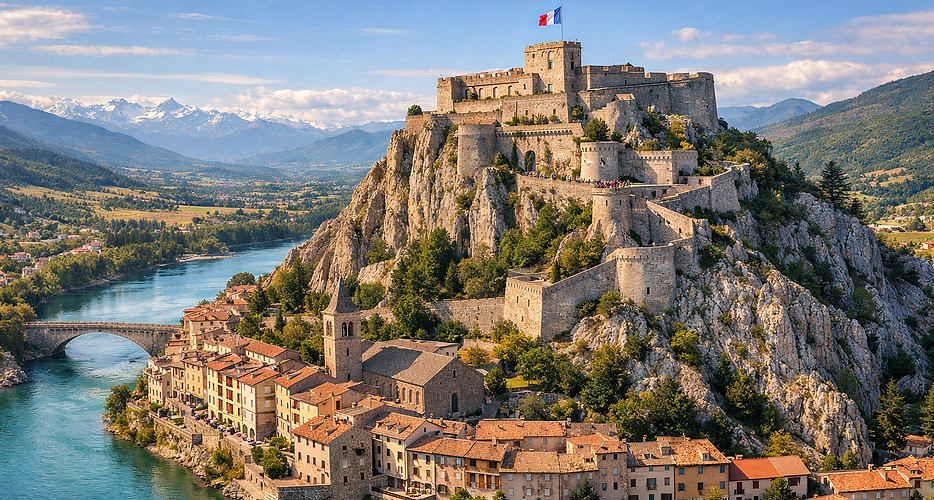
Nestled at the gateway to Provence, where the Alps gently slope down to the Mediterranean, Sisteron is a breathtaking vision of absolute power. Located in the Alpes-de-Haute-Provence department, this historic town occupies an exceptional natural setting, earning it the well-deserved title of "Gateway to Provence." Perched on a vertiginous rocky spur facing the impressive Baume cliff, the village guards the Durance Valley, creating a picture-postcard landscape unlike any other in Europe. Between the raw strength of its royal citadel, the hidden charm of its medieval alleyways (the andrones), the pure clarity of its azure sky, and the delights of its mountain terroir, Sisteron promises a tourist experience of rare refinement and intensity.

The Royal Citadel, the Sentinel of the Rock

Proudly crowning the rocky spur overlooking the town, the Citadel of Sisteron is a masterpiece of military architecture, situated on a site listed as a historical monument.

The Crown of Centuries: Built between the 14th and 17th centuries, the citadel bears the mark of great military engineers, notably Jehan Erard and later Vauban. Its white limestone ramparts, bastions, and watchtowers blend so perfectly with the rock that they seem to rise from the very heart of the mountain.

The Chapel of Notre-Dame-du-Château (15th century): Boldly rebuilt on the crest of the rock, this Gothic and Romanesque chapel surprises with the elegance of its clean lines and the beauty of its contemporary stained-glass windows, which bathe the interior in a vibrant, azure light.

The Vertiginous 360° Panorama: From the upper platform of the fortress, the view encompasses a magnificent landscape: the turquoise ribbon of the Durance below, the Provençal tile roofs of the village, the peaks of the Southern Alps and, just opposite, the spectacular pleated silhouette of the Rocher de la Baume.

Sisteron's historic center, nestled at the foot of its rocky outcrop, has preserved all the authenticity of a medieval and Renaissance town in Haute-Provence.

The Mystery of the Andrones: This is the village's unique urban architectural feature. The andrones are narrow medieval alleyways, often covered by barrel vaults or stone arcades, that climb the hillside. They provided quick access from the heart of the town to the upper ramparts and offered a cool refuge during the intense summer heat.

The Cathedral of Notre-Dame-des-Pommiers: A masterpiece of 12th-century Provençal Romanesque art, this former cathedral impresses with the sobriety and power of its gray stone nave. Its portal is adorned with sculpted marble columns and refined capitals, while its Lombard-style bell tower rises above the rooftops of the old town.

The Four Towers of the Ramparts: Of the great medieval wall that protected the lower town, four magnificent crenellated circular towers remain (including the Clock Tower), which punctuate the outer boulevards and recall the fortified past of the town.
Sisteron's historic center, nestled at the foot of its rocky outcrop, has preserved all the authenticity of a medieval and Renaissance town in Haute-Provence.

The Mystery of the Andrones: This is the village's unique urban architectural feature. The andrones are narrow medieval alleyways, often covered by barrel vaults or stone arcades, that climb the hillside. They provided quick access from the heart of the town to the upper ramparts and offered a cool refuge during the intense summer heat.

The Cathedral of Notre-Dame-des-Pommiers: A masterpiece of 12th-century Provençal Romanesque art, this former cathedral impresses with the sobriety and power of its gray stone nave. Its portal is adorned with sculpted marble columns and refined capitals, while its Lombard-style bell tower rises above the rooftops of the old town.

The Four Towers of the Ramparts: Of the great medieval wall that protected the lower town, four magnificent crenellated circular towers remain (including the Clock Tower), which punctuate the outer boulevards and recall the fortified past of the town.
Sisteron's historic center, nestled at the foot of its rocky outcrop, has preserved all the authenticity of a medieval and Renaissance town in Haute-Provence.

The Mystery of the Andrones: This is the village's unique urban architectural feature. The andrones are narrow medieval alleyways, often covered by barrel vaults or stone arcades, that climb the hillside. They provided quick access from the heart of the town to the upper ramparts and offered a cool refuge during the intense summer heat.

The Cathedral of Notre-Dame-des-Pommiers: A masterpiece of 12th-century Provençal Romanesque art, this former cathedral impresses with the sobriety and power of its gray stone nave. Its portal is adorned with sculpted marble columns and refined capitals, while its Lombard-style bell tower rises above the rooftops of the old town.

The Four Towers of the Ramparts: Of the great medieval wall that protected the lower town, four magnificent crenellated circular towers remain (including the Clock Tower), which punctuate the outer boulevards and recall the fortified past of the town.

The Durance Gorge and the Rocher de la Baume

Sisteron's historic center, nestled at the foot of its rocky outcrop, has preserved all the authenticity of a medieval and Renaissance town in Haute-Provence.

The Mystery of the Andrones: This is the village's unique urban architectural feature. The andrones are narrow medieval alleyways, often covered by barrel vaults or stone arcades, that climb the hillside. They provided quick access from the heart of the town to the upper ramparts and offered a cool refuge during the intense summer heat.

The Cathedral of Notre-Dame-des-Pommiers: A masterpiece of 12th-century Provençal Romanesque art, this former cathedral impresses with the sobriety and power of its gray stone nave. Its portal is adorned with sculpted marble columns and refined capitals, while its Lombard-style bell tower rises above the rooftops of the old town.

The Four Towers of the Ramparts: Of the great medieval wall that protected the lower town, four magnificent crenellated circular towers remain (including the Clock Tower), which punctuate the outer boulevards and recall the fortified past of the town.

Sisteron developed around a geological marvel. The gorge (the narrow gorge) carved by the river separates the town from a fascinating wall of stone.

The Rocher de la Baume, a Geological Monument: Rising opposite the citadel, this limestone cliff offers almost vertical strata of stone with surgical regularity. This major geological fold, known worldwide to scientists, is illuminated with golden and russet hues at sunset, offering a striking natural spectacle.

The Trou de l'Argent Cave: Nestled on the slopes of the Baume, this natural cavity is linked to old legends of hidden treasure. A steep hiking trail allows experienced walkers to reach its edge and enjoy a unique view of the valley's narrowest point.

The Marres Lake: At the foot of the rock, a magnificent artificial lake created on the banks of the Durance River offers a welcome respite from the summer heat. Its grassy areas and clear waters allow for supervised swimming with a breathtaking view of the suspended fortress.

Sisteron's historic center, nestled at the foot of its rocky outcrop, has preserved all the authenticity of a medieval and Renaissance town in Haute-Provence.

The Mystery of the Andrones: This is the village's unique urban architectural feature. The andrones are narrow medieval alleyways, often covered by barrel vaults or stone arcades, that climb the hillside. They provided quick access from the heart of the town to the upper ramparts and offered a cool refuge during the intense summer heat.

The Cathedral of Notre-Dame-des-Pommiers: A masterpiece of 12th-century Provençal Romanesque art, this former cathedral impresses with the sobriety and power of its gray stone nave. Its portal is adorned with sculpted marble columns and refined capitals, while its Lombard-style bell tower rises above the rooftops of the old town.

The Four Towers of the Ramparts: Of the great medieval wall that protected the lower town, four magnificent crenellated circular towers remain (including the Clock Tower), which punctuate the outer boulevards and recall the fortified past of the town.

A stroll through the Labyrinth of the Andrones and the Old Stones

Sisteron's historic center, nestled at the foot of its rocky outcrop, has preserved all the authenticity of a medieval and Renaissance town in Haute-Provence.

The Mystery of the Andrones: This is the village's unique urban architectural feature. The andrones are narrow medieval alleyways, often covered by barrel vaults or stone arcades, that climb the hillside. They provided quick access from the heart of the town to the upper ramparts and offered a cool refuge during the intense summer heat.

The Cathedral of Notre-Dame-des-Pommiers: A masterpiece of 12th-century Provençal Romanesque art, this former cathedral impresses with the sobriety and power of its gray stone nave. Its portal is adorned with sculpted marble columns and refined capitals, while its Lombard-style bell tower rises above the rooftops of the old town.

The Four Towers of the Ramparts: Of the great medieval wall that protected the lower town, four magnificent crenellated circular towers remain (including the Clock Tower), which punctuate the outer boulevards and recall the fortified past of the town.

Sisteron's historic center, nestled at the foot of its rocky outcrop, has preserved all the authenticity of a medieval and Renaissance town in Haute-Provence.

The Mystery of the Andrones: This is the village's unique urban architectural feature. The andrones are narrow medieval alleyways, often covered by barrel vaults or stone arcades, that climb the hillside. They provided quick access from the heart of the town to the upper ramparts and offered a cool refuge during the intense summer heat.

The Cathedral of Notre-Dame-des-Pommiers: A masterpiece of 12th-century Provençal Romanesque art, this former cathedral impresses with the sobriety and power of its gray stone nave. Its portal is adorned with sculpted marble columns and refined capitals, while its Lombard-style bell tower rises above the rooftops of the old town.

The Four Towers of the Ramparts: Of the great medieval wall that protected the lower town, four magnificent crenellated circular towers remain (including the Clock Tower), which punctuate the outer boulevards and recall the fortified past of the town.

The Napoleon Route and the Memory of Travelers

Ideally located on the famous Route Napoléon (the RN85), Sisteron is a major historical stop on the route taken by the Emperor upon his return from the island of Elba in 1815.

The Crucial Stop of March 5, 1815: Heading back towards Paris, Napoleon dreaded the stop in Sisteron, whose closed citadel could have halted his advance. Against all odds, the town surrendered without resistance, allowing the Emperor to have lunch at a local inn before continuing his audacious journey towards Gap.

The Earth and Time Museum: Housed in the former chapel of the Visitandine convent (17th century), this unique museum is dedicated to the measurement of time and the history of the Earth. It contains an exceptional collection of antique scientific instruments, sundials, and pendulums, all presented in dialogue with the ancient geology of the valley.

The Musicians at the Bandstand: The Place de la République is home to a superb 19th-century bandstand, shaded by large plane trees, where the heart of Sisteron conviviality beats during traditional markets and open-air concerts.

Sisteron's historic center, nestled at the foot of its rocky outcrop, has preserved all the authenticity of a medieval and Renaissance town in Haute-Provence.

The Mystery of the Andrones: This is the village's unique urban architectural feature. The andrones are narrow medieval alleyways, often covered by barrel vaults or stone arcades, that climb the hillside. They provided quick access from the heart of the town to the upper ramparts and offered a cool refuge during the intense summer heat.

The Cathedral of Notre-Dame-des-Pommiers: A masterpiece of 12th-century Provençal Romanesque art, this former cathedral impresses with the sobriety and power of its gray stone nave. Its portal is adorned with sculpted marble columns and refined capitals, while its Lombard-style bell tower rises above the rooftops of the old town.

The Four Towers of the Ramparts: Of the great medieval wall that protected the lower town, four magnificent crenellated circular towers remain (including the Clock Tower), which punctuate the outer boulevards and recall the fortified past of the town.

Flavors of Haute-Provence and Sisteron Lamb

The Sisteron way of life is savored with generosity through its distinctive cuisine, a blend of Alpine influences and Provençal flavors.

The Prestigious Sisteron Lamb (Label Rouge & IGP): A true star of local haute cuisine, Sisteron lamb is raised on its mother's milk in the region's pastures. Its delicate, tender meat, with its incomparable aromatic sweetness, is celebrated during the grand lamb festival and is best enjoyed roasted with Provençal herbs.

Pieds Paquets and Tomme de l'Ubaye: At the tables of traditional inns in the historic center, gourmets enjoy pieds paquets (a specialty of tripe and lamb simmered in white wine and bacon), tourtons des Alpes (Alpine tarts), or sheep and goat cheeses from the nearby mountains.

Lavender Honey and Sweet Treats: To conclude the meal, local markets abound with creamy lavender honey (PDO), artisanal nougat, and candied fruit. Meals are ideally accompanied by a glass of wine from the nearby Coteaux de Pierrevert, whose sun-drenched vineyards border the Durance River.

Conclusion

Sisteron is a magnificent tourist destination, a charming and historic stopover that stirs the soul with the raw power of its landscapes. By successfully achieving the remarkable feat of blending the military grandeur of its Vauban citadel, the geological wonder of its Rocher de la Baume, the fresh poetry of its medieval alleyways, and the culinary excellence of its legendary lamb, the Gateway to Provence stands as a monument of emotion. Whether one comes to trace Napoleon's history on the cobblestones of a narrow street, enjoy a refreshing break overlooking the Durance River, or contemplate the limestone strata illuminated under the clear skies of the Southern Alps, Sisteron leaves an indelible impression on the traveler of a luminous, impregnable, and forever unforgettable city.

Sisteron Buëch Tourist Office

Information Regarding Visuals: This website uses computer-generated images and illustrations created by artificial intelligence for atmospheric and stylistic purposes. These representations are not actual photographs and are strictly non-binding.

bottom of page