top of page

Sarlat-la-Canéda

Sarlat is the undisputed capital of fine Périgord cuisine. Its twice-weekly markets (Wednesdays and Saturdays) are considered among the most beautiful and gourmet in France.

Périgord's Black Gold: Truffles: During the winter, Sarlat hosts its famous fresh truffle market (Tuber melanosporum). Local truffle growers trade these black diamonds with their captivating aroma, celebrated during the grand Truffle Festival in January.

Foie Gras and Duck with Character: At the tables of traditional inns in the historic center or at producers' stalls, duck and goose reign supreme. People flock there to savor Périgord foie gras, melt-in-your-mouth confit, dried duck breasts, and cracklings, precious testaments to centuries-old farming expertise.

Périgord Walnuts and Cabécou Cheese: Local gastronomy is complemented by Périgord Walnuts (AOP), available as flavored oil or in traditional cakes, and Cabécou, a small, creamy raw milk goat cheese. All of this pairs wonderfully with a glass of wine from the nearby Bergerac, Pécharmant, or Monbazillac appellations.

In the heart of the Périgord Noir, in the Dordogne department of the Nouvelle-Aquitaine region, Sarlat-la-Canéda stands as one of the most dazzling jewels of French heritage. Nicknamed the "Pearl of the Périgord," this medieval and Renaissance town boasts the highest density of listed historical monuments per square meter in Europe. Spared from industrial modernization and magnificently restored thanks to the Malraux Law in the 1960s, Sarlat is like an open-air film set. Its facades of warm-grained, golden limestone, its dark slate roofs, and its winding alleyways instantly transport visitors to the era of knights and noblemen. Between architectural splendor, nocturnal mysteries, and gastronomic delights, Sarlat promises an utterly romantic tourist experience.

The Medieval Heritage and the Lantern of the Dead

The history of Sarlat is rooted in its 9th-century Benedictine abbey. From this era of fervor and chivalry, the upper town preserves monuments of undiminished spirituality and power.

The Lantern of the Dead (12th century): Isolated on the heights of the former abbey cemetery, this curious shell-shaped monument, adorned with Romanesque windows, intrigues historians. The oldest building in the town, it likely served as a funerary chapel or a spiritual beacon to guide the souls of the deceased. Its rough-hewn stone architecture exudes a unique, mystical atmosphere.

Saint-Sacerdos Cathedral: Erected as a cathedral in the 14th century, this massive edifice harmoniously blends Romanesque and late Gothic styles. Its Romanesque bell tower-porch, a remnant of the former abbey church, contrasts with the height of its Gothic nave, offering a sanctuary of coolness and contemplation.

The Enfeus Garden: Adjacent to the cathedral, this former cemetery houses medieval tombs carved directly into the stone walls (the enfeus). It is the historical cradle of Sarlat, a shady place conducive to meditation.

Sarlat is the undisputed capital of fine Périgord cuisine. Its twice-weekly markets (Wednesdays and Saturdays) are considered among the most beautiful and gourmet in France.

Périgord's Black Gold: Truffles: During the winter, Sarlat hosts its famous fresh truffle market (Tuber melanosporum). Local truffle growers trade these black diamonds with their captivating aroma, celebrated during the grand Truffle Festival in January.

Foie Gras and Duck with Character: At the tables of traditional inns in the historic center or at producers' stalls, duck and goose reign supreme. People flock there to savor Périgord foie gras, melt-in-your-mouth confit, dried duck breasts, and cracklings, precious testaments to centuries-old farming expertise.

Périgord Walnuts and Cabécou Cheese: Local gastronomy is complemented by Périgord Walnuts (AOP), available as flavored oil or in traditional cakes, and Cabécou, a small, creamy raw milk goat cheese. All of this pairs wonderfully with a glass of wine from the nearby Bergerac, Pécharmant, or Monbazillac appellations.
Sarlat is the undisputed capital of fine Périgord cuisine. Its twice-weekly markets (Wednesdays and Saturdays) are considered among the most beautiful and gourmet in France.

Périgord's Black Gold: Truffles: During the winter, Sarlat hosts its famous fresh truffle market (Tuber melanosporum). Local truffle growers trade these black diamonds with their captivating aroma, celebrated during the grand Truffle Festival in January.

Foie Gras and Duck with Character: At the tables of traditional inns in the historic center or at producers' stalls, duck and goose reign supreme. People flock there to savor Périgord foie gras, melt-in-your-mouth confit, dried duck breasts, and cracklings, precious testaments to centuries-old farming expertise.

Périgord Walnuts and Cabécou Cheese: Local gastronomy is complemented by Périgord Walnuts (AOP), available as flavored oil or in traditional cakes, and Cabécou, a small, creamy raw milk goat cheese. All of this pairs wonderfully with a glass of wine from the nearby Bergerac, Pécharmant, or Monbazillac appellations.
Sarlat is the undisputed capital of fine Périgord cuisine. Its twice-weekly markets (Wednesdays and Saturdays) are considered among the most beautiful and gourmet in France.

Périgord's Black Gold: Truffles: During the winter, Sarlat hosts its famous fresh truffle market (Tuber melanosporum). Local truffle growers trade these black diamonds with their captivating aroma, celebrated during the grand Truffle Festival in January.

Foie Gras and Duck with Character: At the tables of traditional inns in the historic center or at producers' stalls, duck and goose reign supreme. People flock there to savor Périgord foie gras, melt-in-your-mouth confit, dried duck breasts, and cracklings, precious testaments to centuries-old farming expertise.

Périgord Walnuts and Cabécou Cheese: Local gastronomy is complemented by Périgord Walnuts (AOP), available as flavored oil or in traditional cakes, and Cabécou, a small, creamy raw milk goat cheese. All of this pairs wonderfully with a glass of wine from the nearby Bergerac, Pécharmant, or Monbazillac appellations.

The Splendor of the Renaissance and the Noble Palaces

Sarlat is the undisputed capital of fine Périgord cuisine. Its twice-weekly markets (Wednesdays and Saturdays) are considered among the most beautiful and gourmet in France.

Périgord's Black Gold: Truffles: During the winter, Sarlat hosts its famous fresh truffle market (Tuber melanosporum). Local truffle growers trade these black diamonds with their captivating aroma, celebrated during the grand Truffle Festival in January.

Foie Gras and Duck with Character: At the tables of traditional inns in the historic center or at producers' stalls, duck and goose reign supreme. People flock there to savor Périgord foie gras, melt-in-your-mouth confit, dried duck breasts, and cracklings, precious testaments to centuries-old farming expertise.

Périgord Walnuts and Cabécou Cheese: Local gastronomy is complemented by Périgord Walnuts (AOP), available as flavored oil or in traditional cakes, and Cabécou, a small, creamy raw milk goat cheese. All of this pairs wonderfully with a glass of wine from the nearby Bergerac, Pécharmant, or Monbazillac appellations.

In the aftermath of the Hundred Years' War, Sarlat underwent a transformation. Wealthy magistrates and royal consuls transformed the medieval town by building sumptuous private mansions, symbols of the city's architectural golden age.

The Maison de La Boétie (16th century): Located on Place du Peyrou, opposite the cathedral, this is the absolute masterpiece of the Sarlat Renaissance. It was here that the writer and philosopher Étienne de La Boétie, a close friend of Michel de Montaigne, was born. Its façade is adorned with mullioned windows richly sculpted with medallions, scrolls, and exquisitely detailed Baroque figures.

The Hôtel de Plamon: With its three superimposed architectural styles (Gothic, Renaissance, and Classical), this urban palace testifies to the social ascent of the Plamon family. Its large pointed-arch windows and tall stair tower define the elegance of the Rue Consulaire.

The Hôtel de Vienne (or de Maleville): Formed by the joining of three medieval buildings, this private mansion impresses with its Italian Renaissance-style inner courtyard, its raised loggia and its square tower which dominates the Place de la Liberté.

Sarlat is the undisputed capital of fine Périgord cuisine. Its twice-weekly markets (Wednesdays and Saturdays) are considered among the most beautiful and gourmet in France.

Périgord's Black Gold: Truffles: During the winter, Sarlat hosts its famous fresh truffle market (Tuber melanosporum). Local truffle growers trade these black diamonds with their captivating aroma, celebrated during the grand Truffle Festival in January.

Foie Gras and Duck with Character: At the tables of traditional inns in the historic center or at producers' stalls, duck and goose reign supreme. People flock there to savor Périgord foie gras, melt-in-your-mouth confit, dried duck breasts, and cracklings, precious testaments to centuries-old farming expertise.

Périgord Walnuts and Cabécou Cheese: Local gastronomy is complemented by Périgord Walnuts (AOP), available as flavored oil or in traditional cakes, and Cabécou, a small, creamy raw milk goat cheese. All of this pairs wonderfully with a glass of wine from the nearby Bergerac, Pécharmant, or Monbazillac appellations.

The Sarlat Market and the Splendors of the Périgord Region

Sarlat is the undisputed capital of fine Périgord cuisine. Its twice-weekly markets (Wednesdays and Saturdays) are considered among the most beautiful and gourmet in France.

Périgord's Black Gold: Truffles: During the winter, Sarlat hosts its famous fresh truffle market (Tuber melanosporum). Local truffle growers trade these black diamonds with their captivating aroma, celebrated during the grand Truffle Festival in January.

Foie Gras and Duck with Character: At the tables of traditional inns in the historic center or at producers' stalls, duck and goose reign supreme. People flock there to savor Périgord foie gras, melt-in-your-mouth confit, dried duck breasts, and cracklings, precious testaments to centuries-old farming expertise.

Périgord Walnuts and Cabécou Cheese: Local gastronomy is complemented by Périgord Walnuts (AOP), available as flavored oil or in traditional cakes, and Cabécou, a small, creamy raw milk goat cheese. All of this pairs wonderfully with a glass of wine from the nearby Bergerac, Pécharmant, or Monbazillac appellations.

Sarlat is the undisputed capital of fine Périgord cuisine. Its twice-weekly markets (Wednesdays and Saturdays) are considered among the most beautiful and gourmet in France.

Périgord's Black Gold: Truffles: During the winter, Sarlat hosts its famous fresh truffle market (Tuber melanosporum). Local truffle growers trade these black diamonds with their captivating aroma, celebrated during the grand Truffle Festival in January.

Foie Gras and Duck with Character: At the tables of traditional inns in the historic center or at producers' stalls, duck and goose reign supreme. People flock there to savor Périgord foie gras, melt-in-your-mouth confit, dried duck breasts, and cracklings, precious testaments to centuries-old farming expertise.

Périgord Walnuts and Cabécou Cheese: Local gastronomy is complemented by Périgord Walnuts (AOP), available as flavored oil or in traditional cakes, and Cabécou, a small, creamy raw milk goat cheese. All of this pairs wonderfully with a glass of wine from the nearby Bergerac, Pécharmant, or Monbazillac appellations.

Liberty Square and the Rehabilitated Saint-Jean Church

The Place de la Liberté, the beating heart of Sarlat, is the stage for Sarlat's convivial atmosphere, dominated by a major contemporary architectural transformation.

The Covered Market by Jean Nouvel: The former Saint-Jean church, a neglected 14th-century Gothic monument, has undergone a spectacular rehabilitation by the renowned architect Jean Nouvel, a native of the region. He installed monumental 15-meter-high raw steel doors that open onto the square, transforming the nave into an avant-garde covered market.

The Panoramic Elevator: Hidden within the bell tower of the Saint-Jean church, a fully glazed elevator allows visitors to rise above the rooftops. At the top, the view offers an absolutely breathtaking 360-degree panorama of the sea of dark tiles and slate, hidden courtyards, and the verdant hills surrounding the city.

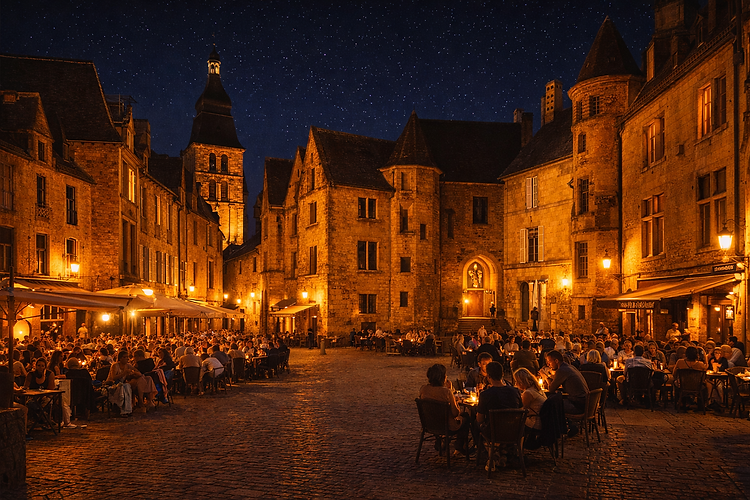
The effervescence of the terraces: Entirely pedestrianized and lined with blond stone facades, the Place de la Liberté comes alive from morning to night to the rhythm of cafe terraces, street artists and summer night markets, embodying the gentle way of life of the Southwest.
Sarlat is the undisputed capital of fine Périgord cuisine. Its twice-weekly markets (Wednesdays and Saturdays) are considered among the most beautiful and gourmet in France.

Périgord's Black Gold: Truffles: During the winter, Sarlat hosts its famous fresh truffle market (Tuber melanosporum). Local truffle growers trade these black diamonds with their captivating aroma, celebrated during the grand Truffle Festival in January.

Foie Gras and Duck with Character: At the tables of traditional inns in the historic center or at producers' stalls, duck and goose reign supreme. People flock there to savor Périgord foie gras, melt-in-your-mouth confit, dried duck breasts, and cracklings, precious testaments to centuries-old farming expertise.

Périgord Walnuts and Cabécou Cheese: Local gastronomy is complemented by Périgord Walnuts (AOP), available as flavored oil or in traditional cakes, and Cabécou, a small, creamy raw milk goat cheese. All of this pairs wonderfully with a glass of wine from the nearby Bergerac, Pécharmant, or Monbazillac appellations.

The Stars of Sarlat, Night Magic and Cinema

As night falls, Sarlat undergoes a second transformation. The spotlights are switched off, giving way to a unique historical gas lighting system, the only one of its kind in France, revealing the dramatic poetry of the stone.

Traditional Gas Lighting: Sarlat is one of the few European cities to have preserved its public gas lighting. The lanterns diffuse a flickering, warm, golden light that highlights the sculpted reliefs of the facades and casts romantic shadows on the cobblestones, creating a magical nighttime stroll.

Sarlat as a Film Location: This preserved lighting and scenery attract the world's greatest directors. From Ridley Scott's The Duellists to Luc Besson's Joan of Arc, and Bertrand Tavernier's The Daughter of d'Artagnan, Sarlat has served as the backdrop for more than 80 historical films, making it the third most popular filming location in France.

The Festival of Theatre Games: Every summer since 1952, medieval squares and the courtyards of private mansions (such as the abbey or the cloister courtyard) are transformed into open-air theatre stages. It is one of the oldest theatre festivals in France, combining live performance with the grandeur of stone.

Conclusion

Sarlat-la-Canéda is a magnificent tourist destination, a masterpiece of preservation and art de vivre that leaves a lasting impression on every traveler. By successfully achieving the remarkable feat of blending the Gothic and Renaissance grandeur of its golden stone palaces with the contemporary audacity of Jean Nouvel, the excellence of its local cuisine, and the theatrical magic of its gaslit nights, this Périgord town stands out as a monument of emotion. Whether one comes to uncover French history along a charming riverside path, savor black truffles on a terrace, or contemplate the sunset from the Saint-Jean bell tower, Sarlat is a luminous, welcoming, and forever unforgettable stop in the heart of the Dordogne.

Sarlat Périgord Noir Tourist Office

Information Regarding Visuals: This website uses computer-generated images and illustrations created by artificial intelligence for atmospheric and stylistic purposes. These representations are not actual photographs and are strictly non-binding.

bottom of page