top of page

Rouen

The history of Rouen is forever linked to the fate of Joan of Arc, who was tried, imprisoned, and executed there in 1431. The city pays her a constant tribute.

The Place du Vieux-Marché: It was on this historic square that the Maid of Orléans was burned at the stake. Today, the contemporary Church of Saint Joan of Arc, with its bold lines evoking flames or upturned ship hulls, stands on the site, housing magnificent Renaissance stained-glass windows.

The Historial Jeanne d'Arc: Housed in the sumptuous Archbishop's Palace, this site offers an immersive multimedia experience. Through projections and dramatized reenactments, visitors relive the historic trial and the heroine's rehabilitation.

The Keep (Joan of Arc Tower): The only intact remnant of the powerful fortified castle built by Philip Augustus in 1204, this massive circular tower is the place where Joan of Arc was threatened with torture before her judges.

Nicknamed by Victor Hugo "the city of a hundred bell towers," Rouen is an open-air history book nestled on the meanders of the Seine. The former capital of the Duchy of Normandy, this thousand-year-old city captivates at first sight with its incredible architectural duality, where the romanticism of half-timbered houses blends seamlessly with the flamboyant virtuosity of Gothic architecture. Marked by the tragic fate of Joan of Arc and celebrated by the brushstrokes of Claude Monet, Rouen exudes a unique atmosphere, at once medieval, maritime, and resolutely vibrant. This detailed guide, in five chapters, invites you to step through the doors of time to explore one of the most precious jewels of French heritage.

The Gros-Horloge and the half-timbered maze

The historic center of Rouen is a pedestrian delight, home to one of the largest collections of medieval houses in Europe.

The Gros-Horloge (Great Clock): An iconic monument of the city, this architectural ensemble consists of a Gothic belfry and a Renaissance arch spanning the street. The 14th-century astronomical clock boasts a magnificent gilded dial that indicates not only the hours, but also the phases of the moon and the days of the week.

Rue de l'Eau-de-Robec: Crossed by a small stream spanned by charming footbridges, this picturesque street with its colorful facades was once home to dyers and cloth merchants. Today, it is a peaceful haven, perfect for a leisurely stroll.

The antiques district (Saint-Maclou): Around the Gothic church of Saint-Maclou unfolds a network of cobbled alleyways lined with half-timbered houses and corbelled structures from the 15th and 16th centuries, housing authentic antique shops and art galleries.

The history of Rouen is forever linked to the fate of Joan of Arc, who was tried, imprisoned, and executed there in 1431. The city pays her a constant tribute.

The Place du Vieux-Marché: It was on this historic square that the Maid of Orléans was burned at the stake. Today, the contemporary Church of Saint Joan of Arc, with its bold lines evoking flames or upturned ship hulls, stands on the site, housing magnificent Renaissance stained-glass windows.

The Historial Jeanne d'Arc: Housed in the sumptuous Archbishop's Palace, this site offers an immersive multimedia experience. Through projections and dramatized reenactments, visitors relive the historic trial and the heroine's rehabilitation.

The Keep (Joan of Arc Tower): The only intact remnant of the powerful fortified castle built by Philip Augustus in 1204, this massive circular tower is the place where Joan of Arc was threatened with torture before her judges.
The history of Rouen is forever linked to the fate of Joan of Arc, who was tried, imprisoned, and executed there in 1431. The city pays her a constant tribute.

The Place du Vieux-Marché: It was on this historic square that the Maid of Orléans was burned at the stake. Today, the contemporary Church of Saint Joan of Arc, with its bold lines evoking flames or upturned ship hulls, stands on the site, housing magnificent Renaissance stained-glass windows.

The Historial Jeanne d'Arc: Housed in the sumptuous Archbishop's Palace, this site offers an immersive multimedia experience. Through projections and dramatized reenactments, visitors relive the historic trial and the heroine's rehabilitation.

The Keep (Joan of Arc Tower): The only intact remnant of the powerful fortified castle built by Philip Augustus in 1204, this massive circular tower is the place where Joan of Arc was threatened with torture before her judges.
The history of Rouen is forever linked to the fate of Joan of Arc, who was tried, imprisoned, and executed there in 1431. The city pays her a constant tribute.

The Place du Vieux-Marché: It was on this historic square that the Maid of Orléans was burned at the stake. Today, the contemporary Church of Saint Joan of Arc, with its bold lines evoking flames or upturned ship hulls, stands on the site, housing magnificent Renaissance stained-glass windows.

The Historial Jeanne d'Arc: Housed in the sumptuous Archbishop's Palace, this site offers an immersive multimedia experience. Through projections and dramatized reenactments, visitors relive the historic trial and the heroine's rehabilitation.

The Keep (Joan of Arc Tower): The only intact remnant of the powerful fortified castle built by Philip Augustus in 1204, this massive circular tower is the place where Joan of Arc was threatened with torture before her judges.

Notre-Dame Cathedral, muse of Impressionism

The history of Rouen is forever linked to the fate of Joan of Arc, who was tried, imprisoned, and executed there in 1431. The city pays her a constant tribute.

The Place du Vieux-Marché: It was on this historic square that the Maid of Orléans was burned at the stake. Today, the contemporary Church of Saint Joan of Arc, with its bold lines evoking flames or upturned ship hulls, stands on the site, housing magnificent Renaissance stained-glass windows.

The Historial Jeanne d'Arc: Housed in the sumptuous Archbishop's Palace, this site offers an immersive multimedia experience. Through projections and dramatized reenactments, visitors relive the historic trial and the heroine's rehabilitation.

The Keep (Joan of Arc Tower): The only intact remnant of the powerful fortified castle built by Philip Augustus in 1204, this massive circular tower is the place where Joan of Arc was threatened with torture before her judges.

Dominating the city with its colossal silhouette, Rouen Cathedral is an absolute masterpiece of Gothic art that has stood the test of time and inspired some of the greatest artists.

The tallest spire in France: Reaching a height of 151 meters, its cast-iron spire (built in the 19th century) makes the cathedral the third tallest church in the world. It forms an unmistakable landmark in the Rouen skyline.

The façade immortalized by Monet: Claude Monet painted no fewer than 30 canvases of this western façade at different times of day, capturing the infinite variations of light on the stone sculpted like lace.

The Tomb of the Kings: Inside the magnificent nave, the ambulatory houses the tombs of the Dukes of Normandy, notably the tomb containing the heart of Richard the Lionheart and the tomb of Rollo, the first Viking founder of Normandy.

The history of Rouen is forever linked to the fate of Joan of Arc, who was tried, imprisoned, and executed there in 1431. The city pays her a constant tribute.

The Place du Vieux-Marché: It was on this historic square that the Maid of Orléans was burned at the stake. Today, the contemporary Church of Saint Joan of Arc, with its bold lines evoking flames or upturned ship hulls, stands on the site, housing magnificent Renaissance stained-glass windows.

The Historial Jeanne d'Arc: Housed in the sumptuous Archbishop's Palace, this site offers an immersive multimedia experience. Through projections and dramatized reenactments, visitors relive the historic trial and the heroine's rehabilitation.

The Keep (Joan of Arc Tower): The only intact remnant of the powerful fortified castle built by Philip Augustus in 1204, this massive circular tower is the place where Joan of Arc was threatened with torture before her judges.

Following in the footsteps of Joan of Arc, the tragic heroine

The history of Rouen is forever linked to the fate of Joan of Arc, who was tried, imprisoned, and executed there in 1431. The city pays her a constant tribute.

The Place du Vieux-Marché: It was on this historic square that the Maid of Orléans was burned at the stake. Today, the contemporary Church of Saint Joan of Arc, with its bold lines evoking flames or upturned ship hulls, stands on the site, housing magnificent Renaissance stained-glass windows.

The Historial Jeanne d'Arc: Housed in the sumptuous Archbishop's Palace, this site offers an immersive multimedia experience. Through projections and dramatized reenactments, visitors relive the historic trial and the heroine's rehabilitation.

The Keep (Joan of Arc Tower): The only intact remnant of the powerful fortified castle built by Philip Augustus in 1204, this massive circular tower is the place where Joan of Arc was threatened with torture before her judges.

The history of Rouen is forever linked to the fate of Joan of Arc, who was tried, imprisoned, and executed there in 1431. The city pays her a constant tribute.

The Place du Vieux-Marché: It was on this historic square that the Maid of Orléans was burned at the stake. Today, the contemporary Church of Saint Joan of Arc, with its bold lines evoking flames or upturned ship hulls, stands on the site, housing magnificent Renaissance stained-glass windows.

The Historial Jeanne d'Arc: Housed in the sumptuous Archbishop's Palace, this site offers an immersive multimedia experience. Through projections and dramatized reenactments, visitors relive the historic trial and the heroine's rehabilitation.

The Keep (Joan of Arc Tower): The only intact remnant of the powerful fortified castle built by Philip Augustus in 1204, this massive circular tower is the place where Joan of Arc was threatened with torture before her judges.

The banks of the Seine - From maritime quays to the painters' panorama

The Charente River brought wealth to Angoulême, but it is the Seine that sets the pulse of Rouen, linking the city to the ocean and opening up bucolic vistas.

The redeveloped Seine quays: Former industrial port areas, the quays on the right and left banks have become vast green spaces, terraces, and converted warehouses transformed into restaurants, perfect for a bike ride or watching the tall ships pass by.

The Panorama from Sainte-Catherine Hill: Located just outside the city, this natural viewpoint offers the most spectacular view of Rouen, its bell towers, and the meanders of the Seine. It was precisely here that Turner and Monet set up their easels to paint the city.

The Museum of Fine Arts: Home to one of the richest collections of paintings in France outside of Paris, this museum is world-renowned for its Impressionist masterpieces (Monet, Renoir, Sisley, Pissarro) which capture the soul and misty atmosphere of the Seine Valley.

The history of Rouen is forever linked to the fate of Joan of Arc, who was tried, imprisoned, and executed there in 1431. The city pays her a constant tribute.

The Place du Vieux-Marché: It was on this historic square that the Maid of Orléans was burned at the stake. Today, the contemporary Church of Saint Joan of Arc, with its bold lines evoking flames or upturned ship hulls, stands on the site, housing magnificent Renaissance stained-glass windows.

The Historial Jeanne d'Arc: Housed in the sumptuous Archbishop's Palace, this site offers an immersive multimedia experience. Through projections and dramatized reenactments, visitors relive the historic trial and the heroine's rehabilitation.

The Keep (Joan of Arc Tower): The only intact remnant of the powerful fortified castle built by Philip Augustus in 1204, this massive circular tower is the place where Joan of Arc was threatened with torture before her judges.

Palace of Justice and Jewels of Flamboyant Gothic

The wealth of Rouen at the end of the Middle Ages gave rise to civil and religious monuments of rare architectural opulence.

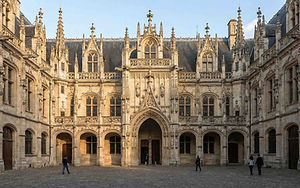
The Palace of Justice: Formerly the seat of the Parliament of Normandy, it is the largest Flamboyant Gothic civil building in France. Its monumental façade, bristling with gargoyles, pinnacles, and sculpted statues, testifies to the city's administrative power.

Saint-Ouen Abbey: Often mistaken for the cathedral due to its immense size, this former Benedictine church impresses with the purity of its Gothic lines and its 14th-century stained-glass windows, forming a veritable wall of glass.

Saint-Maclou Cemetery: This former 16th-century charnel house and cemetery, created during the Great Plague, is organized around a courtyard enclosed by wooden galleries. Its sculpted frameworks with macabre motifs (skulls, bones, gravediggers' tools) make it a unique masterpiece of funerary art in Europe, now converted into an art school.

Conclusion

Rouen is a theatrical and captivating destination that exerts an immediate charm by elevating art, memory, and history to a level of perfect harmony. From the ever-changing reflections of its stone cathedral, immortalized by Impressionism, to the poignant shadows of Joan of Arc's epic story, by way of the convivial atmosphere of its Seine quays and the poetry of its half-timbered alleyways, the Norman capital unfolds an irresistible art of living. A warm, inviting, and luminous city that offers every traveler a veritable open-air history lesson, to the gentle murmur of the royal river.

Rouen Tourist Office

Information Regarding Visuals: This website uses computer-generated images and illustrations created by artificial intelligence for atmospheric and stylistic purposes. These representations are not actual photographs and are strictly non-binding.

bottom of page