
Rocamadour

Suspended between heaven and earth, clinging to a vertiginous limestone cliff that towers 150 meters above the Alzou canyon, the town of Rocamadour is one of the most breathtaking sights in France. Located in the heart of the Causses du Quercy Regional Natural Park, in the Lot department, this medieval gem has been a major pilgrimage site since the 12th century and is a UNESCO World Heritage Site as part of the Routes of Santiago de Compostela. A true defiance of gravity, this vertical village stacks its dwellings, sanctuaries, and castle in a unique spiritual and architectural display. This detailed five-chapter guide invites you to climb the steps of this legendary town, where faith, history, and rock are one.
The Grand Staircase and the challenge of the pilgrims
To ascend to the spiritual heart of the town, one must take Rocamadour's most famous thoroughfare, a passage steeped in history and devotion.
The 216 stone steps: The Grand Staircase connects the lower village to the sanctuary's forecourt. Traditionally, pilgrims climbed these 216 steps on their knees, as a sign of penance and devotion, a practice some still maintain today.
The Fort below: Halfway up, fortified structures frame the steps, offering resting platforms where the sweeping view over the brown-tiled roofs and the Alzou stream is spectacular.
The Hospital Gate: This monumental gateway marks the transition between the secular world of shops and the sacred world of the sanctuaries, welcoming visitors into the religious precinct.


The Courtyard and the Seven Sacred Shrines

Once you reach the top of the stairs, you emerge onto the churchyard, a suspended courtyard surrounded by seven religious buildings carved directly into the rock.
The Chapel of Our Lady and the Black Madonna: The beating heart of Rocamadour. It is here, in this troglodytic chapel, that the famous Black Madonna rests, a 12th-century walnut wood statuette, blackened by time and candle smoke, renowned for its miracles.
The Sword of Durandal: Embedded in the rock just above the door of the Chapel of Our Lady, a heavy chain holds an iron sword. Legend has it that this is Durandal, the magical sword of the knight Roland, Charlemagne's nephew, thrown here to protect it from the Saracens. But it was stolen in 2024 and replaced in 2025.
The Basilica of Saint-Sauveur and the Crypt of Saint-Amadour: A masterpiece of Romanesque-Gothic style, the basilica, built against the cliff, impresses with its sheer size. Just below it lies the Crypt of Saint-Amadour, which housed the incorrupt body of the hermit saint who gave his name to the village.
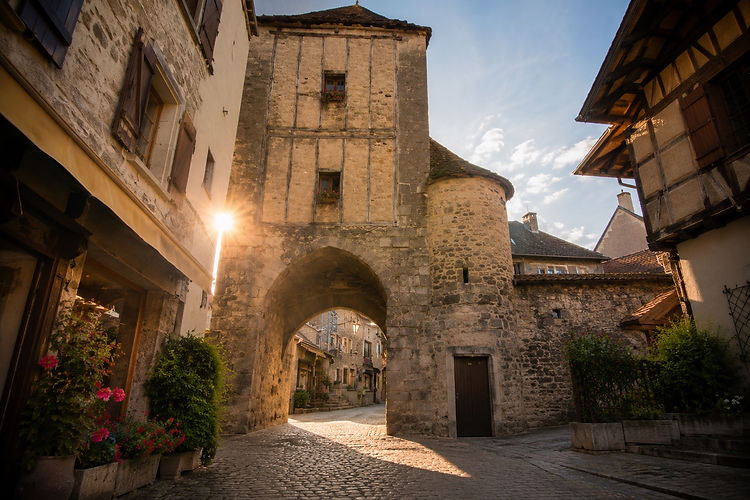
The lower village and the Fig Tree Gate
Exploring Rocamadour begins at the foot of the cliff, where the town's only medieval cobbled street stretches out, once trodden by kings and beggars alike.
The Fig Tree Gate and the Salmon Gate: These imposing fortified limestone gates mark the entrance to the town. They serve as a reminder that Rocamadour, in addition to its religious significance, was a military stronghold designed to withstand raiders.
The Rue de la Couronnerie: Lined with magnificent medieval houses with stone facades, this lively alleyway now houses artisan workshops, inviting terraces, and shops selling regional products, offering breathtaking views as soon as you look up towards the top.
The Maison de la Pomme de Pin (Pine Cone House): One of the oldest houses in the village, remarkable for its typical Quercy architecture, bears witness to the daily lives of the merchants who thrived on the trade generated by the influx of pilgrims.


The Stations of the Cross and the Upper Castle
To reach the cliff's summit, the traveler follows a shaded path that winds along the rock face, leading to the defensive structures.
The Stations of the Cross: Meandering through Mediterranean vegetation clinging to the limestone, this path is marked by 14 sculpted stations. It leads to the monumental Grotto of the Holy Sepulchre.
The Castle Ramparts: Built in the 14th century to protect the sanctuaries, the castle itself is not open to the public, but its ramparts are accessible. Strolling along the rampart walk offers a breathtaking panorama, a bird's-eye view plunging directly down to the sanctuaries below and the vast, wild expanse of the limestone plateau.
The Jerusalem Cross: Located at the edge of the upper plateau, this large monumental cross marks the end of the pilgrim's journey, dominating the Lot landscape as far as the eye can see.
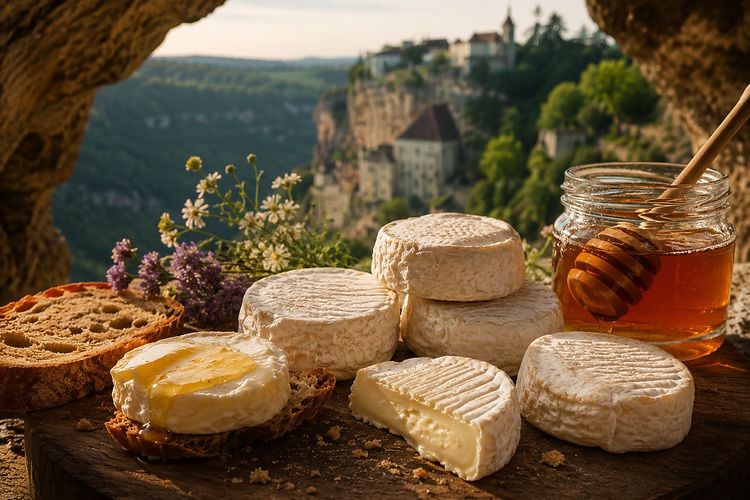
Flavors of Quercy and treasures of the Causse
Rocamadour is also a land of generous local produce, shaped by the pastoral landscapes that surround it.
Rocamadour PDO Cheese: This small, round, raw-milk goat cheese is a marvel of creaminess and sweetness. Matured in the limestone caves of the Causse region, it is best enjoyed creamy, sometimes warm on a slice of country bread with a drizzle of local honey.
The Cave of Wonders: Located on the upper plateau of L'Hospitalet, this decorated prehistoric cave houses genuine cave paintings dating back more than 20,000 years (negative handprints, animal drawings) as well as superb natural concretions.
The Eagles' Rock: In the immediate vicinity of the castle, this eco-park features a free-flight show of birds of prey and parrots, committed to the conservation of these species, offering a fascinating nature break for young and old alike.
Conclusion
Visiting Rocamadour is to experience a rare aesthetic and emotional shock. Whether approached from the bottom of the canyon or discovered from the Hospitalet viewpoint at nightfall, when spotlights illuminate its white stone, the town seems to defy the laws of physics. By uniting the raw verticality of its cliff with the age-old fervor of its sculpted stones, Rocamadour remains forever etched in the minds of travelers as the ultimate symbol of medieval genius and the wild beauty of Occitania.
Dordogne Valley Tourist Office - Rocamadour
Information Regarding Visuals: This website uses computer-generated images and illustrations created by artificial intelligence for atmospheric and stylistic purposes. These representations are not actual photographs and are strictly non-binding.