
Polignac

Majestically perched atop an impressive basalt plateau near Le Puy-en-Velay in the Haute-Loire region, Polignac is a masterpiece of nature and medieval history. Classified as one of the Most Beautiful Villages of France, this picturesque village developed at the foot of a fortress reputed to be impregnable, seemingly rising from a unique volcanic landscape. The ancestral home of the illustrious and powerful Polignac family, the village offers a captivating glimpse into the Velay region of yesteryear, blending the ruggedness of the lava stone with the gentle beauty of an unspoiled countryside.
The Fortress of Polignac, a Giant on its Rock
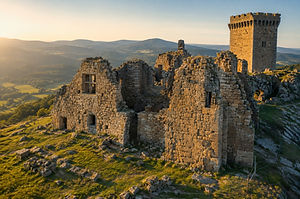
An unmissable landmark that defines the village's skyline, the medieval fortress occupies a vast volcanic plateau encircled by sheer cliffs 60 meters high.
A Formidable Defensive System: Access to the fortress is a reward in itself, revealed via a fascinating route. To reach the summit, visitors once had to ascend a spiral ramp punctuated by three lines of ramparts and six successive fortified gates, designed to deter even the most audacious attackers.
The Main Keep (1385-1421): Built during the Hundred Years' War, this rectangular keep of dark stone rises to a height of 32 meters. A true symbol of the viscounts' power, it houses five residential levels with fireplaces and culminates in a rooftop terrace offering a 360-degree view of the Puy basin.
The Manor House Remains and the Viscount's House: Spread across a three-hectare site are the romantic ruins of the 12th-century manor house, remodeled during the Renaissance, as well as the Viscount's House, the last Gothic-style building erected by the family.
The Lords' Cemetery and its Chapel: Built in the 11th century, the castle chapel stands alongside an unusual cemetery composed of about fifteen anthropomorphic tombs carved directly into the volcanic rock.


The Lower Courtyard and the Secrets of Self-Sufficiency of the Castle

Life on the platform wasn't limited to feats of arms; the fortress was designed as a veritable small town, capable of housing a thousand people in complete self-sufficiency.
The Lower Courtyard and the Medieval Garden: A refuge for the villagers in case of attack, the lower courtyard now houses a magnificent medieval-inspired garden where aromatic plants, medicinal herbs, and heirloom vegetables flourish.
The Well of the Abyss and the Oracle's Well: To supply itself with water, the site boasts colossal hydraulic systems: the "Well of the Abyss," drilled to a record depth of 83.5 meters, and the "Well of the Oracle," an immense vaulted cistern with a capacity of 200,000 liters where, according to legend, divine voices could be heard.
The Old Artisans' Workshops: At the southern end, we discover the daily life infrastructure essential to the garrison: the remains of a forge, an arms workshop, a large bread oven and kitchens, completing the profile of an autonomous city.

Saint-Martin Church and the Historic Village
Nestled at the foot of the basalt cliffs lies the village of Polignac, a maze of narrow streets with a well-preserved architectural heritage.
The Romanesque Church of Saint-Martin: A true masterpiece of local Romanesque art, this church impresses with the elegance of its proportions. The chancel houses remarkable 12th-century polychrome frescoes as well as a magnificent 13th-century statue of Saint Anne bathed in soft light.
The "Charrirous" Trail: This themed walking route invites you to stroll through the village's narrow streets. With the help of maps or smartphones, you can discover the local heritage: ancient fountains, sculpted crosses, and old communal bread ovens made of lava stone.
The Village's Artisans: Tradition and creativity still thrive in the heart of the village. At the foot of the fortress, pottery workshops shape stoneware while artisanal soap factories offer natural products inspired by the flora of Auvergne.


Hiking and Geology in Volcanic Landscapes
Polignac is nestled in the heart of an exceptional geological environment, marked by the volcanic activity of the Velay region and ideal for ecotourism.
The Rocher de Flayac: Located near the village, this basalt dome is a favorite spot for photographers. At sunset, its summit offers a breathtaking panoramic view of the village and the fortress bathed in a splendid golden light.
The Sentiers des Sucs et des Gardes (Trails of the Sucs and the Guards): Several marked hiking trails radiate out from the twenty hamlets of the commune. They wind through a landscape of "sucs" (dome-shaped volcanoes without craters) typical of the Haute-Loire region, offering a breath of fresh air amidst the pastures.
Lava Stone in the Landscape: Hiking in Polignac reveals the omnipresence of volcanic rock, used for centuries in the construction of field walls ("chibottes") and the architecture of traditional farmhouses.

The Surroundings: Between Pilgrimage and Wonders of the Haute-Loire
Ideally located, Polignac is the perfect starting point for exploring the major sites of the Velay and Haute-Loire regions.
Le Puy-en-Velay (5 km): This famous Marian city, the historic starting point of the Way of St. James (Camino de Santiago), boasts one of the most beautiful panoramas in France. Visitors can explore its UNESCO-listed Notre-Dame Cathedral, the volcanic spire of the Saint-Michel d'Aiguilhe Chapel, and the monumental statue of Our Lady of France.
Château de la Rochelambert (9 km): Carved directly into a black basalt cliff, this fairytale castle seems to hang suspended above its river, housing rich private collections of Romanesque and Gothic art.
The Natural Treasures of the Region: Within twenty kilometers, nature becomes magnificent with the Beaume waterfall hidden in the woods, the spectacular multicolored clay canyon of the Corboeuf Ravine, or the wild banks of the nascent Loire.
Conclusion
Polignac is a distinctive stopover that captivates with the raw power of its heritage and the splendor of its natural setting. Dominated by its proud fortified castle, whose lords King Francis I dubbed the "Kings of the Mountains," this "Most Beautiful Village of France" offers a perfect balance between the emotion of medieval history and the poetic beauty of the Auvergne's volcanic landscapes. Whether one comes to climb the steps of its vertiginous keep, contemplate the frescoes in its church, or admire the silhouette of the rock at dusk, Polignac leaves a mystical, authentic, and truly unforgettable impression on the traveler.
Polignac Fortress (Local Tourist Information Center)
Information Regarding Visuals: This website uses computer-generated images and illustrations created by artificial intelligence for atmospheric and stylistic purposes. These representations are not actual photographs and are strictly non-binding.