
Perpignan

The former mainland capital of the Kingdom of Majorca in the 13th century, Perpignan is a vibrant city that pulsates with its dual identity. Nicknamed "The Catalan," this City of Art and History, nestled in the Pyrénées-Orientales department, bridges the majestic ruggedness of the Pyrenees and the gentle warmth of the Mediterranean Sea. Under the watchful gaze of Mount Canigou, Perpignan captivates visitors with its narrow streets lined with ochre and pink facades, its Gothic brick monuments, and its palm-shaded squares. A sun-drenched destination where Iberian spirit meets French elegance.
The Castillet, Sentinel of the City and Catalan Symbol
The Castillet, the former main gate of the now-vanished ramparts, is the beating heart of Perpignan life and the guardian of local identity.
A Pink Brick Fortress: Built in the 14th century under Aragonese rule and later enlarged by Louis XI, this fortified monument is striking for its vibrant red color, achieved through the exclusive use of brick (known locally as "cayrou"). Its crenellated lines and turret make it a veritable urban fairytale castle.
The Casa Pairal Museum: Housed within the building (which once served as a prison), this museum is dedicated to the folk arts and traditions of Roussillon. Visitors can discover collections of traditional costumes, antique tools, and religious objects related to local processions.
The Flame of Canigou: It is at the summit of the Castillet that the flame shines which is used to light the great bonfires of Saint John on June 23, a major Catalan festival which brings together thousands of people at the foot of the ramparts for traditional dances (the sardana).


The Palace of the Kings of Majorca, the Medieval Jewel

Dominating the city from the Puig del Rei hill, this 13th-century palace-fortress is the most emblematic monument of Perpignan's historical grandeur.
Unique Gothic Architecture: Built to house the court of King James II of Majorca, this monumental edifice perfectly blends the southern Gothic style with Arab and Hispanic architectural influences. Its massive walls of river pebbles and brick conceal a palace of great refinement.
The Courtyard of Honor and the Superimposed Chapels: The large inner courtyard, surrounded by arcaded galleries, leads to the royal apartments and two magnificent superimposed chapels (Holy Cross and Holy Magdalene) adorned with intricate carvings and medieval frescoes.
The Panorama over the Plain and the Canigou: From the high tower of the Homage or the hanging gardens that surround the fortress, visitors enjoy a spectacular 360-degree view encompassing the roofs of Perpignan, the Roussillon plain and the snowy silhouette of the Canigou.

The Cathedral of Saint-Jean-Baptiste and Campo Santo
The religious quarter of Perpignan is home to a Gothic architectural ensemble of exceptional spiritual and artistic richness.
The Cathedral's Single Nave: Begun in the 14th century, Saint John the Baptist Cathedral is striking for the dimensions of its single nave, typical of southern Gothic architecture, which creates an impression of immense space. The interior houses sumptuous carved wooden altarpieces and a monumental 16th-century suspended organ.
The Devout Christ: In an adjoining chapel, visitors flock to admire the "Devoted Christ" (14th century), a strikingly realistic and poignant wooden sculpture, considered one of the finest masterpieces of medieval European sacred art.
The Campo Santo (Cloister-Cemetery): Unique in France for its size, this vast 14th-century funerary cloister is bordered by large Gothic arcades of white marble. Now restored, this magical and solemn place hosts major cultural events and open-air concerts during the summer.

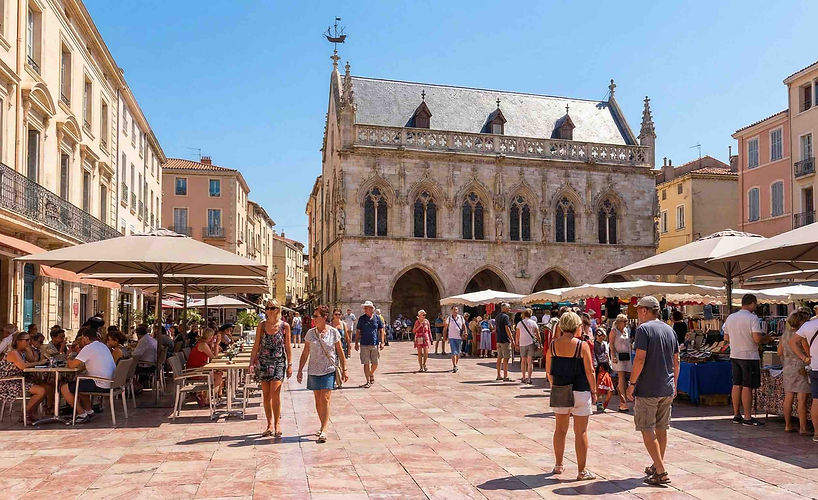
The Sea Lodge and the Historic Baroque Heart
The Place de la Loge and the surrounding alleyways form the heart of Perpignan, a testament to its past commercial prosperity.
The Loge de Mar (Llotja de Mar): This magnificent 14th-century Flamboyant Gothic building housed the maritime commercial court. Its façade is adorned with sculpted windows and a weathervane in the shape of a ship. Right next door stand the Town Hall and the Palace of the Provincial Council, forming a splendid architectural alignment.
The Labyrinth of Colorful Alleyways: Strolling along Rue de l'Ange or Rue Paratilla (the Spice Street), you'll be immersed in a Mediterranean atmosphere. The façades painted in warm colors (saffron yellow, ochre red), the wrought-iron balconies, and the artisan shops evoke the atmosphere of Barcelona or Girona.
The Hôtel de Pams: This sumptuous 19th-century mansion, located near the Saint-Jacques church, illustrates the opulence of Perpignan's industrial bourgeoisie. Its state rooms, monumental paintings, and patio planted with palm trees and exotic plants are of rare elegance.

Flavors, Sweet Wines and the Roussillon Art of Living
Perpignan is also a culinary experience, thanks to its bountiful terroir that showcases the bounty of the sea, the land, and its prestigious vineyards.
Catalan Gastronomy: Perpignan's restaurants celebrate the marriage of land and sea. Here you can savor boles de picolat (meatballs in a sauce with olives and porcini mushrooms), escalivada (sun-dried vegetables roasted in the oven), ollada (a local stew), and of course, anchovies from nearby Collioure.
Wines of Roussillon: Surrounded by vineyards swept by the Tramontane wind, Perpignan is a showcase for the great local appellation wines (Côtes du Roussillon, Collioure). It is especially famous for its legendary fortified wines such as Banyuls, Maury, and Muscat de Rivesaltes.
The Garnet of Perpignan: The city possesses a unique jewelry-making expertise dating back to the 18th century. The Garnet of Perpignan, a deep red stone set in gold using a specific "paillon" technique, is the traditional jewel of the region, protected by a Protected Geographical Indication.
Conclusion
In conclusion, Perpignan is an enchanting stopover that warms the heart and soul. Far from standardized metropolises, this Catalan city has preserved its proud character, the poetry of its pink brick buildings, and the conviviality of its large, shaded squares. Whether you come to step back in time amidst the Gothic splendor of the Palace of the Kings of Majorca, to experience the excitement of the Visa pour l'Image international photojournalism festival, or to savor a glass of Muscat on a terrace at the foot of the Castillet, Perpignan offers a complete sensory journey, intensely warm and unforgettable.
Perpignan Tourist Office
Information Regarding Visuals: This website uses computer-generated images and illustrations created by artificial intelligence for atmospheric and stylistic purposes. These representations are not actual photographs and are strictly non-binding.