
Orléans

Bordered by the majestic meanders of France's longest river, Orléans is a royal city with a national destiny. Capital of the Centre-Val de Loire region, located just an hour from Paris, this City of Art and History has embarked on a spectacular transformation to reveal the full beauty of its heritage. Inextricably linked to the epic story of Joan of Arc, Orléans captivates visitors with the elegance of its Renaissance architecture, the gentle charm of its Loire riverbanks, and the vibrancy of its cultural life. It is the ideal gateway for exploring the famous Loire Valley châteaux.
The Cathedral of the Holy Cross, a Gothic and Royal Masterpiece
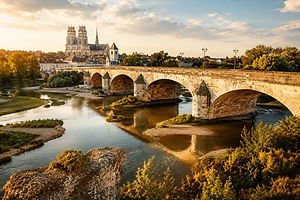
Proudly dominating the Orléans skyline, Sainte-Croix Cathedral is a monument of exceptional stature, its history intimately linked to the kings of France and the city's golden age.
A Monumental Reconstruction: Largely destroyed by the Huguenots in 1568 during the Wars of Religion, it was rebuilt starting in 1601 thanks to the vision of Henry IV and his successors. It is one of the rare examples of a great Gothic cathedral built during the Classical period.
The Chiseled Towers and Crowns: Its western façade is striking for its two towers, reaching a height of 82 meters, crowned with incredibly delicate and refined openwork stone crowns.
The Epic of Joan of Arc in Stained Glass: Inside, the nave houses a splendid series of 19th-century stained-glass windows. They tell the story of Joan of Arc's life in a luminous and colorful way, from the voices of Domrémy to her burning at the stake in Rouen, including the liberation of the city.
The Aristide Cavaillé-Coll Grand Organ: This exceptional instrument, a listed historical monument, regularly resonates during concerts and recitals, filling the cathedral's vaults with a rare and powerful acoustic.


The Historic Centre, the Splendor of the Renaissance

Orléans boasts one of the largest protected historical areas in France. Its cobbled streets, entirely pedestrianized, reveal treasures of brick and stone civil architecture.
The Town Hall (Hôtel de Groslot): This magnificent palace of red brick and black diamonds, built in the 16th century, is a jewel of the Renaissance. It has hosted illustrious kings of France, including Francis II (who died there in the presence of his mother, Catherine de Medici). A free visit to the richly decorated state rooms and its wooded park is a must.
Half-Timbered Architecture: Strolling through the Charpenterie district or along Rue de la Poterne, you'll discover hundreds of medieval half-timbered houses painted in warm colors, meticulously restored over the past few decades.
Renaissance Mansions: Tucked away on Rue Royale or Rue de la Bretonnerie, magnificent courtyards conceal buildings with sculpted facades, blending Italian influences with the Loire Valley tradition.
The Museum of Fine Arts: Located a stone's throw from the cathedral, it is one of the richest provincial museums. Its collections span the 15th to the 20th centuries, with a pastel collection unique in the world (second only to the Louvre) and masterpieces by Veronese, Boucher, and Gauguin.

The Quays of the Loire, the Great River Port of Yesteryear
In the 18th century, Orléans was the main port supplying Paris via the Loire River and its canals. Today, the riverbanks have regained their vibrancy and their role as leisure destinations.
The Redeveloped Quays: The former unloading quays (Quai du Châtelet, Quai de la Poterne) are now a popular spot for walkers, cyclists on the "Loire à Vélo" route, and outdoor cafés during the warmer months.
The Loire River Boats and the Place de Loire: Replicas of traditional flat-bottomed boats (toues, barges, futreaux) are moored along the banks, maintained by associations of enthusiasts who keep the art of river navigation alive.
The Loire Festival: This is the largest gathering of riverboats in Europe. Every two years in September, Orléans welcomes over 200 traditional boats, hundreds of boatmen, demonstrations of boat handling, concerts, and food stalls celebrating river culture.
The Bridges of Orléans: The Pont Royal (Pont George V), built in the 18th century, offers a majestic view of the city's riverfront, while the ultra-modern Pont de l'Europe, designed by architect Santiago Calatrava, adds a touch of contemporary boldness to the west of the city.


Nature, Exceptional Parks and Orléans Delicacies
Orléans knows how to be green and gentle, offering magnificent spaces for natural escape and local specialties with a strong character.
The Parc Floral de la Source: Located south of the city, this park, designated a "Remarkable Garden," covers 35 hectares. It is here that the important Loiret River has its source (a resurgence of the Loire) amidst a tropical butterfly aviary, a magnificent rose garden, and enclosures housing pink flamingos.
Orléans Vinegar and Mustard: Thanks to its river tradition and the wines that spoiled during transport by boat to Paris, Orléans became the historical capital of wine vinegar. The Martin-Pouret company has been perpetuating this ancestral know-how since 1797, also producing a fine and flavorful Orléans mustard.
Sweet Treats: Those with a sweet tooth will adore the Cotignacs d'Orléans (a firm quince jelly presented in small spruce bark boxes), the Fruit Macarons of Orléans, or the chocolates shaped like the cobblestones of Place du Martroi.
Wines of the Orléans Region: The hillsides bordering the river produce Appellation d'Origine Contrôlée (AOC) wines (Orléans and Orléans-Cléry), notably white wines made from the Chardonnay grape and fruity red wines made from Pinot Meunier.

Following in the Footsteps of Joan of Arc, the Heroine of the City
In May 1429, Joan of Arc liberated Orléans from the English siege, changing the course of the Hundred Years' War. Nearly six centuries later, the spirit of the saintly warrior infuses the city with a unique poetry.
Place du Martroi: This is the beating heart and rallying point of Orléans. At its center stands the monumental bronze equestrian statue of Joan of Arc, created by the sculptor Denis Foyatier in the 19th century, proudly overlooking the surrounding café terraces.
The House of Joan of Arc: This charming half-timbered and brick building is a reconstruction of the house of Jacques Boucher, treasurer to the Duke of Orléans, where Joan stayed during the liberation of the city. Today, it houses a modern museum space dedicated to her life and legend.
Rue Jeanne d’Arc: Created in the 19th century, this grand, straight thoroughfare offers a regal and theatrical vista leading directly to the cathedral's façade. Its uniform neoclassical facades are adorned with colorful banners during celebrations.
The Joan of Arc Festival: Listed in the inventory of France's intangible cultural heritage, these traditional festivals have taken place every year from April 29 to May 8 since 1432. Military and civilian parades, medieval markets, and sound and light shows transform Orléans into an unforgettable celebration.
Conclusion
Orléans is a royal metropolis that has reinvented its way of life without sacrificing any of its historical grandeur. By blending the panache of Joan of Arc's epic story with the gentle lines of its restored Loire riverbanks, this city on the Loire offers a balanced and profoundly captivating experience. Whether you come to admire the intricate stonework of its cathedral, stroll through the colorful streets of its Renaissance heart, or embark on a spiritual journey along its untamed river, Orléans stands out as a major cultural, green, and gastronomic destination in the heart of the Loire Valley.
Orléans Val de Loire Tourism - Orléans Métropole Tourist Office
Information Regarding Visuals: This website uses computer-generated images and illustrations created by artificial intelligence for atmospheric and stylistic purposes. These representations are not actual photographs and are strictly non-binding.