
Oradour-sur-Glane

Located in Haute-Vienne, in the heart of Nouvelle-Aquitaine, Oradour-sur-Glane is the largest sanctuary of collective memory in France. On June 10, 1944, this peaceful village in the Limousin region was completely destroyed by a unit of the SS Das Reich division, which methodically massacred 643 men, women, and children. Preserved frozen in time by order of General de Gaulle, the Martyr Village now stands opposite the new town and the Memorial Center like an open-air history book, delivering a universal message of peace, tolerance, and vigilance.
The Memory Centre — The Historical Introduction
Exploring the site inevitably begins with this contemporary cultural and historical center, which lays the necessary groundwork for understanding the tragedy.
The architecture of rupture: Designed by architect Yves Devraine, the building blends seamlessly into the Limousin countryside. Blades of rusted steel cleave the limestone soil, symbolizing the brutal fracture of history and the violence of war.
The permanent museum exhibit: Through five thematic spaces, the exhibition retraces the events of the Second World War, from the rise of Nazism to the occupying forces' policy of terror in France. It highlights the carefree daily lives of Oradour's inhabitants before the tragedy.
The preservation of the archives: The center houses poignant testimonies, period documents, and photographs. Putting a face to the names of the victims restores their dignity as men, women, and children.


Entering the Martyr Village — The Seizing of Suspended Time
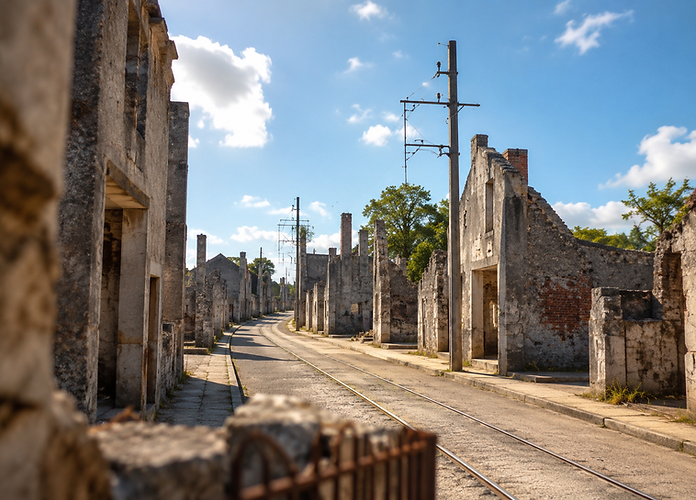
Upon entering the tunnel leading to the ruins, visitors are greeted by a universal injunction engraved in stone: "REMEMBER." The journey unfolds in solemn silence.
The tracks of the former departmental tramway: The rails and twisted metal lines of the tramway that once connected Oradour to Limoges still run along the main street. Suspended in mid-air, they accentuate the striking sensation of time standing still on June 10, 1944.
The rusted iron skeletons: Several vintage car carcasses (notably the famous Peugeot 202 belonging to the village doctor, still parked in the middle of the market square) bear witness to the suddenness of the German attack.
The shop and artisan signs: The charred facades of the bakery, the garage, the cafes, the schools, and the hardware store are still visible. These ruins serve as a reminder that Oradour was once a particularly vibrant, lively, and welcoming rural village.

The spaces of martyrdom — The barns and the church
The marked path through the ruins leads to the various execution sites where the population, initially gathered in the fairground, was separated and massacred.
The men's execution barns: The men were divided among six places of worship and storage (such as the Laudy barn or the Desourteaux garage). The SS shot them there before covering their bodies with straw and burning them. Commemorative plaques now mark each of these locations.
Saint Martin's Church (The Sanctuary for Women and Children): This is the most harrowing place on the tour. Women and children were imprisoned here. Soldiers detonated a crate of poison gas before machine-gunning the survivors and setting the building on fire. Only Marguerite Rouffanche managed to escape through a window in the chancel.
The melted bell: Inside the nave of the ruined church, the bronze bell, crushed to the ground and deformed by the intense heat of the fire, remained frozen in its fall, an immutable witness to the fury of the flames.


The cemetery and memorial for personal belongings
Located at the edge of the original village, the municipal cemetery is the focal point of remembrance, housing the graves and relics of the tragedy.
The Martyrs' Tomb: This central funerary monument holds the remains of victims whose bodies could not be individually identified due to their charring. Official delegations and families gather here to pay their respects.
Display Cases of Charred Memories: Near the memorial, display cases exhibit hundreds of small objects recovered from the ashes: watches that stopped at the time of the massacre, wedding rings, eyeglasses, school satchels, scissors, and melted coins. These everyday objects make the tragedy profoundly tangible and human.
The Wall of Names: A massive stone stele lists all 643 names of the victims, engraved for eternity so that the memory of each individual will never fade.

The New Oradour — The Triumph of Life and Peace
Leaving the historical site, visitors discover the new village of Oradour-sur-Glane, rebuilt immediately after the war just a few hundred meters from the ruins.
The Architecture of Reconstruction: Designed by urban planner Charles Dorian, the new village boasts a simple, orderly, and airy architecture typical of the 1950s. It symbolizes resilience and the strength of life reclaiming its place.
The New Church and its Stained-Glass Windows: This modern building features contemporary stained-glass windows bathed in a soft light, focused on hope, and regularly displays messages of international solidarity.
The Glane Valley: The Glane River continues to flow peacefully along the edge of the two villages. This verdant and shaded natural setting offers a welcome respite of serenity, essential for calming the mind after the intense emotional impact of the visit.
Conclusion
A visit to Oradour-sur-Glane is not a traditional tourist trip; it is a civic act, a necessary and profoundly moving pilgrimage of remembrance. By preserving the striking silence of its ruins and combining it with the historical rigor of its Memorial Center, Oradour transcends the horror of the past to speak to the present. This Limousin sanctuary delivers to each generation a universal and essential message of peace, tolerance, and fraternity, reminding us of the fragility of freedom and the need to protect it.
Limousin Intercommunal Tourist Office
Information Regarding Visuals: This website uses computer-generated images and illustrations created by artificial intelligence for atmospheric and stylistic purposes. These representations are not actual photographs and are strictly non-binding.