
Nîmes

Nicknamed "the French Rome," Nîmes is a magnificent metropolis in the Gard department, ideally located in the Occitanie region, between the Camargue and the Cévennes mountains. With over two millennia of history, the city owes its splendor to Emperor Augustus, who made it one of the most opulent colonies of the Roman Empire. From this golden age, Nîmes has preserved ancient monuments of unparalleled freshness, listed as a UNESCO World Heritage Site. The historical birthplace of denim, the city now pulsates with the rhythm of its festive festivals, its hidden parks, and its distinctly Mediterranean way of life.
The Colossi of Antiquity — Major Roman Monuments
Nîmes boasts some of the best-preserved Roman monuments in the world, spectacularly integrated into the modern urban fabric.
The Arena of Nîmes: This Roman amphitheater, dating from the late 1st century, is a marvel of architectural perfection. Its two levels, each with 60 arcades, could accommodate 24,000 spectators who came to watch gladiatorial combats. Today, it still serves as a memorable setting for concerts, large-scale historical reenactments, and festivals.
The Maison Carrée: The only fully preserved temple from the ancient world, this neoclassical gem of rare elegance was built to glorify the grandsons of Emperor Augustus. Its perfect proportions and Corinthian colonnade earned it official inscription as a UNESCO World Heritage Site.
The Tour Magne: Perched atop Mont Cavalier hill, this octagonal tower is the tallest remaining vestige of the ancient Roman city walls of Augustus. After climbing its interior stairs, you reach a panoramic terrace which offers a breathtaking view over the entire Nîmes plain.


The Fountain Gardens — The romantic and aquatic oasis
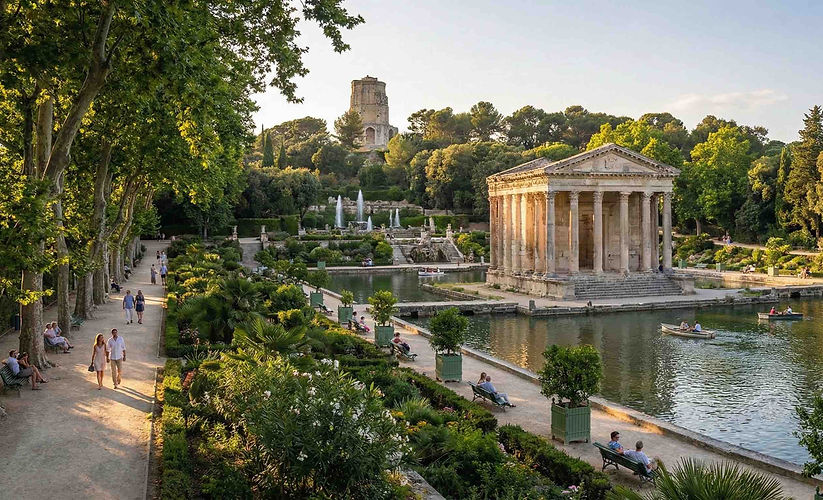
Created in the 18th century around the city's original spring (the Nemausus spring), these gardens are considered among the most beautiful parks in Europe.
Classical urban planning and canals: Designed by the king's engineer, Jacques-Philippe Mareschal, the gardens are organized around a double network of canals, stone balustrades, monumental vases, and mythological statues, blending the formality of French gardens with Provençal charm.
The Temple of Diana: Hidden beneath the greenery of the gardens, this enigmatic and romantic Roman monument, with its collapsed barrel vaults, likely served as a library or sanctuary linked to the cult of the spring.
The ascent of Mount Cavalier: Climbing the steep paths lined with umbrella pines, oleanders, and holm oaks, the formal garden transforms into a picturesque English-style park that leads to the foot of the Tour Magne.

The Museum of Roman Civilization — The Contemporary Mirror
Facing the Arena, this internationally renowned museum is a marvel of contemporary architecture designed by Elizabeth de Portzamparc.
Architecture draped in glass: The museum's façade, composed of thousands of translucent glass panels, evokes the folds of a Roman toga or the weave of a fabric, creating a striking visual dialogue with the two-thousand-year-old stone of the amphitheater.
An exceptional archaeological collection: Thanks to cutting-edge interactive and digital displays, the museum presents more than 5,000 archaeological artifacts, including mosaics of rare finesse (such as the Pentheus Mosaic), statues, and everyday objects from the Gauls and Romans.
The green roof terrace: The museum's summit features a 360-degree panoramic roof garden, offering views of the Arena and the rooftops of the old city in the shade of fragrant Mediterranean vegetation.


The Ecusson — Secret alleyways and private mansions
The historic center of Nîmes, known as "l'Écusson" (the Shield) because of its shield shape, invites you to a charming stroll.
Shaded squares and fountains: The center is organized around charming little squares such as the Place de l'Horloge (Clock Square) or the Place du Chapitre (Chapter Square) with its refreshing fountain. Don't miss the Place du Marché (Market Square), adorned with its crocodile fountain; the reptile chained to a palm tree has been the symbol of the city since Roman times (recalling Augustus' victory in Egypt).
The courtyards of the private mansions: Behind heavy, carved wooden carriage gates lie sumptuous 17th- and 18th-century residences (such as the Hôtel de Régis or the Hôtel de Fontfroide). Their courtyards conceal monumental staircases with openwork stone balustrades.
The textile past and the saga of denim: Nîmes has a long tradition of textile spinning. It was here that the famous "Nîmes serge" was created, a robust cotton fabric exported to the United States in the 19th century by Levi Strauss to make the first jeans, becoming the world-renowned Denim (De Nîmes). The Musée du Vieux Nîmes (Museum of Old Nîmes) beautifully recounts this industrial saga.
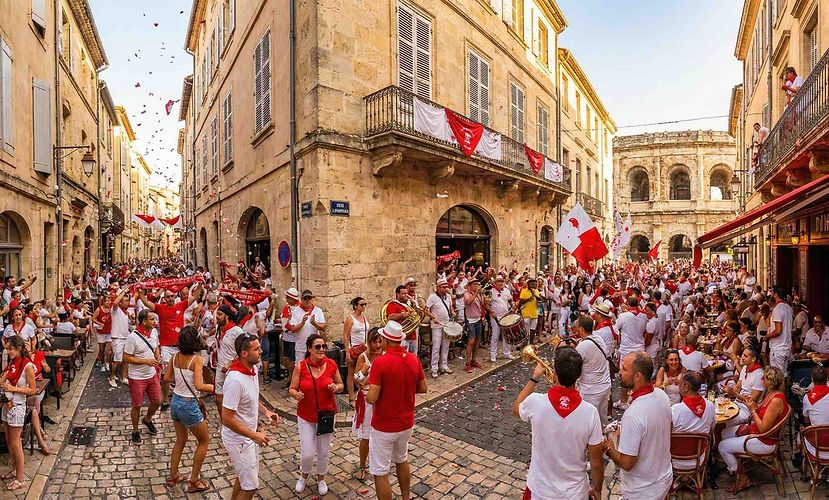
Gard flavours and Feria traditions
Nîmes celebrates a vibrant festive culture, strongly influenced by its proximity to the Camargue and Spain, which is reflected in its cuisine and street life.
The Nîmes Market Hall: This large covered market is the city's culinary heart. People come in the morning to buy the famous Brandade de Nîmes (a delicate emulsion of desalted cod, olive oil, and milk), small Nîmes-style pâtés, crisp Picholine olives, and Pélardon goat cheese from the Cévennes.
Camargue bull and gardiane stew: The proximity of the vast Camargue landscape influences local cuisine, where gardiane de taureau (a stew of bull meat marinated in red wine and black olives) takes center stage, served with Camargue red rice.
The excitement of the Ferias: Twice a year (at Pentecost and in September), Nîmes transforms for its Feria. The city comes alive with traditional music (peñas), bull runs through the streets (abrivados), and grand festive banquets in the pop-up bodegas that stay open until the early hours.
Costières de Nîmes wines: This vineyard, situated on terraces of rounded pebbles, produces characterful AOC wines, fruity and spicy reds and rosés, perfect companions to Mediterranean meals.
Conclusion
Nîmes is a vibrant and theatrical destination that captivates with its ability to bring millennia into dialogue. Far from resting on the sacred stones of its Maison Carrée or the splendor of its Roman Arena, this city in the Gard region pulsates with constant creativity, magnificently showcased by the modern architecture of its Museum of Romanity. Whether you choose to come for a romantic interlude by the gentle murmur of the canals in the Jardins de la Fontaine, to hunt for the crocodile symbol in a winding alley of the Écusson district, or to share the conviviality of a brandade de morue (salt cod purée) on a Feria morning, Nîmes stands out as an absolutely essential cultural, human, and sun-drenched stopover in the heart of the South of France.
Nîmes Tourist Office
Information Regarding Visuals: This website uses computer-generated images and illustrations created by artificial intelligence for atmospheric and stylistic purposes. These representations are not actual photographs and are strictly non-binding.