
Epinal
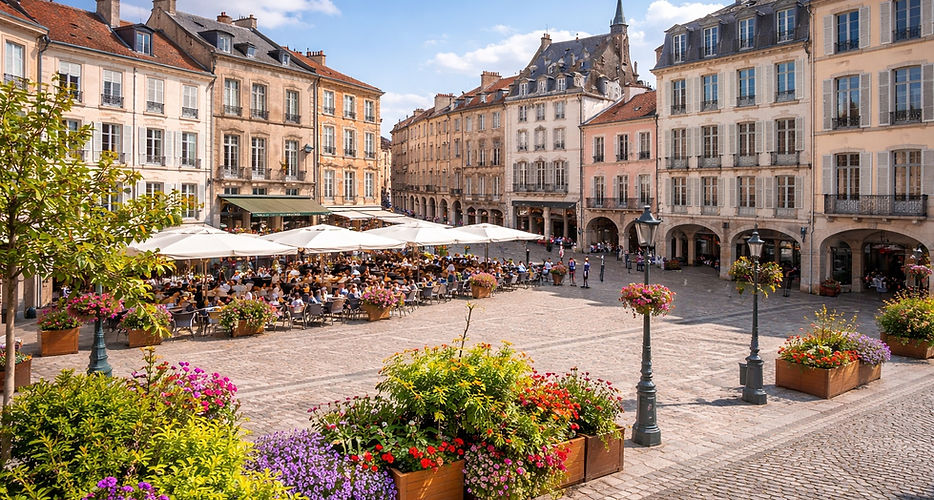
Nestled in the heart of the Moselle Valley and bordered by the vast Vosges forest, Épinal, the capital of the Vosges department in the Grand Est region, is a city of surprising charm and tranquility. World-renowned for its iconic "Images d'Épinal" (Epinal prints) that have captivated the imaginations of generations, the city is a Green Capital that perfectly blends a rich historical heritage, vibrant artistic creativity, and an exceptional natural environment. Between its medieval fortifications, its major museums, its lively marina, and its forested landscapes, Épinal offers a most appealing cultural and rejuvenating escape.
Old Épinal and its historical heritage
Épinal boasts a picturesque historic center centered around the Moselle River. Its squares and monuments tell the story of a once prosperous fortified city.
Place des Vosges: This is the historic heart of the city. This magnificent cobbled square is lined with 16th- and 17th-century arcaded houses, showcasing Renaissance and Classical architectural styles. The most remarkable is the Bailiff's House (1604), with its exquisitely sculpted details.
Saint-Maurice Basilica: Built between the 11th and 13th centuries, this basilica harmoniously blends Romanesque and Gothic styles. Its massive bell tower-porch is impressive, while its interior houses a superb, light-filled choir and a monumental sculpture of the Entombment.
The Chapter Quarter: This medieval haven of peace is home to magnificent canonical houses where the city's canonesses once resided. The colorful facades and surrounding cobbled alleyways offer an intimate, timeless atmosphere.


The City of Images and the legacy of imagery

It's impossible to talk about Épinal without mentioning its incredible graphic heritage, which originated in the 18th century and has been passionately preserved to this day.
The Épinal Imagery House (Pellerin Foundry): Founded in 1796 by Jean-Charles Pellerin, this historic factory, still in operation, keeps alive the ancestral know-how of printing popular images. A tour of the workshops allows visitors to discover the authentic printing presses of the period and the stencil coloring techniques.
The Museum of Images: Located directly opposite the factory, this modern museum houses one of the world's largest collections of popular images (more than 110,000 pieces). The clever exhibition design creates a dialogue between antique engravings (nursery rhymes, toy soldiers, moral tales) and contemporary artworks and photographs.
The street art and image-makers' trail: Throughout the city, contemporary artists have reinterpreted the famous Images d'Épinal through murals and urban installations, creating a veritable open-air museum linking the graphic past to modern graphic design.

The Castle and its park, the green sentinel
Perched on a hill overlooking the old town, the site of Épinal Castle is a favorite walking spot for locals and offers breathtaking views.
The ruins of the medieval fortress: Built in the 13th century by the bishops of Metz, the fortified castle was dismantled by the troops of Louis XIV in 1670. Today, the impressive stone remains, its corner towers, and deep moats create a captivating historical trail.
The Wildlife Park and Gardens: The former defensive terraces now house a vast landscaped park featuring a medicinal herb garden, a fragrant rose garden, and a wildlife area where goats, fallow deer, and peacocks can roam freely.
The panoramas over the Moselle: From the esplanade of the castle, the view encompasses the entire Moselle valley, the roofs of the basilica, the course of the river and the dark line of the great Vosges forests that encircle the horizon.


The Moselle region in celebration, marina and water sports
Épinal lives in harmony with its river and canal, offering state-of-the-art nautical leisure facilities in the heart of the city.
The Épinal Marina: Located on the Canal des Vosges, just steps from the city center, this Blue Flag marina is a verdant haven of relaxation. Lined with café terraces and harbor master's offices, it welcomes boaters and offers rentals of electric boats that don't require a license.
The Maison du Vélo (Bike House) and cycle paths: Épinal is bordered by the Moselle Green Way (which is part of the larger Charles the Bold cycle route). It's the ideal starting point for superb bike rides, rollerblades, or walks along the shaded former towpath.
Natur'O (The Whitewater Stadium): For thrill-seekers, this unique artificial water complex in the city center allows you to practice kayaking, rafting or hydrospeeding on a modular artificial river, welcoming both families and top-level athletes.

The Departmental Museum of Ancient and Contemporary Art (MUDAAC)
Housed in a striking, ship-like building on an island in the Moselle River, the MUDAAC is one of the richest museums in Eastern France.
Masterpieces of Old Masters: The museum boasts an exceptional collection of paintings from the 17th to the 19th centuries, featuring works by masters such as Georges de La Tour (with his famous painting The Labour of Job), Rembrandt, Brueghel, and Claude Lorrain.
The Contemporary Art Collection: The upper floors are dedicated to the major artistic movements of the second half of the 20th century. Pop Art, Nouveau Réalisme, and Arte Povera are represented through works by leading artists such as Andy Warhol, César, and Gilbert & George.
Vosges archaeological heritage: The museum's basement presents rich archaeological collections retracing daily life in the Vosges department from prehistory to the Gallo-Roman and medieval periods, highlighting local stone and glass craftsmanship.
Conclusion
Housed in a striking, ship-like building on an island in the Moselle River, the MUDAAC is one of the richest museums in Eastern France.
Masterpieces of Old Masters: The museum boasts an exceptional collection of paintings from the 17th to the 19th centuries, featuring works by masters such as Georges de La Tour (with his famous painting The Labour of Job), Rembrandt, Brueghel, and Claude Lorrain.
The Contemporary Art Collection: The upper floors are dedicated to the major artistic movements of the second half of the 20th century. Pop Art, Nouveau Réalisme, and Arte Povera are represented through works by leading artists such as Andy Warhol, César, and Gilbert & George.
Vosges archaeological heritage: The museum's basement presents rich archaeological collections retracing daily life in the Vosges department from prehistory to the Gallo-Roman and medieval periods, highlighting local stone and glass craftsmanship.
Epinal Tourist Office
Information Regarding Visuals: This website uses computer-generated images and illustrations created by artificial intelligence for atmospheric and stylistic purposes. These representations are not actual photographs and are strictly non-binding.