top of page

Albi

Albi brick originated from the riverbed. The Tarn River shaped the city's economic history and today offers an essential natural and heritage site.

The Old Bridge (1040): Built in the 11th century of stone and later reinforced with brick, this eight-arched bridge is a monument of historical engineering. It enabled the city's commercial development in the Middle Ages by connecting the two banks of the Tarn. A stroll across it offers one of the most beautiful views of the cathedral.

The Green Escape and Boating: The banks of the Tarn have been transformed into a bucolic pedestrian path several kilometers long (the Green Escape), ideal for observing river wildlife (herons, beavers). In the summer, traditional gabarres (flat-bottomed wooden boats) offer narrated cruises along the river.

The Madeleine district (right bank): By crossing the Pont-Vieux, discover this suburb of artisans of yesteryear, which houses the Lapérouse Museum, dedicated to the famous navigator and explorer from Albi, Jean-François de Galaup, Count of Lapérouse.

Nicknamed the "Red City," Albi is a visual stunner. Here, brick reigns supreme. From sunrise to sunset, the city transforms, shifting from soft ochre to incandescent red, reflected in the calm waters of the Tarn River. A UNESCO World Heritage Site, it boasts an urban ensemble unlike any other in the world.

Saint Cecilia's Cathedral, a fortress of faith and a splendor of art

Dominating the skyline majestically, the Cathedral of Saint Cecilia is the largest brick cathedral in the world (113 meters long, 78 meters high). Built from 1282 onwards following the Albigensian Crusade (the Cathars), it was intended to assert the renewed power of the Catholic Church through its impressive military architecture.

A fortress-like silhouette: From the outside, Saint Cecilia resembles an austere citadel, devoid of flying buttresses, buttresses, and a monumental bell tower-keep. The contrast with the entrance is striking: the Domenico di Florence portico opens like a delicate lacework of stone carved into the white limestone.

The largest painted surface in Europe: Upon entering the nave, visitors experience a major aesthetic shock. The vaults and walls are entirely covered with Renaissance frescoes painted by Italian masters in the 16th century. The deep blue (obtained from azurite) and geometric patterns create a visual spectacle of pristine freshness.

The monumental Last Judgment and the Rood Screen: Beneath the grand organ stretches a monumental 15th-century fresco depicting the Last Judgment, covering more than 200 square meters. The canons' choir, enclosed by a rood screen of exquisitely carved white stone, houses polychrome statuary of absolute grace.

Albi brick originated from the riverbed. The Tarn River shaped the city's economic history and today offers an essential natural and heritage site.

The Old Bridge (1040): Built in the 11th century of stone and later reinforced with brick, this eight-arched bridge is a monument of historical engineering. It enabled the city's commercial development in the Middle Ages by connecting the two banks of the Tarn. A stroll across it offers one of the most beautiful views of the cathedral.

The Green Escape and Boating: The banks of the Tarn have been transformed into a bucolic pedestrian path several kilometers long (the Green Escape), ideal for observing river wildlife (herons, beavers). In the summer, traditional gabarres (flat-bottomed wooden boats) offer narrated cruises along the river.

The Madeleine district (right bank): By crossing the Pont-Vieux, discover this suburb of artisans of yesteryear, which houses the Lapérouse Museum, dedicated to the famous navigator and explorer from Albi, Jean-François de Galaup, Count of Lapérouse.
Albi brick originated from the riverbed. The Tarn River shaped the city's economic history and today offers an essential natural and heritage site.

The Old Bridge (1040): Built in the 11th century of stone and later reinforced with brick, this eight-arched bridge is a monument of historical engineering. It enabled the city's commercial development in the Middle Ages by connecting the two banks of the Tarn. A stroll across it offers one of the most beautiful views of the cathedral.

The Green Escape and Boating: The banks of the Tarn have been transformed into a bucolic pedestrian path several kilometers long (the Green Escape), ideal for observing river wildlife (herons, beavers). In the summer, traditional gabarres (flat-bottomed wooden boats) offer narrated cruises along the river.

The Madeleine district (right bank): By crossing the Pont-Vieux, discover this suburb of artisans of yesteryear, which houses the Lapérouse Museum, dedicated to the famous navigator and explorer from Albi, Jean-François de Galaup, Count of Lapérouse.
Albi brick originated from the riverbed. The Tarn River shaped the city's economic history and today offers an essential natural and heritage site.

The Old Bridge (1040): Built in the 11th century of stone and later reinforced with brick, this eight-arched bridge is a monument of historical engineering. It enabled the city's commercial development in the Middle Ages by connecting the two banks of the Tarn. A stroll across it offers one of the most beautiful views of the cathedral.

The Green Escape and Boating: The banks of the Tarn have been transformed into a bucolic pedestrian path several kilometers long (the Green Escape), ideal for observing river wildlife (herons, beavers). In the summer, traditional gabarres (flat-bottomed wooden boats) offer narrated cruises along the river.

The Madeleine district (right bank): By crossing the Pont-Vieux, discover this suburb of artisans of yesteryear, which houses the Lapérouse Museum, dedicated to the famous navigator and explorer from Albi, Jean-François de Galaup, Count of Lapérouse.

The Berbie Palace and the brilliant world of Henri de Toulouse-Lautrec

Albi brick originated from the riverbed. The Tarn River shaped the city's economic history and today offers an essential natural and heritage site.

The Old Bridge (1040): Built in the 11th century of stone and later reinforced with brick, this eight-arched bridge is a monument of historical engineering. It enabled the city's commercial development in the Middle Ages by connecting the two banks of the Tarn. A stroll across it offers one of the most beautiful views of the cathedral.

The Green Escape and Boating: The banks of the Tarn have been transformed into a bucolic pedestrian path several kilometers long (the Green Escape), ideal for observing river wildlife (herons, beavers). In the summer, traditional gabarres (flat-bottomed wooden boats) offer narrated cruises along the river.

The Madeleine district (right bank): By crossing the Pont-Vieux, discover this suburb of artisans of yesteryear, which houses the Lapérouse Museum, dedicated to the famous navigator and explorer from Albi, Jean-François de Galaup, Count of Lapérouse.

Adjoining the cathedral, the Palais de la Berbie (13th century) was the fortified residence of the lords-bishops of Albi. This imposing brick complex now houses one of the region's most prestigious art museums.

The Toulouse-Lautrec Museum: Albi is the birthplace of Henri de Toulouse-Lautrec (1864-1901). The palace houses the world's largest public collection dedicated to the painter. From paintings of his early life to the famous Moulin Rouge posters and scenes of Parisian life during the Belle Époque, the exhibition offers a raw and moving immersion into the genius of this extraordinary artist.

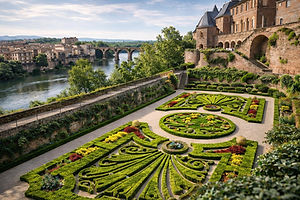
The Gardens of the Palais de la Berbie: Designated a Remarkable Garden, these former medieval kitchen gardens were transformed in the 17th century into a French formal garden of rare elegance. Laid out in terraces above the Tarn River, they feature geometric boxwood parterres bordered by a shaded walkway.

The panoramic view of the river: From the garden's curtain walls, the view is spectacular: it overlooks the Tarn River, the old mills, and the line of the city's historic bridges.

Albi brick originated from the riverbed. The Tarn River shaped the city's economic history and today offers an essential natural and heritage site.

The Old Bridge (1040): Built in the 11th century of stone and later reinforced with brick, this eight-arched bridge is a monument of historical engineering. It enabled the city's commercial development in the Middle Ages by connecting the two banks of the Tarn. A stroll across it offers one of the most beautiful views of the cathedral.

The Green Escape and Boating: The banks of the Tarn have been transformed into a bucolic pedestrian path several kilometers long (the Green Escape), ideal for observing river wildlife (herons, beavers). In the summer, traditional gabarres (flat-bottomed wooden boats) offer narrated cruises along the river.

The Madeleine district (right bank): By crossing the Pont-Vieux, discover this suburb of artisans of yesteryear, which houses the Lapérouse Museum, dedicated to the famous navigator and explorer from Albi, Jean-François de Galaup, Count of Lapérouse.

The banks of the Tarn and the thousand-year-old splendor of the Old Bridge

Albi brick originated from the riverbed. The Tarn River shaped the city's economic history and today offers an essential natural and heritage site.

The Old Bridge (1040): Built in the 11th century of stone and later reinforced with brick, this eight-arched bridge is a monument of historical engineering. It enabled the city's commercial development in the Middle Ages by connecting the two banks of the Tarn. A stroll across it offers one of the most beautiful views of the cathedral.

The Green Escape and Boating: The banks of the Tarn have been transformed into a bucolic pedestrian path several kilometers long (the Green Escape), ideal for observing river wildlife (herons, beavers). In the summer, traditional gabarres (flat-bottomed wooden boats) offer narrated cruises along the river.

The Madeleine district (right bank): By crossing the Pont-Vieux, discover this suburb of artisans of yesteryear, which houses the Lapérouse Museum, dedicated to the famous navigator and explorer from Albi, Jean-François de Galaup, Count of Lapérouse.

Albi brick originated from the riverbed. The Tarn River shaped the city's economic history and today offers an essential natural and heritage site.

The Old Bridge (1040): Built in the 11th century of stone and later reinforced with brick, this eight-arched bridge is a monument of historical engineering. It enabled the city's commercial development in the Middle Ages by connecting the two banks of the Tarn. A stroll across it offers one of the most beautiful views of the cathedral.

The Green Escape and Boating: The banks of the Tarn have been transformed into a bucolic pedestrian path several kilometers long (the Green Escape), ideal for observing river wildlife (herons, beavers). In the summer, traditional gabarres (flat-bottomed wooden boats) offer narrated cruises along the river.

The Madeleine district (right bank): By crossing the Pont-Vieux, discover this suburb of artisans of yesteryear, which houses the Lapérouse Museum, dedicated to the famous navigator and explorer from Albi, Jean-François de Galaup, Count of Lapérouse.

Old Alby, a labyrinth of bricks and secrets of corners

Extending around the Episcopal City, Albi's historic center invites you to a poetic stroll through meticulously preserved medieval quarters.

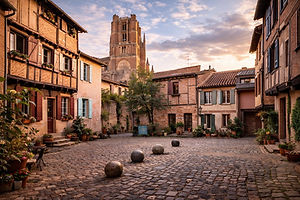
Half-timbered houses and the Castelviel district: Explore the Castelviel district, the city's original heartland. Its narrow, cobbled streets are lined with medieval houses combining ochre-red brick and corbelled timber structures (like the famous Maison Vieille).

The Saint-Salvi Cloister: Nestled in the heart of the old town, adjoining the Saint-Salvi Collegiate Church (the city's oldest monument), this 13th-century cloister is a haven of quiet serenity. Its galleries uniquely blend Romanesque and Gothic styles, surrounding a charming herb garden.

Renaissance Mansions: Thanks to the flourishing trade in woad (the plant that produced a unique blue dye sought after throughout Europe), Albi's merchants built sumptuous mansions. Admire the Hôtel de Reynès or the Hôtel de Saunal, with their Italianate loggias and opulent courtyards.

Albi brick originated from the riverbed. The Tarn River shaped the city's economic history and today offers an essential natural and heritage site.

The Old Bridge (1040): Built in the 11th century of stone and later reinforced with brick, this eight-arched bridge is a monument of historical engineering. It enabled the city's commercial development in the Middle Ages by connecting the two banks of the Tarn. A stroll across it offers one of the most beautiful views of the cathedral.

The Green Escape and Boating: The banks of the Tarn have been transformed into a bucolic pedestrian path several kilometers long (the Green Escape), ideal for observing river wildlife (herons, beavers). In the summer, traditional gabarres (flat-bottomed wooden boats) offer narrated cruises along the river.

The Madeleine district (right bank): By crossing the Pont-Vieux, discover this suburb of artisans of yesteryear, which houses the Lapérouse Museum, dedicated to the famous navigator and explorer from Albi, Jean-François de Galaup, Count of Lapérouse.

The Occitanie way of life and the gastronomy of the Tarn region

Albi cultivates an innate sense of conviviality, blending the warmth of Southwest France with the generous flavors of its exceptional terroir.

The Covered Market (Baltard-style market hall): Inaugurated in 1905, this triangular market is the gourmet heart of Albi. The stalls overflow with mountain charcuterie (Lacaune ham), Lautrec pink garlic (with Protected Geographical Indication status), goat cheeses (Rocamadour), and meats from Tarn farms.

Albi's sweet treats: Indulge in Janots (anise-flavored shortbread cookies), Gimbelettes (scalded crown-shaped cakes), or the traditional Mesturet (a homemade cake made with pumpkin and cornmeal), available in the artisan bakeries of the city center.

Gaillac Wines (AOC): Located a few kilometers from the town, the Gaillac vineyard is one of the oldest in France. Take advantage of your stay to taste (in moderation) full-bodied reds made from local grape varieties such as Duras or Braucol, as well as white wines.

Conclusion

Albi is a dazzling destination that achieves a perfect balance between the raw power of its brick architecture and the enduring refinement of its artistic heritage. From the celestial, azure vaults of its fortified cathedral to the vibrant and audacious canvases of Toulouse-Lautrec, and the gentle waters of the Tarn River, this city in the Tarn region both captivates and enchants the traveler. By successfully blending the pride of its Occitan traditions with the serenity of its princely gardens, this red citadel stands out as a timeless, welcoming, and profoundly restorative haven under the southern skies. A magical city from which one departs with a spirit dazzled by the golden light that makes its stones shimmer.

Albi Tourist Office

Information Regarding Visuals: This website uses computer-generated images and illustrations created by artificial intelligence for atmospheric and stylistic purposes. These representations are not actual photographs and are strictly non-binding.

bottom of page