top of page

Aix-en-Provence

Aix-en-Provence is inextricably linked to its prodigy, Paul Cézanne. An urban trail marked with bronze studs bearing a "C" allows visitors to walk in the master's footsteps and explore his living and working spaces.

Cézanne's Studio (Colline des Lauves): It was here, in this haven of tranquility that has remained untouched, that the painter spent the last years of his life. Northern light streams in through large bay windows, illuminating his personal belongings, still lifes, and work clothes, creating an atmosphere of intense artistic emotion.

The Painters' Ground: Located a little higher up the hill, this park offers the exact vantage point where Cézanne would set up his easel to paint his most famous canvases of Mont Sainte-Victoire, the limestone giant that dominates the Aix skyline and became an icon of modern art.

The Bastide du Jas de Bouffan and the Bibémus Quarries: The painter's family property and the old ochre stone quarries of Bibémus complete this artistic pilgrimage, offering a raw immersion into the heart of the geometric forms that heralded cubism.

Bathed in golden light that has inspired the greatest painters, Aix-en-Provence is the perfect embodiment of elegance, refinement, and the Provençal art of living. The former administrative capital of Provence and a county seat, this city of art and history exudes a unique aristocratic charm. Nicknamed the "city of a thousand fountains," Aix instantly captivates with the nobility of its elegant townhouses built of ochre-hued Calissanne stone, the majesty of its courtyards shaded by centuries-old plane trees, and its incredible cultural vibrancy. The birthplace of the painter Paul Cézanne, Aix-en-Provence invites you on a sensory stroll where the murmur of water mingles with the scent of coffee and lavender.

The Cours Mirabeau and the grand fountain theatre

The Cours Mirabeau, the city's true backbone, is one of Europe's most famous and elegant boulevards, tracing a poetic boundary between the medieval old town and the classical districts.

A canopy of greenery and history: Laid out in the 17th century on the site of the former ramparts, the Cours is sheltered by a majestic canopy of century-old plane trees. It is bordered on one side by sumptuous facades of private mansions adorned with wrought-iron balconies and sculpted caryatids, and on the other by the terraces of legendary cafés, such as Les Deux Garçons, once frequented by Cézanne, Zola, and Camus.

The Rotunda Fountain: Marking the monumental entrance to the Cours, this immense fountain, built in 1860, is surmounted by three marble statues representing Justice, Agriculture, and the Fine Arts, illustrating the city's great virtues.

The mossy and thermal fountains: Going up the Cours, discover the Mossy Fountain, fed by a hot thermal spring at 18°C, entirely covered with a thick mantle of greenery and velvet of moss, as well as the King René Fountain, which stands proudly at the upper end.

Aix-en-Provence is inextricably linked to its prodigy, Paul Cézanne. An urban trail marked with bronze studs bearing a "C" allows visitors to walk in the master's footsteps and explore his living and working spaces.

Cézanne's Studio (Colline des Lauves): It was here, in this haven of tranquility that has remained untouched, that the painter spent the last years of his life. Northern light streams in through large bay windows, illuminating his personal belongings, still lifes, and work clothes, creating an atmosphere of intense artistic emotion.

The Painters' Ground: Located a little higher up the hill, this park offers the exact vantage point where Cézanne would set up his easel to paint his most famous canvases of Mont Sainte-Victoire, the limestone giant that dominates the Aix skyline and became an icon of modern art.

The Bastide du Jas de Bouffan and the Bibémus Quarries: The painter's family property and the old ochre stone quarries of Bibémus complete this artistic pilgrimage, offering a raw immersion into the heart of the geometric forms that heralded cubism.
Aix-en-Provence is inextricably linked to its prodigy, Paul Cézanne. An urban trail marked with bronze studs bearing a "C" allows visitors to walk in the master's footsteps and explore his living and working spaces.

Cézanne's Studio (Colline des Lauves): It was here, in this haven of tranquility that has remained untouched, that the painter spent the last years of his life. Northern light streams in through large bay windows, illuminating his personal belongings, still lifes, and work clothes, creating an atmosphere of intense artistic emotion.

The Painters' Ground: Located a little higher up the hill, this park offers the exact vantage point where Cézanne would set up his easel to paint his most famous canvases of Mont Sainte-Victoire, the limestone giant that dominates the Aix skyline and became an icon of modern art.

The Bastide du Jas de Bouffan and the Bibémus Quarries: The painter's family property and the old ochre stone quarries of Bibémus complete this artistic pilgrimage, offering a raw immersion into the heart of the geometric forms that heralded cubism.
Aix-en-Provence is inextricably linked to its prodigy, Paul Cézanne. An urban trail marked with bronze studs bearing a "C" allows visitors to walk in the master's footsteps and explore his living and working spaces.

Cézanne's Studio (Colline des Lauves): It was here, in this haven of tranquility that has remained untouched, that the painter spent the last years of his life. Northern light streams in through large bay windows, illuminating his personal belongings, still lifes, and work clothes, creating an atmosphere of intense artistic emotion.

The Painters' Ground: Located a little higher up the hill, this park offers the exact vantage point where Cézanne would set up his easel to paint his most famous canvases of Mont Sainte-Victoire, the limestone giant that dominates the Aix skyline and became an icon of modern art.

The Bastide du Jas de Bouffan and the Bibémus Quarries: The painter's family property and the old ochre stone quarries of Bibémus complete this artistic pilgrimage, offering a raw immersion into the heart of the geometric forms that heralded cubism.

Old Aix, medieval alleyways and flower-filled squares

Aix-en-Provence is inextricably linked to its prodigy, Paul Cézanne. An urban trail marked with bronze studs bearing a "C" allows visitors to walk in the master's footsteps and explore his living and working spaces.

Cézanne's Studio (Colline des Lauves): It was here, in this haven of tranquility that has remained untouched, that the painter spent the last years of his life. Northern light streams in through large bay windows, illuminating his personal belongings, still lifes, and work clothes, creating an atmosphere of intense artistic emotion.

The Painters' Ground: Located a little higher up the hill, this park offers the exact vantage point where Cézanne would set up his easel to paint his most famous canvases of Mont Sainte-Victoire, the limestone giant that dominates the Aix skyline and became an icon of modern art.

The Bastide du Jas de Bouffan and the Bibémus Quarries: The painter's family property and the old ochre stone quarries of Bibémus complete this artistic pilgrimage, offering a raw immersion into the heart of the geometric forms that heralded cubism.

As you wander through the pedestrian maze of the old town, the atmosphere becomes more intimate, punctuated by Baroque squares, colorful markets, and remarkable religious heritage.

Town Hall Square and Clock Tower: Flanked by the magnificent Town Hall and the former grain market, this historic square is dominated by a medieval belfry with an astronomical clock and a wrought-iron cage typical of Provence. The flower market displays its vibrant colors several times a week.

Saint-Sauveur Cathedral: This fascinating religious building encapsulates the city's history, combining a flamboyant Gothic portal, a Romanesque nave, Romanesque structures, and a 5th-century baptistery. It houses the celebrated Burning Bush triptych by Nicolas Froment, a masterpiece of 15th-century painting.

Albertas Square: Designed in the 18th century on the model of Parisian royal squares, this small, intimate square surrounded by private mansions in a semicircle and adorned with a central cast-iron fountain is undoubtedly one of the most romantic and theatrical settings in Aix.

Aix-en-Provence is inextricably linked to its prodigy, Paul Cézanne. An urban trail marked with bronze studs bearing a "C" allows visitors to walk in the master's footsteps and explore his living and working spaces.

Cézanne's Studio (Colline des Lauves): It was here, in this haven of tranquility that has remained untouched, that the painter spent the last years of his life. Northern light streams in through large bay windows, illuminating his personal belongings, still lifes, and work clothes, creating an atmosphere of intense artistic emotion.

The Painters' Ground: Located a little higher up the hill, this park offers the exact vantage point where Cézanne would set up his easel to paint his most famous canvases of Mont Sainte-Victoire, the limestone giant that dominates the Aix skyline and became an icon of modern art.

The Bastide du Jas de Bouffan and the Bibémus Quarries: The painter's family property and the old ochre stone quarries of Bibémus complete this artistic pilgrimage, offering a raw immersion into the heart of the geometric forms that heralded cubism.

Following in the footsteps of Paul Cézanne, the soul of modern painting

Aix-en-Provence is inextricably linked to its prodigy, Paul Cézanne. An urban trail marked with bronze studs bearing a "C" allows visitors to walk in the master's footsteps and explore his living and working spaces.

Cézanne's Studio (Colline des Lauves): It was here, in this haven of tranquility that has remained untouched, that the painter spent the last years of his life. Northern light streams in through large bay windows, illuminating his personal belongings, still lifes, and work clothes, creating an atmosphere of intense artistic emotion.

The Painters' Ground: Located a little higher up the hill, this park offers the exact vantage point where Cézanne would set up his easel to paint his most famous canvases of Mont Sainte-Victoire, the limestone giant that dominates the Aix skyline and became an icon of modern art.

The Bastide du Jas de Bouffan and the Bibémus Quarries: The painter's family property and the old ochre stone quarries of Bibémus complete this artistic pilgrimage, offering a raw immersion into the heart of the geometric forms that heralded cubism.

Aix-en-Provence is inextricably linked to its prodigy, Paul Cézanne. An urban trail marked with bronze studs bearing a "C" allows visitors to walk in the master's footsteps and explore his living and working spaces.

Cézanne's Studio (Colline des Lauves): It was here, in this haven of tranquility that has remained untouched, that the painter spent the last years of his life. Northern light streams in through large bay windows, illuminating his personal belongings, still lifes, and work clothes, creating an atmosphere of intense artistic emotion.

The Painters' Ground: Located a little higher up the hill, this park offers the exact vantage point where Cézanne would set up his easel to paint his most famous canvases of Mont Sainte-Victoire, the limestone giant that dominates the Aix skyline and became an icon of modern art.

The Bastide du Jas de Bouffan and the Bibémus Quarries: The painter's family property and the old ochre stone quarries of Bibémus complete this artistic pilgrimage, offering a raw immersion into the heart of the geometric forms that heralded cubism.

The Mazarin Quarter, the splendor of the Grand Siècle

Created in the 17th century by Archbishop Michel Mazarin (brother of the famous cardinal), this residential district, laid out in a perfect grid pattern, embodies classical rigor and the splendor of Aix-en-Provence's nobility.

Exceptional private mansions: Strolling along Rue Cardinale or Rue de Quatre-Septembre, admire the façades of the Hôtel de Caumont or the Hôtel de Forbin. These residences of golden stone conceal magnificent inner courtyards and secret hanging gardens behind heavy carriage gates.

The Fountain of the Four Dolphins: Located in the heart of the district, this perfectly circular square is home to one of the city's most charming fountains. Four dolphins sculpted in limestone spout clear water into a circular basin, surrounded by an architectural perspective of absolute harmony.

The Granet Museum: Housed in the former Palace of Malta in the Mazarin district, this world-class fine arts museum contains masterpieces of European painting, from Rembrandt to Ingres, as well as an entire room dedicated to Paul Cézanne and major collections of modern art (Giacometti, Picasso, Mondrian).

Aix-en-Provence is inextricably linked to its prodigy, Paul Cézanne. An urban trail marked with bronze studs bearing a "C" allows visitors to walk in the master's footsteps and explore his living and working spaces.

Cézanne's Studio (Colline des Lauves): It was here, in this haven of tranquility that has remained untouched, that the painter spent the last years of his life. Northern light streams in through large bay windows, illuminating his personal belongings, still lifes, and work clothes, creating an atmosphere of intense artistic emotion.

The Painters' Ground: Located a little higher up the hill, this park offers the exact vantage point where Cézanne would set up his easel to paint his most famous canvases of Mont Sainte-Victoire, the limestone giant that dominates the Aix skyline and became an icon of modern art.

The Bastide du Jas de Bouffan and the Bibémus Quarries: The painter's family property and the old ochre stone quarries of Bibémus complete this artistic pilgrimage, offering a raw immersion into the heart of the geometric forms that heralded cubism.

The Calisson and the gourmet lifestyle of Provence

Aix-en-Provence is also a delight to savor, thanks to its vibrant local markets and world-renowned royal confectionery.

The Calisson d'Aix, a queen's secret: An iconic confection of the city with Protected Geographical Indication (PGI) status, the calisson is made of a delicate paste of candied melon and ground almonds, placed on a wafer and topped with white royal icing. Legend has it that it was created in the 15th century to bring a smile to Queen Jeanne's face on her wedding day to King René. The great Aix-en-Provence confectioners (such as Roy René and Béchard) continue to uphold this exquisite craftsmanship.

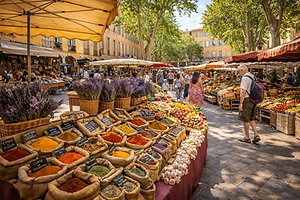
The grand Provençal markets (Place des Prêcheurs and Place de Verdun): A complete sensory experience. The stalls overflow with olive oils from the Alpilles, goat cheeses from the Luberon, fragrant lavender honeys, tapenades, and Provençal herbs, all accompanied by the lilting accents of the local producers.

Modern thermal tradition: True to its Roman origins (Aquae Sextiae), Aix still offers the opportunity to enjoy the benefits of its waters thanks to the modern Thermes Sextius complex, a high-end wellness center built against ancient ruins, ideal for a relaxing break.

Conclusion

Aix-en-Provence is a luminous destination that elevates elegance and the art of living to an absolute level. From the ochre hues of its Baroque façades on the Cours Mirabeau to the majestic silhouette of Mont Sainte-Victoire, immortalized by Cézanne, this historic city captivates with its quiet nobility and refreshing atmosphere. By successfully blending the rigor of its grand classical heritage with the vibrant warmth of Provençal traditions, Aix stands as a timeless haven under the southern sky. A magical city from which one departs with a spirit soothed by the sound of its fountains and a palate won over by the sweetness of its calissons.

Aix-en-Provence Tourist Office

Information Regarding Visuals: This website uses computer-generated images and illustrations created by artificial intelligence for atmospheric and stylistic purposes. These representations are not actual photographs and are strictly non-binding.

bottom of page