
Noirlac Abbey

Founded in 1136 by a small group of monks from Clairvaux, Noirlac Abbey embodies the ideal of simplicity advocated by Saint Bernard. In this landscape of hedgerows and waterways, the builders erected an ideal city where the stone seems to breathe. Formerly an abbey, then a porcelain factory, and finally a refugee camp, Noirlac is today a Cultural Meeting Centre where heritage engages in a dialogue with contemporary creation in perfect harmony.
The Abbey Church, a Vessel of Light
The church at Noirlac is the highlight of the visit, a demonstration of architectural strength and restraint.
Cistercian Simplicity: True to the rule, the church is devoid of figurative sculptures. Its beauty arises from the geometry of the vaults and the quality of the limestone.
Contemporary Stained Glass Windows: Created by the artist Jean-Pierre Raynaud, the modern stained glass windows with their gray and white motifs respect the Cistercian tradition of non-figurative art while providing a soft, ever-changing light.
Exceptional Acoustics: The high vaulted ceiling and the bare walls create a unique resonance, making the abbey church a privileged venue for concerts of sacred and contemporary music.


The Cloister, the Beating Heart of Monastic Life

A veritable stone garden, the cloister was the heart of the monks' daily life, a space for prayer and work.
The Evolution of Styles: The cloister presents a fascinating contrast between the austere Romanesque galleries and the more ethereal elegance of the Gothic sections, rebuilt in the 13th and 14th centuries.
The Inner Garden: The central space, open to the sky, offers a verdant haven that invites meditation and peace of mind.
The Community Rooms: From the cloister, one can access the chapter house, where the monks made important decisions, and the warming room, the only heated room in the abbey.

The Monks' Hall and the Art of Work
The abbey bears witness to the rigorous organization of medieval life and the expertise of its artisans.
Working Spaces: The monks' hall, with its large ribbed vaults, was the place for intellectual and manual work, notably the scriptorium.
The Refectory: A majestic and luminous room where the monks took their meals in silence, listening to the reading of a sacred text from the reader's pulpit.
The Cellar: A vast vaulted room used for storing provisions, it serves as a reminder that the abbey was a self-sufficient economic unit, living off the fruits of the land.


Noirlac Through Time: From Porcelain to Silence
The abbey's history is marked by surprising transformations that have contributed to its preservation.
The Porcelain Factory: In the 19th century, the abbey was converted into a factory. This industrial activity, while altering the site, prevented the buildings from falling into ruin.
A Place of Refuge: During the Spanish Civil War and then World War II, Noirlac served as a refuge for displaced populations, adding a humanist dimension to its stone walls.
The Cultural Meeting Center: Today, the abbey is not a static museum; it hosts artists in residence, masterclasses, and festivals, bringing its stones to life with the sounds of contemporary creations.
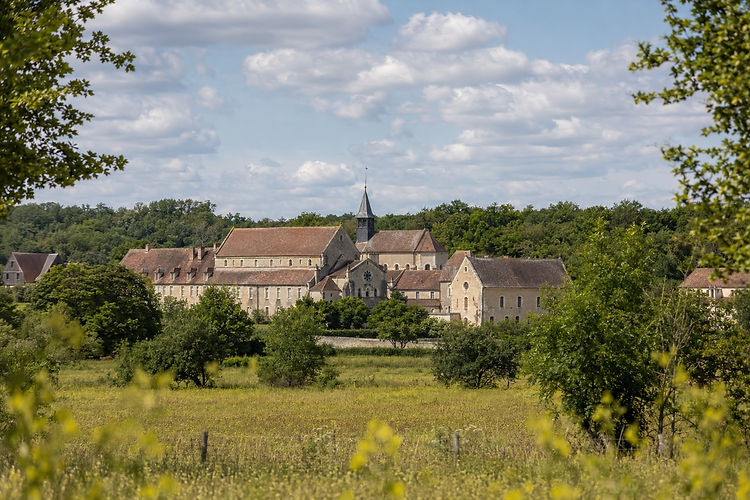
The Gardens and the Natural Setting
Noirlac extends beyond its walls; it lies within a protected natural environment designated as a "Sensitive Natural Area."
The Hedgerows and Marshes: The paths surrounding the abbey offer opportunities to discover the flora and fauna along the banks of the Cher River, between wet meadows and ash forests.
The Meditation Garden: A contemporary landscape design that extends the monastic spirit outdoors, playing on textures and local plant species.
The Mineral and Plant Harmony: From the meadows, the view of the slate roofs and the wooden bell tower silhouetted against the Berry sky is one of the most peaceful in the region.
Conclusion
Noirlac Abbey is a spiritual and aesthetic experience that leaves an indelible mark. It teaches us that true greatness lies in restraint and that light is the most beautiful ornament of architecture. Whether one comes for the history of the white monks, for the purity of a concert, or for a solitary walk in the marshes, Noirlac remains a haven of absolute peace, a sentinel of silence in the tumult of the modern world.
Welcome to Noirlac Abbey
Information Regarding Visuals: This website uses computer-generated images and illustrations created by artificial intelligence for atmospheric and stylistic purposes. These representations are not actual photographs and are strictly non-binding.