top of page

Cluny Abbey

The abbey's influence extended far beyond its walls, shaping a charming medieval town that thrives at the foot of its spiritual fortresses.

The Romanesque houses of the town: Cluny boasts the highest concentration of Romanesque houses in Europe. Strolling along Rue d'Avril or Rue de la République, admire the stone facades adorned with arched windows and 12th-century sculpted decorations.

The Cheese Tower and the panorama: Formerly a watchtower on the abbey's ramparts, it offers, after climbing its steps, a breathtaking panoramic view of the monastery structures, the rooftops of the town, and the rolling hills of the Cluniac landscape.

The Cluny National Stud Farm: Established by Napoleon I in 1806 on the abbey's land, this historic stud farm bears witness to another local tradition. Its brick and stone stables house thoroughbred horses, equestrian shows and perpetuate the art of carriage driving in the heart of the city.

Founded in 910 by Duke William I of Aquitaine, Cluny Abbey, located in Saône-et-Loire in the heart of Burgundy, was the center of the largest monastic empire in medieval Western Europe. Directly under the protection of the Pope, the Cluniac city reigned spiritually, politically, and artistically over more than 1,400 monasteries across Europe. Although the French Revolution transformed this masterpiece into a stone quarry, the current remains, grandiose and poetic, are enough to take one's breath away. Nicknamed the Maior Ecclesia (the largest church in Christendom until the reconstruction of St. Peter's Basilica in Rome), Cluny invites visitors on a fascinating journey into the heart of faith, grandeur, and memory.

The Maior Ecclesia, the vertigo of medieval excess

The abbey church of Cluny III, built from the late 11th century onwards under the direction of Abbot Hugh of Semur, was a colossal monument intended to reflect the glory of God and the power of the order.

Titanic dimensions: Imagine a Romanesque building 187 meters long, with two transepts, five naves, and a vaulted ceiling reaching over 30 meters in height. An architectural scale entirely unprecedented for the medieval period.

The Holy Water Tower: This is the south arm of the great transept, miraculously preserved from demolition. Topped by an octagonal bell tower rising to a height of 56 meters, this remarkably elegant remnant alone gives a sense of the scale of the vanished nave.

The monumental portal: Although destroyed, archaeologists were able to reconstruct the appearance of this western portal which opened onto the narthex. Its sculptures, representing Christ in glory surrounded by angels, were among the finest examples of Romanesque sculpture.

The abbey's influence extended far beyond its walls, shaping a charming medieval town that thrives at the foot of its spiritual fortresses.

The Romanesque houses of the town: Cluny boasts the highest concentration of Romanesque houses in Europe. Strolling along Rue d'Avril or Rue de la République, admire the stone facades adorned with arched windows and 12th-century sculpted decorations.

The Cheese Tower and the panorama: Formerly a watchtower on the abbey's ramparts, it offers, after climbing its steps, a breathtaking panoramic view of the monastery structures, the rooftops of the town, and the rolling hills of the Cluniac landscape.

The Cluny National Stud Farm: Established by Napoleon I in 1806 on the abbey's land, this historic stud farm bears witness to another local tradition. Its brick and stone stables house thoroughbred horses, equestrian shows and perpetuate the art of carriage driving in the heart of the city.
The abbey's influence extended far beyond its walls, shaping a charming medieval town that thrives at the foot of its spiritual fortresses.

The Romanesque houses of the town: Cluny boasts the highest concentration of Romanesque houses in Europe. Strolling along Rue d'Avril or Rue de la République, admire the stone facades adorned with arched windows and 12th-century sculpted decorations.

The Cheese Tower and the panorama: Formerly a watchtower on the abbey's ramparts, it offers, after climbing its steps, a breathtaking panoramic view of the monastery structures, the rooftops of the town, and the rolling hills of the Cluniac landscape.

The Cluny National Stud Farm: Established by Napoleon I in 1806 on the abbey's land, this historic stud farm bears witness to another local tradition. Its brick and stone stables house thoroughbred horses, equestrian shows and perpetuate the art of carriage driving in the heart of the city.
The abbey's influence extended far beyond its walls, shaping a charming medieval town that thrives at the foot of its spiritual fortresses.

The Romanesque houses of the town: Cluny boasts the highest concentration of Romanesque houses in Europe. Strolling along Rue d'Avril or Rue de la République, admire the stone facades adorned with arched windows and 12th-century sculpted decorations.

The Cheese Tower and the panorama: Formerly a watchtower on the abbey's ramparts, it offers, after climbing its steps, a breathtaking panoramic view of the monastery structures, the rooftops of the town, and the rolling hills of the Cluniac landscape.

The Cluny National Stud Farm: Established by Napoleon I in 1806 on the abbey's land, this historic stud farm bears witness to another local tradition. Its brick and stone stables house thoroughbred horses, equestrian shows and perpetuate the art of carriage driving in the heart of the city.

Technology at the service of the past: Cluny in augmented reality

The abbey's influence extended far beyond its walls, shaping a charming medieval town that thrives at the foot of its spiritual fortresses.

The Romanesque houses of the town: Cluny boasts the highest concentration of Romanesque houses in Europe. Strolling along Rue d'Avril or Rue de la République, admire the stone facades adorned with arched windows and 12th-century sculpted decorations.

The Cheese Tower and the panorama: Formerly a watchtower on the abbey's ramparts, it offers, after climbing its steps, a breathtaking panoramic view of the monastery structures, the rooftops of the town, and the rolling hills of the Cluniac landscape.

The Cluny National Stud Farm: Established by Napoleon I in 1806 on the abbey's land, this historic stud farm bears witness to another local tradition. Its brick and stone stables house thoroughbred horses, equestrian shows and perpetuate the art of carriage driving in the heart of the city.

Since most of the church was dismantled in the 19th century, the Cluny archaeological site has developed cutting-edge digital tools to allow visitors to visualize the unseen.

Augmented reality screens: Positioned along the exterior path and inside the ruins, these rotating devices overlay 3D reconstructions onto the current ruins in real time. By rotating the screen, you see the great nave rise above your head.

The 3D film "Maior Ecclesia": Shown at the beginning of the visit, this immersive film offers a spectacular virtual flyover of the monastic city at its height in the 12th century, allowing visitors to understand the interconnectedness of the cloisters, dormitories, and successive churches (Cluny I, II, and III).

The museum's digital models: The Museum of Art and Archaeology, housed in the sumptuous Jean de Bourbon Abbey Palace, complements this approach by exhibiting the original sculpted fragments virtually repositioned in their original location.

The abbey's influence extended far beyond its walls, shaping a charming medieval town that thrives at the foot of its spiritual fortresses.

The Romanesque houses of the town: Cluny boasts the highest concentration of Romanesque houses in Europe. Strolling along Rue d'Avril or Rue de la République, admire the stone facades adorned with arched windows and 12th-century sculpted decorations.

The Cheese Tower and the panorama: Formerly a watchtower on the abbey's ramparts, it offers, after climbing its steps, a breathtaking panoramic view of the monastery structures, the rooftops of the town, and the rolling hills of the Cluniac landscape.

The Cluny National Stud Farm: Established by Napoleon I in 1806 on the abbey's land, this historic stud farm bears witness to another local tradition. Its brick and stone stables house thoroughbred horses, equestrian shows and perpetuate the art of carriage driving in the heart of the city.

The monastic town of Cluny and the National Stud Farm

The abbey's influence extended far beyond its walls, shaping a charming medieval town that thrives at the foot of its spiritual fortresses.

The Romanesque houses of the town: Cluny boasts the highest concentration of Romanesque houses in Europe. Strolling along Rue d'Avril or Rue de la République, admire the stone facades adorned with arched windows and 12th-century sculpted decorations.

The Cheese Tower and the panorama: Formerly a watchtower on the abbey's ramparts, it offers, after climbing its steps, a breathtaking panoramic view of the monastery structures, the rooftops of the town, and the rolling hills of the Cluniac landscape.

The Cluny National Stud Farm: Established by Napoleon I in 1806 on the abbey's land, this historic stud farm bears witness to another local tradition. Its brick and stone stables house thoroughbred horses, equestrian shows and perpetuate the art of carriage driving in the heart of the city.

The abbey's influence extended far beyond its walls, shaping a charming medieval town that thrives at the foot of its spiritual fortresses.

The Romanesque houses of the town: Cluny boasts the highest concentration of Romanesque houses in Europe. Strolling along Rue d'Avril or Rue de la République, admire the stone facades adorned with arched windows and 12th-century sculpted decorations.

The Cheese Tower and the panorama: Formerly a watchtower on the abbey's ramparts, it offers, after climbing its steps, a breathtaking panoramic view of the monastery structures, the rooftops of the town, and the rolling hills of the Cluniac landscape.

The Cluny National Stud Farm: Established by Napoleon I in 1806 on the abbey's land, this historic stud farm bears witness to another local tradition. Its brick and stone stables house thoroughbred horses, equestrian shows and perpetuate the art of carriage driving in the heart of the city.

The Jean de Bourbon Palace and the grand classical buildings

Beyond its Romanesque remains, Cluny Abbey bears witness to its constant architectural reinvention, particularly during the Renaissance and the 18th century under the commendatory abbots.

The Abbot's Palace of Jean de Bourbon (15th century): This masterpiece of Flamboyant Gothic style, with its magnificent monumental fireplaces and mullioned windows, evokes the princely lifestyle of the great abbots of Cluny. Today, it houses rich archaeological collections.

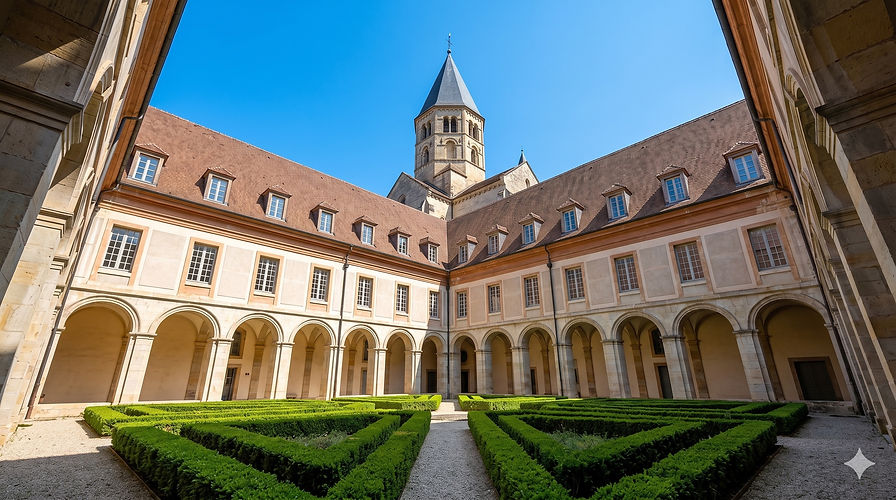
The Abbey Cloister (18th century): Rebuilt in a monumental and refined Neoclassical style, this vast cloister surprises with the regularity of its arcaded galleries. It surrounds a large courtyard that invites a solemn and silent stroll.

The Flour Mill and its extraordinary timber frame: This 13th-century building boasts a remarkably well-preserved oak timber frame in the shape of an inverted ship's hull. It protects the precious capitals of the Romanesque choir arranged below.

The abbey's influence extended far beyond its walls, shaping a charming medieval town that thrives at the foot of its spiritual fortresses.

The Romanesque houses of the town: Cluny boasts the highest concentration of Romanesque houses in Europe. Strolling along Rue d'Avril or Rue de la République, admire the stone facades adorned with arched windows and 12th-century sculpted decorations.

The Cheese Tower and the panorama: Formerly a watchtower on the abbey's ramparts, it offers, after climbing its steps, a breathtaking panoramic view of the monastery structures, the rooftops of the town, and the rolling hills of the Cluniac landscape.

The Cluny National Stud Farm: Established by Napoleon I in 1806 on the abbey's land, this historic stud farm bears witness to another local tradition. Its brick and stone stables house thoroughbred horses, equestrian shows and perpetuate the art of carriage driving in the heart of the city.

The capitals of the choir, pinnacles of Romanesque sculpture

Displayed today in the majestic setting of the Abbey's Flour Storehouse (the monks' former pantry), the capitals of the Cluny III ambulatory are true masterpieces of geometric and spiritual refinement.

The Eight Tones of Gregorian Chant: Unique in the history of art, a series of capitals depicts sacred music. Each face represents a sculpted figure personifying a tone of Gregorian chant, captured in a movement of absolute grace.

The Allegory of Virtues and Paradise: Other stone capitals depict the trees of paradise, the four cardinal virtues (Prudence, Justice, Temperance, and Fortitude), and the work of the land through the seasons.

The virtuosity of white limestone: Carved from limestone of great purity, these capitals are striking for the precision of their details, the drapery of the garments and the expressiveness of the faces, testifying to the genius of the Cluniac master sculptors.

Conclusion

Cluny Abbey is a place imbued with an extraordinary sense of history and spirituality. While post-revolutionary vandalism deprived humanity of its greatest Romanesque cathedral, the poetic beauty of its surviving arches, the unparalleled finesse of its sculptures, and the ingenuity of its digital reconstructions offer a profound aesthetic experience. Wandering through its spaces bathed in Burgundian light, the traveler contemplates not mere ruins, but the beating heart of what was once the spirit of medieval Europe. An essential, magnificent, and deeply inspiring destination.

Cluny Abbey

Information Regarding Visuals: This website uses computer-generated images and illustrations created by artificial intelligence for atmospheric and stylistic purposes. These representations are not actual photographs and are strictly non-binding.

bottom of page